

350 Parrots Get a Bird Flu Vaccine. The 90 Wild Ones Don't
Tasmania will vaccinate hundreds of captive orange-bellied parrots against H5N1, but the handful still flying free are beyond reach — and India's own outbreak year explains why that gap matters.

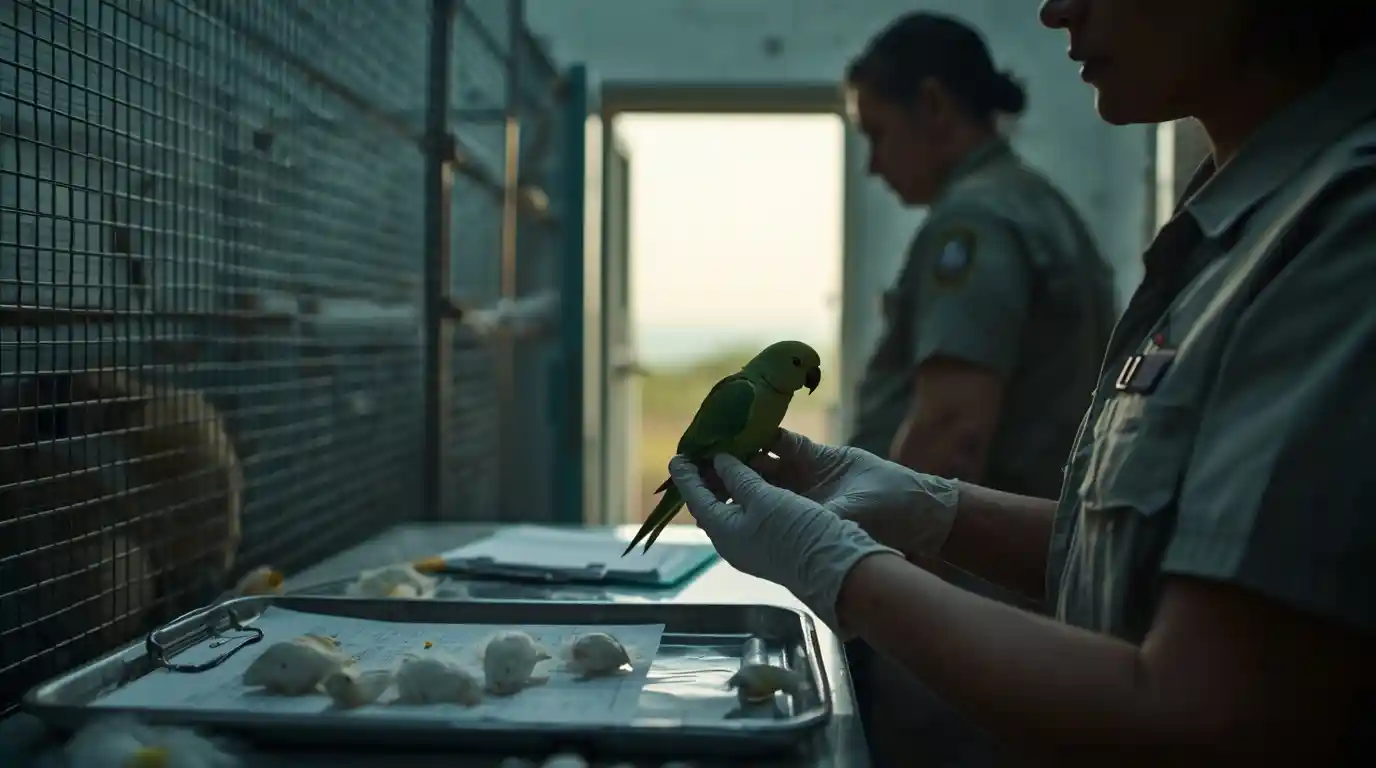
Tasmania is preparing to give a bird flu vaccine to as many as 350 orange-bellied parrots, and not one of them lives in the wild. Environment Minister Guy Barnett has said the rollout begins once approvals come through, starting with captive stock and the birds lined up for future release. The roughly 90 parrots still flying free will get nothing.
The urgency arrived on 13 August, when H5N1 was confirmed in Tasmania for the first time — a single brown skua found at Rocky Cape National Park, tested overnight. Premier Jeremy Rockliff said teams had already flown close to 1,000 kilometres of aerial coastline surveys and surged extra monitoring into the area. So far there is no sign of a wider outbreak and nothing in commercial poultry.
For a reader in India this isn't a faraway curiosity. The same virus has been killing crows in Chennai and emptying poultry sheds in Maharashtra and Karnataka through 2026. Australia's situation is our problem inverted: barely any infected farms, and an enormous amount to lose among wild species that exist nowhere else on earth.
What Tasmania Is Actually Protecting
The orange-bellied parrot is one of the rarest birds alive. It migrates between southwest Tasmania and the southern Australian mainland, and its wild population — around 90 birds — survives only because a captive breeding programme releases new individuals every year. Kill the aviaries and the wild flock goes with them. That is why the vaccine goes to the cages first: they are the species' actual life support.
Why the Bird Flu Vaccine Stops at the Cage Door
A bird flu vaccine is not a spray you fog over a wetland. Each bird needs two injections, three to four weeks apart, then at least a fortnight of observation. Doing that means catching the same individual animal twice, on schedule. In an aviary, routine. On a migration route across Bass Strait, impossible. Officials have been blunt that vaccinating wild birds is not practical at any meaningful scale.
Victoria shows where the line falls. Roughly 5,000 penguins at Phillip Island and St Kilda are slated for vaccination, because those colonies sit in fixed, countable, walk-up burrows. A parrot that crosses open water twice a year does not offer anyone that courtesy.

The Rules That Decide Which Bird Gets a Shot
The approval conditions are narrow, and they quietly exclude a lot of wildlife before anyone even reaches for a net.
38 Grams and Three Weeks Old
The animal must be a bird, weigh more than 38 grams and be at least three weeks of age. That single line rules out chicks, tiny songbirds and every nestling in a rescue centre — often exactly the animals a carer is holding when an outbreak hits.
Two Doses, Then a Fortnight of Watching
Two vaccinations spaced three to four weeks apart, followed by a minimum two-week monitoring period. Protection is not instant. A bird caught today is not covered for well over a month, which is slower than the virus has moved across five Australian jurisdictions since June.
Nothing Vaccinated Reaches a Dinner Plate
Vaccinated animals cannot enter the human food chain. It is a conservation tool, not a poultry-industry one — a distinction India's own policy debate keeps running into.
The Animal No One Can Vaccinate
The species with no option at all isn't a bird. Tasmanian devils are scavengers, and dead seabirds washing up on beaches are exactly what they eat. Dr Rachael Alderman, director of threatened species at Tasmania's environment department, put the risk plainly.
Devils love to scavenge on dead things. There is every chance that devils would eat infected birds.
There is no approved H5 avian influenza vaccine for mammals in Australia, and vaccinating them isn't on the table. For the devil, already fighting a facial tumour disease, the entire plan is surveillance and luck.
What India Should Take From This
India has spent 2026 on the other end of the same virus. Around 200,000 birds were culled in Navapur, Maharashtra, by May, with the state's total nearing four lakh. In Karnataka, a detection at the Hesaraghatta state poultry farm led to 7,444 chickens, about 14,000 eggs and 2,250 kg of feed being destroyed on 15 April. More than 1,000 dead crows around Chennai were confirmed positive by the high-security lab at Bhopal.
India's response is stamping-out: cull, disinfect, quarantine, compensate. Vaccination of poultry is not standard here, largely because it complicates trade and can mask circulating infection. The trade-off Australia has made for 350 parrots is one no country makes for a commercial flock.
The practical bit for households is unglamorous and unchanged. Don't handle dead or sick birds, report clusters of crow or poultry deaths to the local animal husbandry office, and cook chicken and eggs through — no human infections have been reported in India this year, and heat kills the virus.
Watch two things over the coming weeks: whether Tasmania's brown skua stays a single case or becomes a coastal die-off, and whether India logs any winter uptick as migratory birds arrive. If Tasmania loses wild orange-bellied parrots despite vaccinating every captive one, that is the clearest warning yet that a vaccine protects populations you can hold, not populations you can only count.




Comments 0