

A Bird Landed 30 Seconds Before This Solar Eclipse Photo
Vancouver's Liron Gertsman planned a single frame for more than a year, drove across Spain for ten days, and got it when a white stork returned to its nest half a minute before totality.

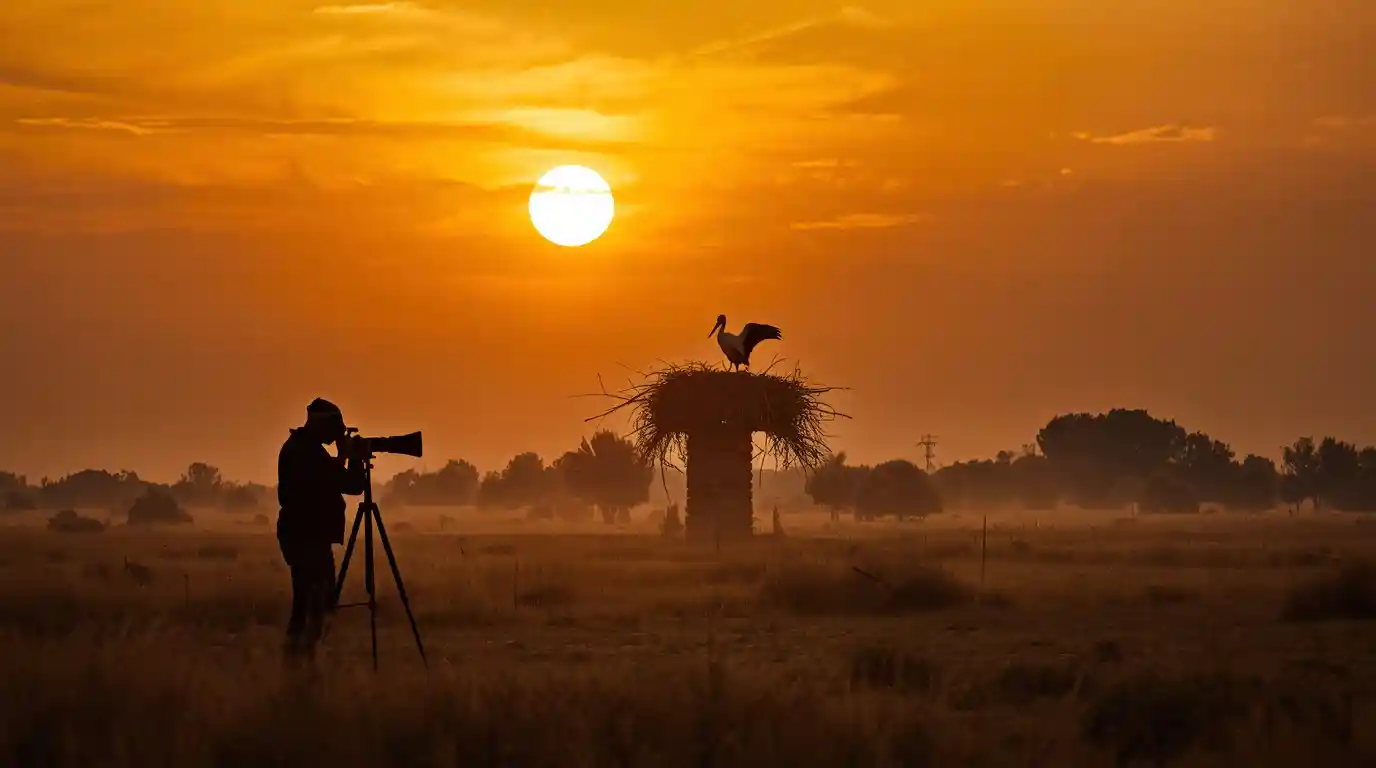
The most discussed solar eclipse photo of the year came down to about half a minute of bird behaviour. Vancouver nature photographer Liron Gertsman spent more than a year working toward a single idea — a wild bird silhouetted against a totally eclipsed sun — and flew to Spain to try it on August 12. The white stork he was counting on dropped back onto its nest roughly 30 seconds before totality began.
That margin is the whole story. Totality on August 12 lasted a maximum of 2 minutes and 18 seconds anywhere on Earth, and far less than that at most spots along the track. Gertsman had spent the previous ten days driving across Spain, scouting sites, running calculations and chasing compositions. All of it was riding on an animal that had no idea it was part of the plan.
For Canadian readers there's a second layer here. No part of Canada saw this totality — the shadow crossed remote Siberian Russia, eastern Greenland, the west coast of Iceland, northern Spain and a sliver of northwestern Portugal. Anyone in this country who wanted the real thing had to buy a plane ticket. Gertsman did, and came home with the frame that ended up circulating worldwide.
What happened in that field in Spain
The concept sounds simple: put a bird in front of a black sun. In practice it means predicting exactly where the eclipsed sun will sit in the sky, then finding a wild animal that will reliably be in that narrow slice of air at that exact minute. Storks help, because they nest on tall structures and return to the same nest. They don't help enough to make it easy.
Gertsman scouted for ten days before settling on a position. Then he waited. The stork came back to the nest with seconds to spare, which is either extraordinary luck or the payoff of stacking the odds for fourteen months straight, depending on how you look at it. Both readings are fair.
Why this solar eclipse photo was so hard
Three separate problems had to be solved at once, and each one could have wrecked the shot on its own. This is the part most people scrolling past the image never see.
The sun was almost on the horizon
In Spain, the sun wasn't fully eclipsed until late evening, shortly before it set. A low sun is beautiful and brutal. You get warm colour and the chance to include landscape and wildlife in the same frame, but you also get haze, atmospheric distortion and hills that can hide the sun entirely. Being 20 kilometres off is enough to lose it.
The bird never read the plan
You can compute the sun's position to the second. You cannot compute a stork. Wildlife photographers deal with this constantly, but usually they can wait out a subject for hours or come back tomorrow. Here the window was a couple of minutes, once, with no second attempt for years.
Ten days of driving to find one nest
The scouting is the invisible labour. Every candidate site needed the right nest, the right sun angle, a clean background, legal access and a weather forecast that wouldn't collapse. Peak-season travel across Spain in August isn't cheap for a Canadian either, which raises the cost of guessing wrong.
Canada watched this one from the sidelines
It's worth remembering what Canadians did get this year. On March 3, a total lunar eclipse was fully visible from Vancouver — the moon started sliding into shadow at 12:44 a.m. PST, totality ran from about 3:04 a.m. to 4:02 a.m., and the last partial phase ended at 5:17 a.m. That one you could shoot from a balcony in Kitsilano with a tripod and patience.
August 12 was different. This was the first total solar eclipse over mainland Europe in 27 years, since 1999, and the only way to stand in the shadow was to travel. Eastern Canada had its turn in April 2024, when totality crossed Ontario, Quebec and Atlantic Canada. Miss that and the wait gets long.
He'd already won a prize for an eclipse shot
Gertsman isn't new to this. CBC reported that his work took top honours in the global Bird Photographer of the Year competition with a dramatic frame made during a solar event — the same combination of wildlife and celestial timing he went back for in Spain. So the stork picture isn't a fluke idea. It's a refinement of something that already worked once.
These are, by far, the most complicated photos I've ever taken.
That's Gertsman on the Spain images, as reported by Vancouver Is Awesome — a notable line from someone who has already been recognised internationally for exactly this kind of picture.
What to borrow if you want to try it
You don't need a transatlantic flight to apply the method. The transferable part is the sequencing:
- Pick the foreground first, then work backwards to where you have to stand.
- Calculate the sun or moon's altitude and bearing for the exact minute, not the general hour.
- Scout in person, on the same clock, days ahead — light and sightlines lie in satellite view.
- Have a backup site within an hour's drive for cloud.
- Accept that the living subject is the variable you can't control, and build in margin.
The takeaway isn't about gear. Gertsman's frame worked because the planning removed almost every variable except the bird, so when luck finally showed up, it only had one job to do. If you're plotting your own attempt, start with the sky-position maths and the location scouting now — the equipment argument can wait, and the next total solar eclipse won't.

Comments 0