

A Trooper Pushed Out a Window in the Carlisle Airport Crash
A state police helicopter was hovering over grass when a Cessna swung right at the last second — and two troopers had to force their way out of the wreck.

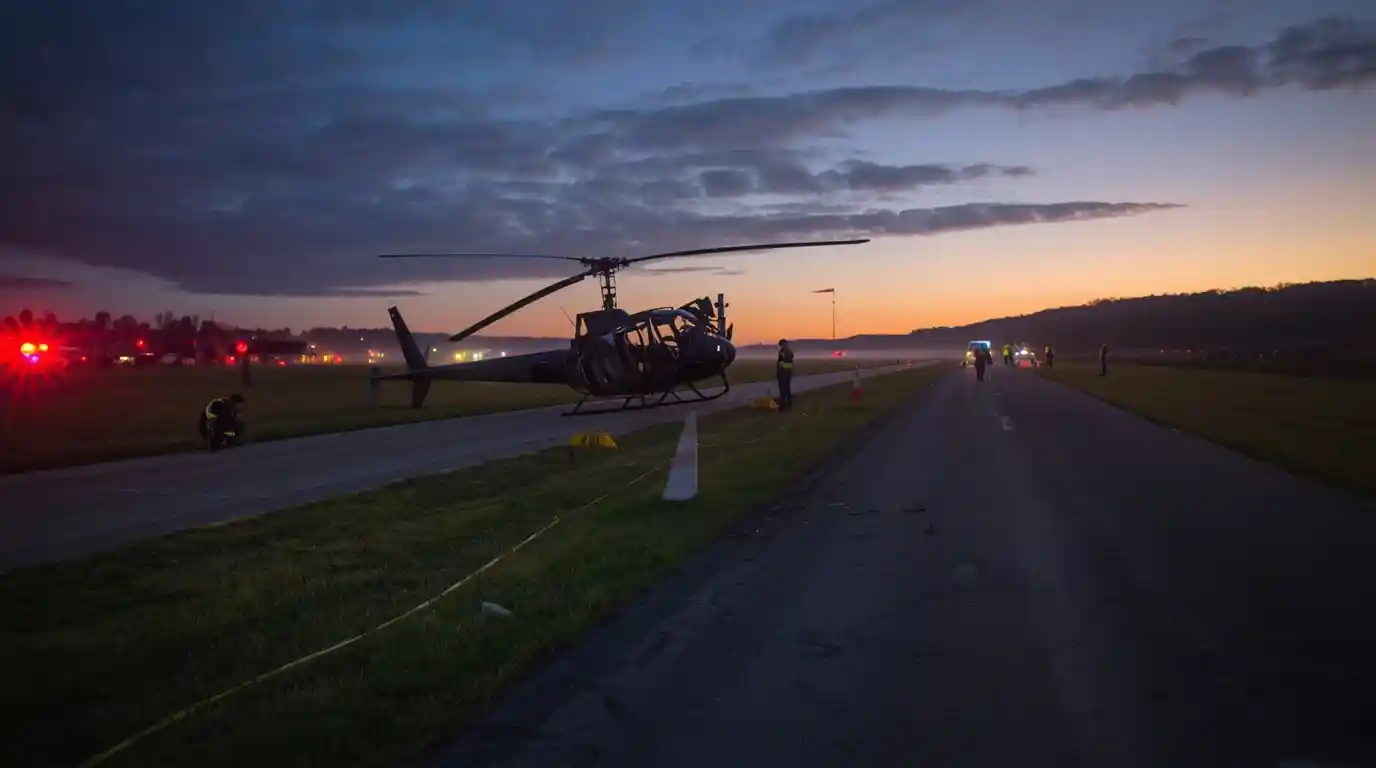
The Carlisle Airport crash that killed a small-plane pilot and injured two Pennsylvania State Police troopers ended the way very few aviation accidents do — with one of the injured men forcing a window out of an overturned helicopter so his partner could climb clear. It happened Wednesday evening, August 19, at a single-runway field in Cumberland County that has never had a control tower.
A Bell 407 helicopter flown by the state police aviation unit was hovering a few feet above the grass beside the runway, finishing a routine training session. A Cessna 150 came in from behind, lined up on the runway, then swung hard right at the last moment and struck the helicopter from the rear. The Cessna pilot was killed. Corporal Bryce Corman and Trooper Jason Mills survived and are expected to recover.
This matters well past one county line. Most general-aviation fields in America work exactly the way Carlisle does: no tower, no controller sequencing anybody, just pilots calling out their positions on a shared radio frequency and sorting out traffic with their own eyes. That arrangement has moved millions of flights safely. Wednesday is a look at the seconds when it fails.
What We Know About the Carlisle Airport Crash
The collision was reported around 6:50 p.m. on the 200 block of Petersburg Road, at the airport known to pilots as N94. Fire crews, the county coroner, the FAA and eventually the NTSB all converged on a field roughly 120 miles west of Philadelphia and a short drive west of Harrisburg. The runway was shut down. Here is how the sequence broke down, according to state police.
A helicopter parked in mid-air
The Bell 407 was in a low hover over turf next to the runway — not on the pavement, not climbing out, essentially stationary a few feet off the ground. Hover work is standard training, and it is one of the few times an aircraft occupies airport property while being nearly invisible in motion. Nothing about the helicopter's position was improper. It simply was not going anywhere.
The turn nobody expected
The Cessna was tracking down the runway when, for reasons still unexplained, it banked sharply to the right. It clipped the helicopter's tail rotor first, then went into the main rotor. The 407 lost its blades and its tail boom and rolled onto its side, coming partly to rest on its roof. State Police Lt. Col. George Bivens called it a very violent crash.
The pilots would not have been able to even see that airplane approaching them.
Pushing out the window
Inside the tipped-over airframe, Corman shoved a window out and helped Mills — the more badly hurt of the two — get through the opening. Both were taken in as Level 1 trauma patients. Trauma director Dr. Ashley Ludwig said their injuries turned out to be minor and both remained stable, with one trooper facing discharge the same night and the other held for further testing.
Why a Field With No Tower Raises the Stakes
Carlisle has one runway, about 4,000 feet long, marked 10/28, with pilot-activated lighting and a common traffic advisory frequency. There is no controller watching a radar scope and telling anyone to hold. The system depends on two things working together: everyone announcing intentions on the same frequency, and everyone actually seeing each other. Helicopters break the second half of that, because they sit still in places fixed-wing pilots aren't scanning.

How Often Do Aircraft Actually Hit Each Other?
Rarely — but the pattern is consistent. NTSB records logged 97 midair collisions in the U.S. between January 2010 and December 2021, and 87 of them involved general aviation flying under Part 91. When collisions happen near an airport traffic pattern, roughly 78% of them occur at fields without a tower. A separate look at 2016 through 2026 found the split closer to even, 14 towered against 13 non-towered.
Put next to the January 2025 collision between an Army Black Hawk and a regional jet near Washington's Reagan National Airport, which killed 67 people, Wednesday's toll is small. But the shape is familiar: a helicopter and a fixed-wing aircraft in the same small slice of sky, with nobody catching the conflict in time.
What Investigators Will Chase Next
The NTSB documented the wreckage and moved it to a secure facility for teardown. A preliminary report — facts only, no cause — typically lands within a few weeks. Investigators have already secured video and photographs from the field. The questions that will drive the file: what the Cessna pilot said on the radio, whether that late right turn was a control problem, a medical event, or an attempt to avoid something else entirely.
The dead pilot's name is being withheld pending notification of family. Expect a full probable-cause finding to take a year or more; that is normal, not a sign of anything unusual.
What to Watch, and What Pilots Should Take From It
If you fly, ride along, or live near a small airfield, the practical lesson is narrow and useful:
- Helicopters operate off the runway, on grass and ramps — scan there, not just the pavement.
- Announce position and intentions on the common frequency even when the field sounds empty.
- A hovering aircraft has almost no relative motion, which is exactly what the human eye fails to detect.
Watch for the NTSB preliminary report in the coming weeks and for the pilot's identity once family is notified. If the report points at radio calls or at low-visibility conflict points on the field, expect renewed pressure on the FAA to tighten helicopter-and-airplane separation guidance at non-towered airports — a conversation that has been running since Reagan National and just got a second, quieter data point.




Comments 0