

Congo Ebola Outbreak Was Mistaken for Malaria for Months
A new genetic study says the virus jumped fresh from an animal in February — and by the time anyone called it Ebola, more than 500 people were already sick.

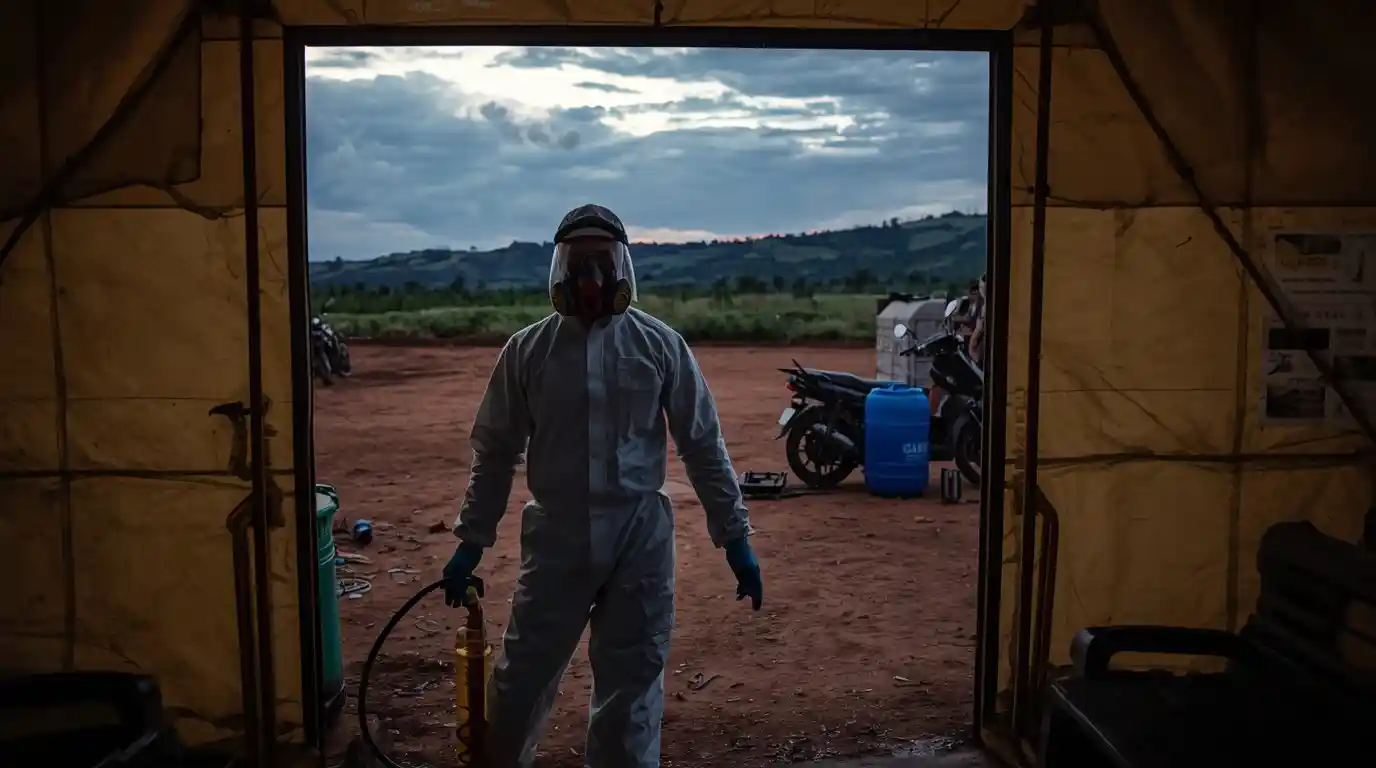
The Congo Ebola outbreak that has now killed more than 2,000 people didn't spill out of some older, simmering epidemic. It started with a single jump from an animal into one person, most likely in February — and for roughly three months, nobody realized what they were looking at. That's the finding of a genetic study published this week in Nature Medicine, and it changes how scientists read the whole event.
The scale is hard to overstate. Health ministries in the Democratic Republic of the Congo and Uganda declared outbreaks of Bundibugyo virus disease on May 15, 2026. Since then the count has reached 4,449 recorded cases and more than 2,000 deaths — close to half of everyone infected. WHO Director-General Tedros Adhanom Ghebreyesus has said it is on track to eclipse the 2014–16 West African epidemic, which remains the worst on record.
For Canadians, the practical stakes are smaller but not zero. The Public Health Agency of Canada rates the risk to the general population here as low, and notes that no case of Ebola has ever been imported into Canada. Even so, since May 20 there has been enhanced screening at five major airports, and temporary border measures are in place until August 28.
What a Fresh Jump From an Animal Means
Researchers sequenced 22 patient specimens, 21 of which were usable, with the lab work done by the Institut National de Recherche Biomédicale in Kinshasa and Uganda's Central Public Health Laboratories in Kampala. The virus turned out to be a Bundibugyo variant only distantly related to the strains behind earlier human outbreaks. That distance is the tell: this wasn't a flare-up of something already circulating in people.
Instead it points to a reservoir animal — the source is still unidentified — passing the virus to a human once, cleanly, in mid-to-late February. Everything after that was people infecting people. Krutika Kuppalli, an infectious diseases specialist, put it plainly:
After that initial spillover, the outbreak has been driven predominantly by human-to-human transmission.
The genomes carry a second clue. Nine mutations bore the fingerprint of ADAR, a human enzyme that edits viral genetic material during replication. One stretch showed four such edits inside 27 nucleotides. That signature only builds up over months inside human hosts, which independently supports a start date well before the outbreak was named.
How Big the Congo Ebola Outbreak Has Become
Comparison helps here. The 2014–16 West African epidemic produced more than 28,000 cases and over 11,000 deaths across three countries — it took two years to get there. This one has passed 4,000 cases in roughly six months, which is why WHO calls it the fastest-moving on record. More than 100 health workers have been infected and 35 have died, a loss that compounds with every week.
Bundibugyo virus is not new to the region. It caused an epidemic in western Uganda in 2007 and another in Isiro, DRC, in 2012. Both were contained at a fraction of this size. The difference this time is how long the virus ran unseen.
Why Nobody Caught It Until May
WHO's Africa director, Mohamed Yakub Janabi, has said sequencing evidence points to a February start and that early cases were written off as malaria or typhoid. Both are common in Ituri province, both begin with fever and body aches, and both are far more likely on any given day than Ebola. A field reconstruction in the mining town of Mongbwalu later documented more than 500 cases before the official declaration, with the earliest deaths in January.
There's a frustrating consequence. Every sample that was sequenced came from May 2 or later, deep into the transmission chain, so the molecular clock couldn't be calibrated properly. Scientists can say a fresh spillover happened; they can't yet date it precisely. Earlier stored specimens would fix that, and finding them matters for identifying which animal to look at.

Why There's No Shot for This Strain
This is the part that surprises most people. There is a licensed Ebola vaccine, and Canada has a real claim on it — the science behind Ervebo came out of the National Microbiology Laboratory in Winnipeg. But it targets the Zaire strain, the one behind the West African crisis. It does not cover Bundibugyo.
No approved vaccine or treatment exists for this strain today. Several candidates are in development, but none are ready to be deployed at scale into Ituri. Responders are left with the pre-2014 toolkit: contact tracing, isolation, safe burials and protective equipment. WHO's Abdirahman Mahamud has said a moderate projection has the outbreak peaking within six months.
What Canada Is Actually Doing
Screening at five airports
Since May 20, the Public Health Agency of Canada has run enhanced screening for travellers who've been in the DRC or Uganda in the previous 21 days. It applies at:
- Toronto Pearson
- Vancouver
- Montréal
- Calgary
- Ottawa
Temporary border measures also cover travel from South Sudan and run to August 28, at which point Ottawa will reassess.
What travellers are told
There is no travel ban, and PHAC is not testing everyone arriving. Testing is reserved for people showing symptoms consistent with Ebola. Returning travellers are asked to monitor themselves for 21 days and to phone ahead — not walk in — if fever, severe headache, vomiting or unexplained bleeding appear. Calling first lets the hospital prepare isolation before you arrive.
What to Watch Next
Three things will tell you where this goes. Whether older specimens surface and let researchers date the spillover and hunt the reservoir animal. Whether case growth bends before the six-month peak WHO models suggest. And whether a Bundibugyo-specific vaccine candidate gets fast-tracked into the field. If you're planning travel to the region, check the federal travel advisory before you book rather than after — and if you work in health care and have been in the DRC or Uganda recently, tell your employer's occupational health team now, not when symptoms start.




Comments 0