

Forecast Said 5,000. The School Enrolment Decline Hit 11,000
Broward County Public Schools budgeted for 5,000 missing students this year and opened its doors to 11,000 fewer — a forecasting miss that costs about A$150 million and carries a warning for Australia's shrinking public sector share.

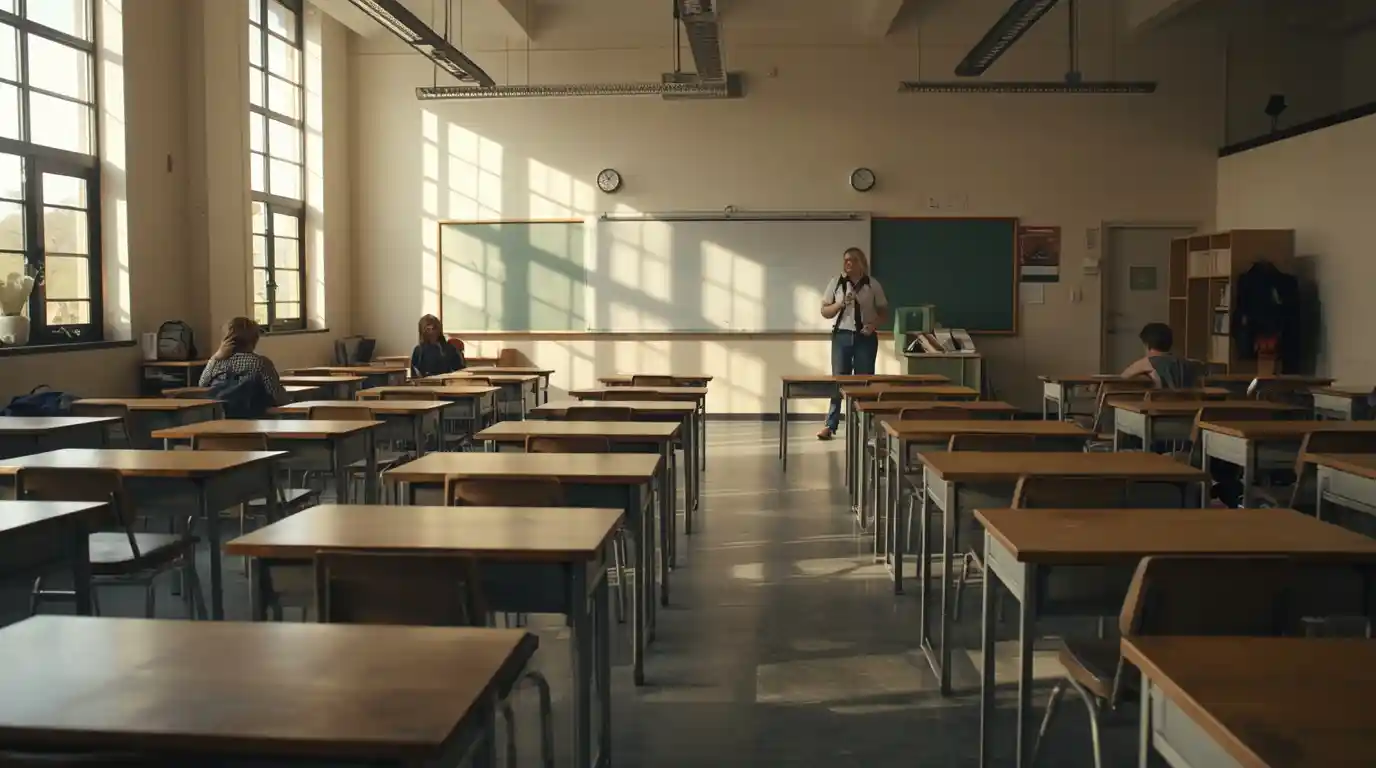
A school enrolment decline that Broward County Public Schools had pencilled into its own budget at 5,000 students turned out to be more than twice that size. On the first day of the new year, 11,000 fewer children walked through the doors than on the same day twelve months earlier. The Florida district is the sixth largest in the United States and the second largest in its state, teaching around 180,000 students in its own schools.
Superintendent Howard Hepburn put the funding hit at roughly US$100 million — somewhere near A$150 million. In Florida, as in most of America, the money follows the child. Fewer children on the roll means a smaller cheque from the state, and it lands in the same financial year the empty desks appear. There's no lag to cushion it, and no way to argue the number down.
That's the part worth watching from Australia. Broward isn't shrinking because families shuffled to the next suburb. It's shrinking because vouchers, immigration policy and housing costs are pulling in the same direction at once — and because the projection the whole budget rested on was wrong by about 6,000 kids.
The Forecast Miss Nobody Budgeted For
District staff circulated a memo in December 2025 projecting roughly 5,000 fewer students for the coming year. Eight months later the real figure was 11,000. Charter schools, which normally absorb families leaving traditional public schools, lost about 2,100 students of their own on the same day. When both sectors fall together, it usually means people are leaving the area entirely, or leaving for private options the district never sees.
How a School Enrolment Decline Becomes a Budget Hole
Florida funds schools per head, so a school enrolment decline of this scale converts almost directly into lost revenue. Broward shed about US$90.5 million in the past year on that basis alone. Stretch the trend across a decade and it reaches roughly US$342 million, close to A$515 million. Against a total budget near US$5 billion that isn't fatal. It is, however, relentless.
Costs don't fall at the same speed. A school that loses forty students spread across seven year levels still needs the same roof, the same front office, the same bus run. The gap between a thinning roll and fixed overheads is what eventually forces the ugly decisions — and it opens quietly, a year or two before anyone says the word closure out loud.
Where Did the Students Go?
There isn't one cause, which is exactly why the forecast missed. Three pressures are stacking.
Vouchers and school choice
Florida has pushed public money toward private tuition harder than almost any state. When a family takes a voucher, the district loses the funding entirely — it doesn't come back in another form. Florida's Office of Economic and Demographic Research has named school choice as a driver of the statewide slide, and revised its 2025-26 projection down by 46,456 students to about 3.2 million.
Immigration fear and the TPS cliff
Florida hosts about 113,000 Haitian holders of Temporary Protected Status, more than any other state, and a large share live in the Broward and Miami-Dade corridor. The same state research office pointed to a chilling effect from recent immigration enforcement. Hepburn has stressed that police need a court order to enter a school, an assurance districts only issue when families have stopped believing it.
The cost of living squeeze
South Florida housing has become genuinely unaffordable for working families, and some are simply moving to cheaper states. Hepburn described the mix bluntly last year:
You have school choice, vouchers, and people leaving for other places where their paycheck goes further.
Six Schools Already Consolidated
In January 2026 the Broward board voted to merge six schools, expected to save about US$8.95 million a year. That was stage two. Stage one, announced in August 2025, flagged 34 of the district's 239 schools as candidates for closure or consolidation. Hepburn has said a few may close and a few may be repurposed. No layoffs have been announced. Miami-Dade, next door, lost roughly 12,000 students last year.
Could This Happen in Australia?
Not in this form. Australian enrolments hit a record 4,160,918 students in 2025, according to the ABS. But the mix is moving steadily. Independent school enrolments grew 3.4% that year while government schools went backwards by 0.2%. Between 2016 and 2025, independent schools added 168,448 students, a 31% jump, against 5% growth in the public sector. Government schools now hold 62.8% of all students.
The mechanics differ in ways that matter. Australia doesn't hand parents a voucher, and state funding formulas don't punish a single bad enrolment year as sharply or as fast. What travels is the pattern underneath: a public system losing share while total numbers still look healthy, with the losses concentrated in the suburbs least able to absorb them.
What to Watch Next
Broward publishes a full breakdown by student group on 14 September, which will show whether the drop clusters in particular communities. If it does, the immigration explanation firms up considerably and other districts near large migrant populations should expect the same. Closer to home, the number to track is the next ABS schools release and whether government enrolments fall for a second straight year. And if your local public school's roll has dropped two years running, ask the P&C what next year's staffing entitlement looks like — a shrinking roll shows up in teacher numbers long before it shows up in a headline.




Comments 0