

How the Cost of Heatwaves Took £4.4bn From Britain
Britain lost £4.4bn to three hot spells before August even started, and across the EU the summer has quietly swallowed almost an entire year of growth.

The cost of heatwaves has quietly become a line item in Britain's national accounts. Three separate hot spells between May and the end of July stripped at least £4.4bn out of the UK economy, according to the think tank Verdant. That is lost output — work that didn't happen, orders that slipped, shifts cut short — rather than storm damage you can photograph.
The picture across the Channel is bigger and stranger. Triodos Bank, the Dutch lender, puts the damage from extreme heat and wildfires across the EU at around €180bn this year, roughly 1% of the bloc's entire GDP and somewhere north of £150bn in sterling. The EU was forecast to grow about 1.1% in 2026. Do the arithmetic and the summer has more or less eaten the year.
None of this arrives as a single event with a death toll and a news cycle attached. It leaks out through slower afternoons on building sites, reactors throttled back because a river got too warm, barges sailing half-empty, and supermarket prices that drift up two harvests later. That's precisely why it's easy to miss and hard to bill for.
Where Britain's £4.4bn Actually Went
Verdant's earlier work priced the June heatwave on its own at £2.36bn. The updated figure covers all three spells. London absorbed the largest share, with the City of London — the square mile of banks, brokers and law firms — accounting for roughly £435m by itself. Offices full of people who cannot concentrate turn out to be surprisingly expensive.
The think tank is clear that this is a floor, not a ceiling. It leaves out the extra energy burned on cooling, the long tail of deferred investment, and knock-on effects running through supply chains. Verdant's own projection is that cumulative losses could reach £25.6bn by 2030 if hot summers keep arriving at the current rate.
How Heat Drains an Economy, Piece by Piece
Triodos splits the EU hit into four channels, and roughly the same pattern shows up in nearly every member state:
- Weaker crop and dairy output, plus the food price rises that follow — about 0.15% of GDP
- Constrained nuclear, hydro and thermal generation, poorer solar efficiency and higher wholesale power prices — 0.12% to 0.15%
- Disrupted rail, road and waterway capacity — another 0.15%
- Lost labour productivity — the largest slice, and the hardest to measure
Workers Slow Down Once It Passes 30C
Output per worker starts sliding somewhere between 25C and 30C. Allianz has put a number on the far end of that curve: roughly 3% less output per hour worked for every degree above 30C. Bricklayers, warehouse pickers and delivery drivers lose most. Air conditioning helps, which is partly why Poland, hot but poorly cooled, still expects growth near 2.9%.
Rivers Too Warm to Cool a Reactor
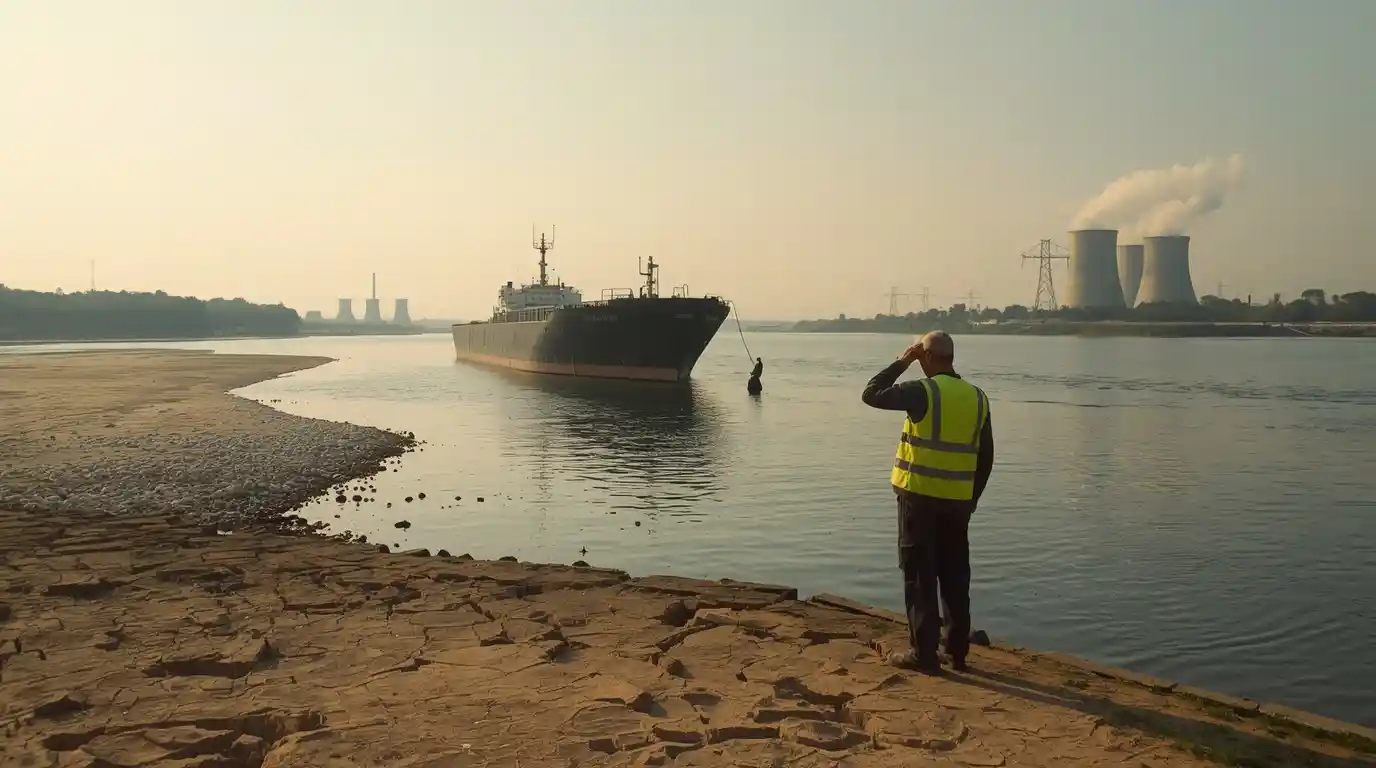
France draws more than two-thirds of its electricity from nuclear plants, many of them cooled by river water. When the Rhône, the Garonne and the Seine push against their thermal limits, output has to come down. Up to 15% of French nuclear capacity was expected offline this summer, and Hungary has curtailed reactors for the same reason.
Barges That Can't Sail Fully Loaded
The Rhine and the Danube have fallen to critically low levels, forcing freight barges to lighten their loads so they don't ground. Wolfgang Grosse Entrup, who heads Germany's chemical industry association, said alarm bells were ringing loudly. Water dropped far enough on the Rhine to expose the wreck of the De Hoop, a vessel that sank back in 1895.

The Cost of Heatwaves Across the Continent
France comes off worst in the Triodos numbers, losing about 1.4 percentage points of growth — enough to tip it into a contraction of roughly 0.6% for the year, just as it borrows at the highest rates in 15 years. Italy loses around 1.1 points. The Netherlands loses 0.8 and lands close to flat.
Spain is the genuine surprise. Wildfires damaged nearly 275,000 hectares according to Copernicus, and the country is on course for around 47 excessively hot days. Yet credit card spending data suggests tourists largely kept turning up in the affected regions anyway. Decades of building for heat buys more resilience than the thermometer readings imply.
Is This Just a Bad Summer, or the New Normal?
By mid-August more than 490,000 hectares had burned across Europe, against a 20-year average of about 197,000 — roughly two and a half times normal. Heat-related deaths across France, Germany, Spain and Italy reached an estimated 20,400 during June's heatwave alone, with the full summer toll put near 25,000.
Italy's farm lobby Coldiretti reckons agricultural losses have run to €20bn over four years, around 12.5% of the sector's output. That's the tell. The cost of heatwaves is turning into a recurring line on the ledger rather than a one-off shock, and businesses have started budgeting accordingly.
What This Means for Your Bills and Holidays
Most of the cost of heatwaves never shows up as an invoice with your name on it. Wholesale power prices rise when reactors throttle back and rivers run low, and that reaches UK energy bills with a lag of months. Food inflation follows failed harvests on a similar delay. If you're booking a Mediterranean trip for next year, May and late September are looking better on both comfort and price.
Watch three things this autumn: the next energy price cap announcement, which carries some of this summer's power-market stress; the revised EU growth forecasts, which will show whether the €180bn call was close; and whether your own employer has anything resembling a hot-weather policy. Britain's £4.4bn was paid mostly in lost hours — and those are the easiest to claw back.



Comments 0