

Hurricane Lala Stayed Offshore. Two Homes Washed Away.
The storm's center never crossed the coast, but its eyewall, 80 mph gusts and three-inch-an-hour rain did most of what a landfall would have done anyway.

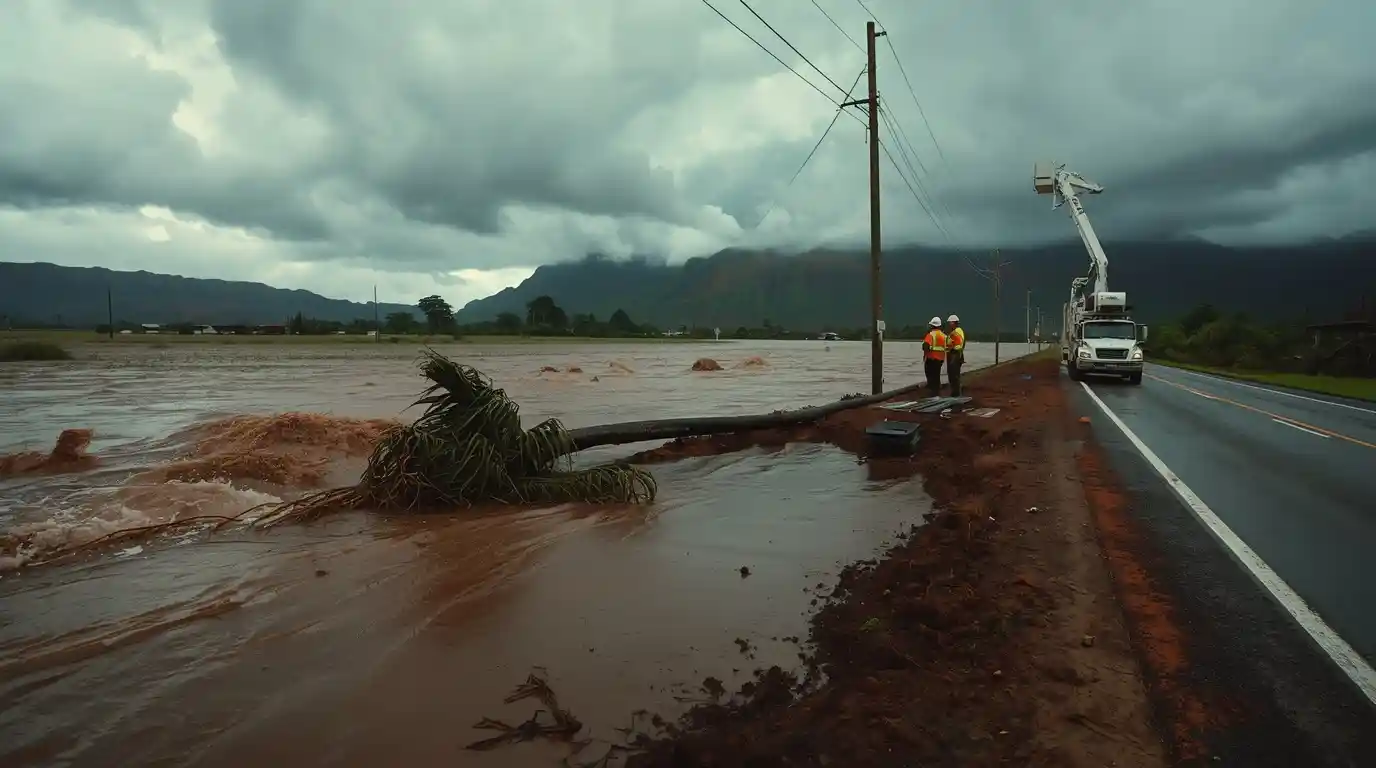
Hurricane Lala never technically made landfall on Hawaii's Big Island, and that distinction was worth exactly nothing to the people of Naalehu. Floodwaters there pushed two homes off their foundations Saturday evening while rain fell at three to five inches an hour. The National Weather Service declared a flash flood emergency for the small Kau District town — the most severe flood alert it issues.
The system reached Category 1 strength Saturday with sustained winds of 75 mph, then dragged its eyewall along the island's southern shoreline while the center stayed out over water. One person died in a car crash near the island's southern tip, though officials had not confirmed what role the weather played. At least 19 roofs were torn off. More than 125,000 customers lost power statewide, according to CBS News.
If you have a flight booked, a rental reserved or family on the island, the disruption is already locked in. Roughly 190 flights were canceled or postponed. Both Big Island airports — Hilo International and Ellison Onizuka Kona International — closed, as did commercial ports on the Big Island and in Maui County. Governor Josh Green said his team had begun paperwork for a major disaster declaration.
What Hurricane Lala Actually Did to the Big Island
Rain was the real weapon. By late Saturday afternoon, windward areas had taken 5 to 15 inches, with isolated spots past 20. Hakalau and Laupahoehoe both cleared 15 inches. Hilo Airport, meanwhile, measured just 3.5 inches — a reminder that on this island, the gap between soaked and merely damp can be a few miles. Forecasters expected another 4 to 8 inches on top of that.
Storm totals on the windward slopes could reach 30 to 35 inches. That is a function of geography as much as meteorology: Mauna Kea and Mauna Loa both rise well above 13,000 feet, and they force saturated ocean air straight up until it wrings itself out. A storm doesn't need to come ashore to aim a firehose at those slopes for a day.
Why "No Landfall" Is Almost a Technicality
Forecasters use a narrow definition: landfall happens when the storm's surface center crosses a coastline. The eyewall — the ring of the fiercest winds and heaviest rain wrapped around that center — can scrape a shore for hours while the center itself stays a few miles offshore and the official record shows no landfall at all.
The instruments told the truer story. Gusts topped 70 mph at South Point and hit 80 mph in the Kohala area. Kona Airport clocked 52 mph sustained winds with a 71 mph gust. Near Volcano, gusts ran in the high 40s. At 11 p.m. Saturday the center sat about 65 miles west of Kailua-Kona, moving northwest at 15 mph.
Where Lala Hit Hardest
Naalehu, Where the Water Rose Fastest
The two homes lost to floodwaters were in Naalehu, in the rural Kau District on the island's southern flank — the stretch closest to the eyewall. Three to five inches of rain per hour is faster than any drainage system or gulch can carry away, which is how a stream becomes a wall of water in under an hour.
Roads, Power and the National Guard
Crews closed long segments of Highways 11 and 19, plus Kohala Mountain Road and a string of smaller routes across South Hilo, Puna, Kohala and Kau. Outages climbed through the day: about 23,000 customers by late morning, roughly 60,000 by evening, then past 125,000. About 180 Hawaii National Guard members were deployed.

How This Compares With Iniki in 1992
Landfalling hurricanes remain genuinely rare here. Only two have come ashore in Hawaii since the 1950s — Dot in 1959 and Iniki in 1992. Iniki struck Kauai on September 11, 1992, as a Category 4 with 145 mph winds, killed six people, injured about 100 and caused $3.1 billion in damage in 1992 dollars, or roughly $7 billion today.
The usual shields are cooler water, dry stable air, wind shear and a ridge of high pressure that nudges storms away. Those defenses degrade the incoming winds. They do very little to the rain. Hurricane Lane in 2018 also stayed offshore and still triggered catastrophic flooding on the Big Island.
"Please be safe. You definitely want to be home, do not be out on the roads," Green told residents.
What the Forecast Says Next
Lala weakened to a tropical storm with 70 mph sustained winds as it tracked northwest past Oahu and the smaller islands, and forecasters expect the rest of the chain to see 4 to 6 inches of rain. The system is projected to regain hurricane strength midweek, though on a track that carries it away from the islands.
What to Do Right Now
- Do not drive through standing water. The Weather Service is blunt about it: most flood deaths happen in vehicles.
- Stock 14 days of drinking water, the standard Honolulu Board of Water Supply guidance, and limit use to essentials while systems are strained.
- Photograph any damage before cleanup, in case the federal disaster declaration is approved.
- Standard homeowners insurance does not cover flood damage, and new federal flood policies carry a 30-day waiting period — buying now won't help with this storm.
Watch three things this week: whether the Kau District gulches drain before more rain arrives, whether the disaster declaration clears, and whether the airports reopen on schedule. Central Pacific hurricane season runs through November 30, and August through October is the busiest stretch. If you're traveling to Hawaii, check your airline's waiver policy before you leave for the gate.




Comments 0