

Melbourne Retail Crime Fell. One Shop Was Hit Seven Times
Statewide break-ins at Victorian shops actually dropped last year — which is exactly why a single venue taking seven hits should worry every small operator in Melbourne.

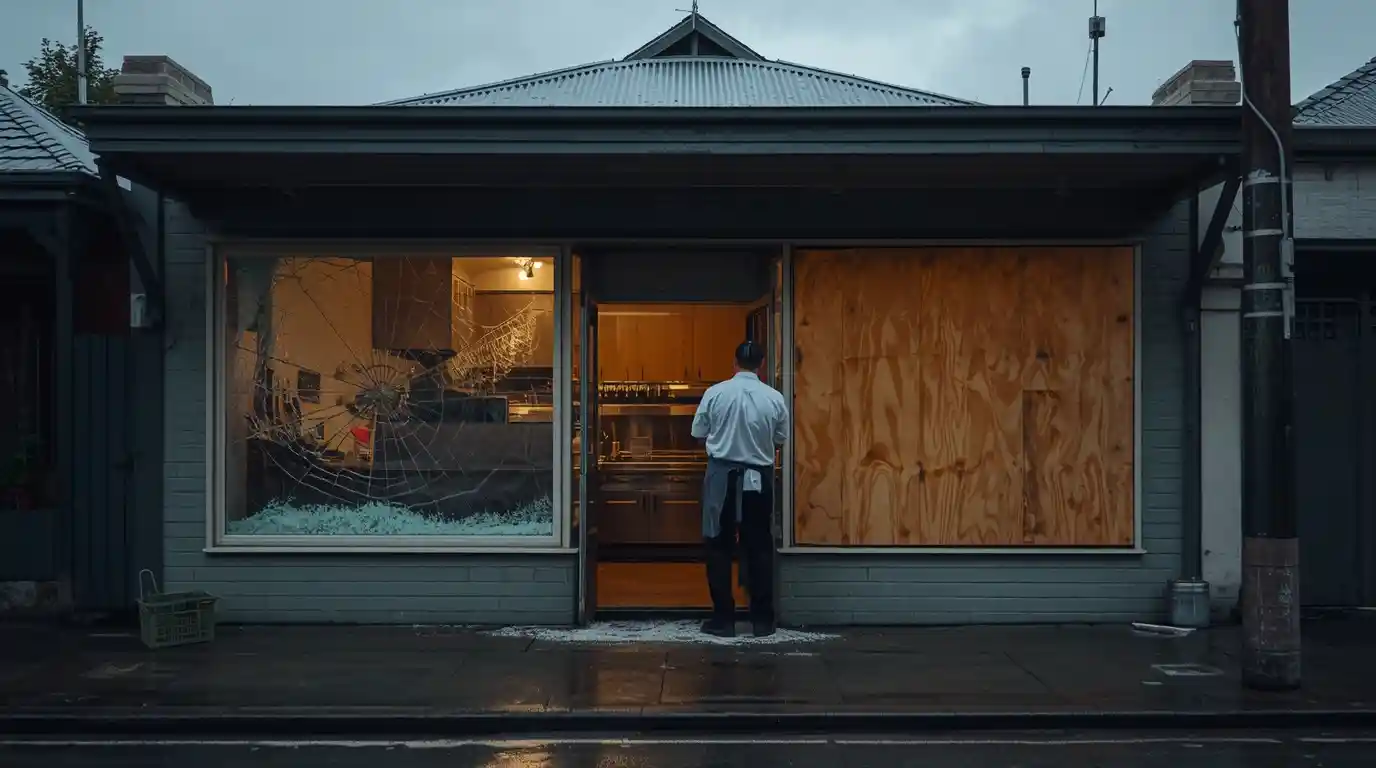
Melbourne retail crime is one of those subjects where the official spreadsheet and the person behind the counter flatly refuse to agree. News.com.au has reported on a hatted Melbourne chef whose shop has been broken into and wrecked seven times in three years, and who has now gone public asking for help. The line that carried the story was a question, not a complaint: Melbourne, are we going to live like this?
For anyone outside the industry, a "hat" is Australia's restaurant scoring award, handed out by the major good food guides and treated locally the way a Michelin star is treated overseas. It marks a kitchen that critics rate among the best in the state. That's the detail that stopped people scrolling. This isn't a marginal takeaway on a dark strip — it's a decorated operator saying the numbers no longer work.
And here's the part that doesn't fit the headline at all. Crime Statistics Agency data shows retail burglary and break-and-enter offences across Victoria actually went down over the past year, from 7,796 in 2024 to 6,804 in 2025. Fewer break-ins statewide. So how does one small business quietly absorb seven of them?
Seven Hits Is a Pattern, Not Bad Luck
Crime researchers have a name for this: repeat victimisation. A premises that gets done once is far more likely to be done again, because the second offender inherits everything the first one learned — which window gives, how long the alarm takes to bring anyone, whether the street has eyes on it after 1am. The site stops being a random target and becomes a known one.
That's why a falling statewide count and a business on its seventh break-in can both be true at the same time. Averages describe the state. They tell you nothing about the distribution underneath, where a small number of addresses soak up a disproportionate share of the damage while everyone around them is untouched.
What the Melbourne Retail Crime Numbers Actually Say
The Australian Retail Council, drawing on Crime Statistics Agency data released in March 2026, counted 95,181 criminal incidents at retail locations in the year to 31 December 2025. That's up 1.1 per cent on 2024, and up 25.7 per cent on the 75,709 recorded a decade earlier. Retail is now the third most common location for crime in Victoria, behind only streets and private homes.
The mix has shifted, too. Stealing from retail stores climbed 16.7 per cent to 20,615 alleged offender incidents. Assaults at retail sites rose to 5,357. Stalking, harassment and threatening behaviour hit 687 incidents — up 12.8 per cent in a year and up 65.9 per cent over the decade. Statewide, Victoria recorded 630,592 offences in the 12 months to December, a record.
Australian Retail Council chief executive Chris Rodwell put it bluntly, saying the trend is clear and that stronger enforcement is needed to deal with repeat offending. Read alongside the falling burglary figure, the picture is less "more break-ins" than fewer, heavier, more concentrated attacks on the same places.

The Coburg Store That Got a Note Instead
Repeat targeting isn't only about tills and freezers. In Coburg, convenience store owner De Ashley told The Noticer that a note referencing "The Commission" was left in the shop, and that days later a vehicle was rammed into the building at roughly 2am. Ashley had traded there for 25 years and said there was simply no money to hand over.
I've been here for so long and they've just put me out of business. I just hope they realise what they're doing to people's lives.
Different suburb, different crime, same shape: a long-established small operator hit more than once, with the cost landing on one family rather than a corporate risk line.
What a Small Venue Can Do Before the Next Hit
None of this is fixed by a single owner buying a better padlock. But repeat victimisation is one of the few crime patterns that responds well to fairly cheap, fairly fast intervention — and the window right after the first incident is when it works best.
Harden the Door, the Glass and the Kerb
Most repeat entries reuse the original weak point. Security film on shopfront glass, a reinforced strike plate, an internal roller shutter and a bollard or planter box in front of the door address the three common methods: smashing, jemmying and driving straight through. Fix the exact hole that was used, not a generic one.
Log Every Hit, Even the Cheap Ones
A cracked pane or a bin fire feels too minor to phone in, so it doesn't get reported — and then the address looks like a one-off rather than a pattern. Get a police report number every single time. That record is what triggers a tasking response and what backs any later claim about a targeted campaign.
Talk to Your Insurer Before You Claim Again
Claim history drives both your excess and your renewal, and hospitality margins are thin enough that the fourth or fifth claim can cost more than it recovers. Ask your broker where your threshold sits, and whether funding security upgrades yourself buys back a better premium than another payout will.
What to Watch Over the Next Few Months
The next Crime Statistics Agency release is the number worth watching. If total retail incidents keep creeping up while burglary keeps falling, that confirms the concentration problem rather than a broad crime wave, and it puts the pressure squarely on repeat-offender bail and sentencing settings rather than on shopfront hardware.
If you run a Melbourne venue, the practical move this week is unglamorous: pull your incident history, count how many times your address has been hit in 36 months, and take that number — not a vague sense of unease — to your local police station and your insurer. And if a place near you has boarded-up glass, buy something. A shop that keeps trading is a shop that's harder to write off.



Comments 0