

Robot Beats Usain Bolt's Record at Humanoid Robot Games
A machine ran 100 meters in 9.39 seconds in Beijing on Saturday — a year after the same robot needed 21.50.

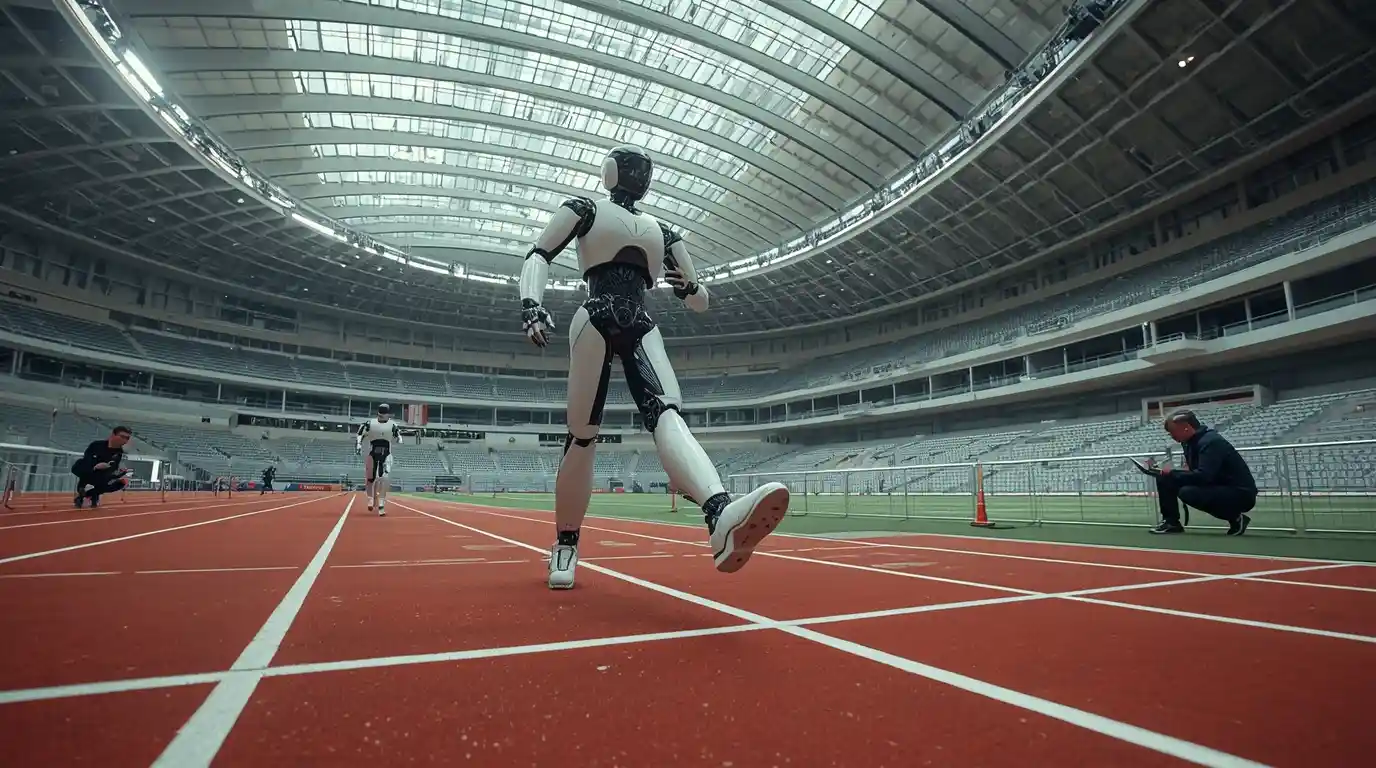
A machine ran 100 meters in 9.39 seconds on the opening day of the second World Humanoid Robot Games in Beijing, and no human being has ever gone faster. Usain Bolt's record of 9.58 seconds, set in Berlin in 2009, has stood for 17 years. On Saturday it was beaten by a two-legged robot called Tiangong Ultra, built by the Beijing Humanoid Robot Innovation Center.
It wasn't even a runaway. Tiangong Ultra fell behind early and caught a rival named Lightning — built by the smartphone maker Honor — close to the line. Lightning finished in 9.47 seconds, also under Bolt's mark. Now the number that matters more: twelve months ago, at the first edition of these games, that same Tiangong platform won the 100 meters in 21.50 seconds.
Cutting a sprint time by more than half in a single year is not normal engineering progress. And for readers in the U.S. watching robotics valuations, factory automation budgets or their own job security, the race is the least important thing that happened at the National Speed Skating Oval this week.
The Arrow, the Horse and the Glowing Chip
The ceremony leaned hard into spectacle. A humanoid robot mounted on a robotic horse drew a bow and loosed an arrow that lit a giant emblem above the arena called the "Zhixin," which translates roughly as intelligence chip. It's the event's answer to the Olympic flame. More than 1,000 robots filled the floor under the theme "Intelligence Competing Toward the Future," with a 50-strong contingent of Tiangong 3.0 units serving as flag bearer and archer, according to the Global Times.
How a Robot Cut 12 Seconds Off Its Time
Some perspective is owed here. These sprints run under the games' own rulebook, not World Athletics', so the comparison to Bolt is a headline, not a sanctioned record. Robots aren't reacting to a starter's pistol the way a person does, and they don't have to hold form for a lap afterward. The Global Times also reported a high jump of 288.43 centimeters, well past the human record of 2.45 meters.
What the time does prove is that balance and gait control — the thing that made humanoid robots look ridiculous for 40 years — has stopped being the bottleneck. A robot that can stay upright at sprint speed can stay upright carrying a box down warehouse stairs.
What the Humanoid Robot Games Actually Prove
Autonomy is no longer optional
The 2026 program nearly doubled to 51 events from 26, and scheduled matches jumped from 487 to 1,301. Thirty are athletic events; the other 21 are scenario-based tasks. The bigger shift is in the rules: most events now demand full autonomy, with the 100-meter and 400-meter obstacle races among the few exceptions. Martial arts and dance were added. Teleoperated robots taking instructions from a human off-camera can't quietly pass anymore.
Running is easy; folding laundry is not
Last year's games in August 2025 were widely described as a pratfall reel — robots collapsed in the sprints, wandered during football, and needed handlers everywhere. Tsinghua University's Hephaestus squad won the 5v5 football final 1-0 against a German team, HTWK Robotics and Nao Devils. The scenario events, where machines sort medicine or clean up, are the ones that actually map to paid work, and they remain far harder than a straight line.
Where U.S. Robot Makers Stand Right Now
The scale gap is the story American investors should sit with. Roughly 13,000 to 18,000 humanoid robots sold worldwide in 2025, and about 90% of them went to buyers in China. Unitree shipped more than 5,500 units — nearly a third of the global total — with AgiBot close behind at 5,168. Figure, Agility Robotics and Tesla each sold around 150 that year.
That's changing fast. Figure had delivered more than 350 of its Figure 03 units by April 2026 and is targeting over 1,000 this year. Tesla has been ramping Optimus production at a repurposed Fremont line. Goldman Sachs projects a $38 billion humanoid market by 2035; Morgan Stanley talks about a $5 trillion opportunity by 2050. Both are forecasts, not orders.
What to Watch Before the Games Close
The event runs through August 26. Skip the sprint replays and watch the scenario rounds instead — the sorting, cleaning and materials-handling tasks are the closest thing to a public benchmark for whether these machines can do work a U.S. employer would pay for. If a robot completes those cleanly, without a human at a controller, that's your signal. The 9.39 is just the trailer.




Comments 0