

The Only Thing This Hydrogen-Powered Stage Emits Is Water
Boomtown's HYDRO XL just proved green hydrogen can run a 20,000-capacity main stage — and the question now is whether the fuel can travel.

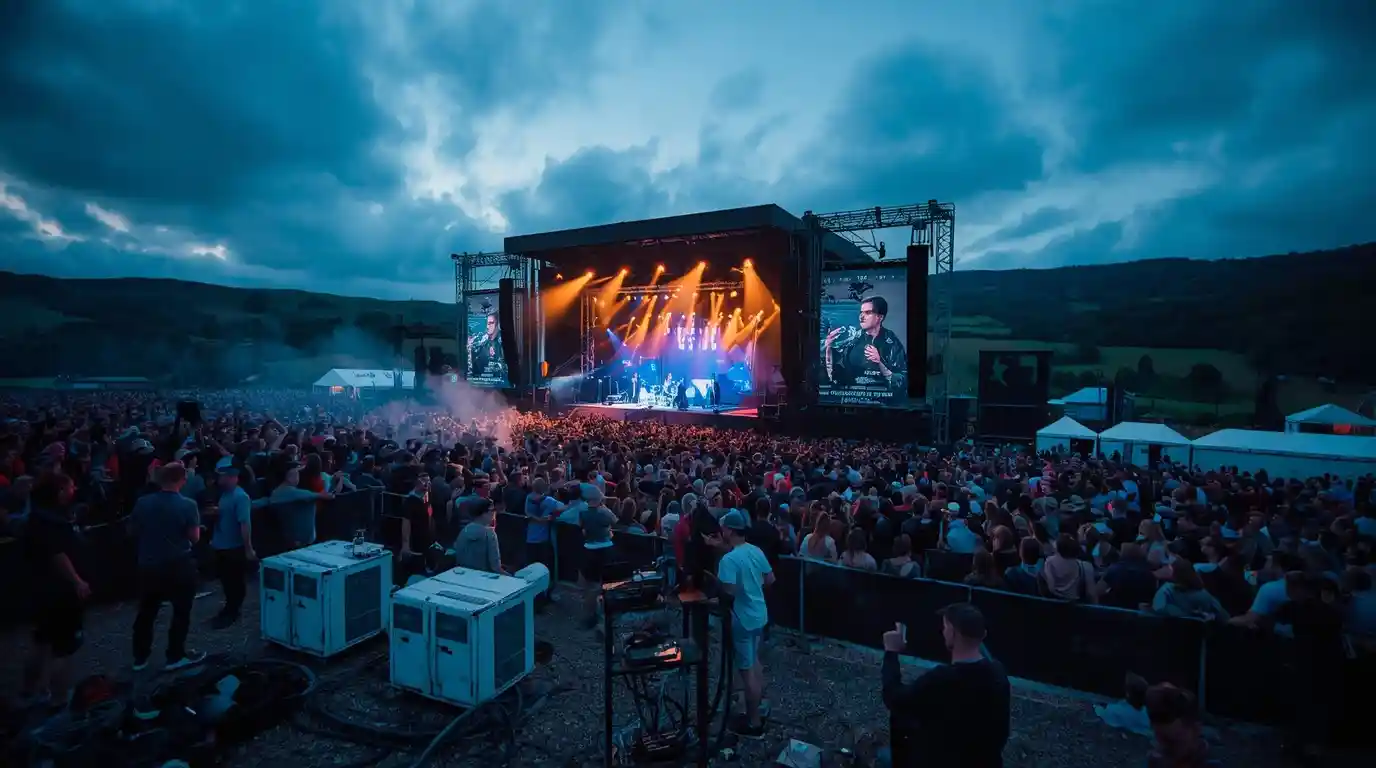
The UK's first hydrogen-powered stage at true main-stage size opened on Friday in a Hampshire field, and the only thing coming out of its generators was water. No diesel fumes drifting over the crowd. No low mechanical drone underneath the bass. Just a 20,000-capacity stage doing everything a flagship festival stage is supposed to do, running on fuel cells instead of a fuel tank.
The stage is called HYDRO XL, and it belongs to Boomtown, the immersive festival held at the Matterley Estate inside the South Downs National Park from August 12 to 16. Roughly 77,000 people are on site this year, the festival's biggest crowd to date. HYDRO XL is one of three main stages, and it grew 150 per cent in twelve months — from an 8,000-capacity pilot in 2025 to 20,000 this year.
That jump is the actual story. Plenty of events have run a hydrogen generator behind a small tent to make a point. Almost none have handed a fuel cell the job of powering the lights, lasers, video walls and a full sound system for a headline crowd, where a five-second power dip in front of 20,000 people is a very public failure.
What Actually Powers the Hydrogen-Powered Stage
The technology behind HYDRO XL comes from GeoPura, a clean-energy firm based in Newcastle. Its hydrogen power units are containerised boxes that look, from a distance, a lot like the diesel gensets they replace. Inside, a fuel cell combines hydrogen with oxygen from the air to make electricity, and the by-products are heat and water vapour — clean enough, the company says, to drink.
Where the hydrogen comes from
The green part matters more than the hydrogen part. GeoPura uses renewable electricity — wind and solar — to split water through electrolysis, then stores the hydrogen and trucks it to site. If that electricity came from gas or coal instead, the carbon would simply move upstream to the production plant. Green hydrogen keeps the emissions at zero across the chain, which is the entire reason the claim holds up.
Why the batteries do the heavy lifting
A festival stage doesn't draw steady power. It spikes hard when a headliner drops and idles between sets. GeoPura's units pair the fuel cell with a large onboard battery — the original HPU model pairs 250 kVA of output with a 216 kWh battery pack — so the battery absorbs the peaks while the fuel cell trickles along at a sensible rate. Larger units in the range scale to 500 kW and beyond.
From a Side Stage to the Main Event
Boomtown ran the smaller HYDRO stage as a trial in 2025, and clean-power supplier Hydrologiq, which delivered that pilot, says it avoided more than eight tonnes of CO2. Eight tonnes is not a climate solution on its own — it's roughly what a couple of Canadian households produce in a year from home energy — but it was never meant to be. It was a test to see whether the thing stayed on.
"This is brand-new technology for the festival industry so we started smaller, we found it worked," said Ruby Handy, Boomtown's festival operations manager.
Boomtown says it has cut its carbon footprint by 98 per cent over the past seven years, largely by attacking generators, transport and waste at once. Co-founder Luke Mitchell described the scale-up with GeoPura as something the team was "over the moon" about.

Festival Power Has a Diesel Problem
Almost every large outdoor festival is, electrically speaking, a temporary off-grid town. Sites are chosen for space and acoustics, not for substation access, so organisers wheel in banks of diesel generators and burn fuel for four days straight. The emissions are real, but so is the local air quality hit and the noise floor that sound engineers spend the whole weekend fighting.
The shift is picking up. Bristol launched a mobile clean-power hub in May 2026 offering batteries and green hydrogen to festivals, concerts and film shoots, so a single producer no longer has to solve the fuel logistics alone. That shared-infrastructure model is probably how this scales — not every festival buying its own kit.
Could This Work at a Canadian Festival?
The technology transfers fine. The fuel doesn't, at least not yet. Canada has serious green hydrogen ambitions and production projects in Atlantic Canada and Alberta, but the piece Boomtown relies on — a supplier who can produce, store and deliver hydrogen to a temporary rural site on a schedule — is thin on the ground here. A festival in the B.C. interior or two hours outside Montreal can't order what nobody trucks.
- Distance is the killer: hydrogen is bulky to transport, and Canadian festival sites are often far from any industrial hydrogen hub.
- Cost still favours diesel per kilowatt-hour, so early adopters are paying a sustainability premium, not saving money.
- Grid-tied and battery-hybrid setups remain the cheaper first move for most Canadian promoters.
What to Watch For Next
The number worth waiting for is Boomtown's post-festival report — specifically whether HYDRO XL ran the full weekend without a diesel backup quietly idling nearby, and what the delivered cost per kilowatt-hour came to. If that figure is within shouting distance of diesel, expect European festivals to move fast in 2027. If you run or book Canadian events, the practical step this year isn't hydrogen; it's asking your power contractor what a battery-hybrid setup would cost, because that is the bridge everyone crosses first.




Comments 0