

What the Galaxy Z Fold8 Teardown Means for Your ₹1.8 Lakh Phone
iFixit gave Samsung's newest foldable a 4 out of 10 for repairability — and destroyed the phone proving why.

The Galaxy Z Fold8 teardown published by iFixit this week hands Samsung's newest foldable a provisional 4 out of 10 for repairability, and the number lands harder when you check the price tag. In India the phone starts at ₹1,79,999 for the 12GB/256GB version, which went on sale on 7 August. Four out of ten is a point better than the Fold7 scored last year. It is still poor by the standards of any ordinary slab phone.
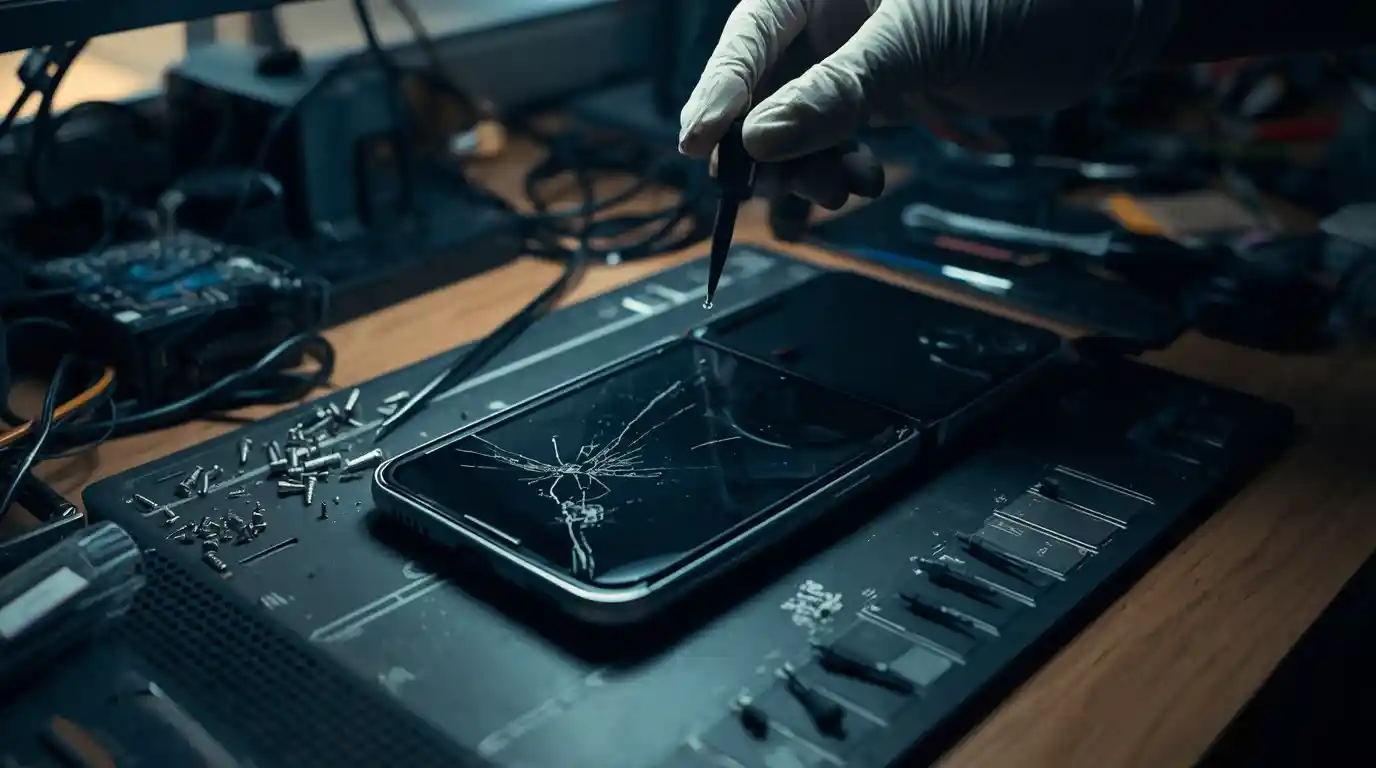
What makes the report worth reading isn't the score, though. It's how the teardown finished. While the team was separating the inner display, the thin plastic bezel running around the panel chipped and broke apart, and the OLED layer went with it. The phone was finished. Not dropped, not bent in a stress test — killed on a workbench, by people who take phones apart for a living, using proper tools and taking their time.
That's the practical warning buried in a technical document. If a professional lab can lose the screen while opening the device carefully, the odds of a local repair shop in Karol Bagh or Ritchie Street pulling off the same job cleanly are not good. And on this phone, the screen isn't a component you shrug off.
Galaxy Z Fold8 Teardown: What iFixit Actually Liked
Samsung has genuinely fixed some things. The screws are standard Phillips/JIS heads, not proprietary fasteners that force you to buy a special kit. The back plate comes off without a fight. Best of all, the USB-C port sits on its own cable rather than soldered to the mainboard, so a worn charging port can be swapped on its own — a real win in a country where cheap cables, humidity and pocket lint kill ports early.
The battery news is also good. There are two silicon-carbon cells adding up to 18.68 watt-hours, about 8.8 percent more capacity than the Fold7 in roughly the same space, working out to around a 5 percent gain in volumetric energy density. Both cells have pull jackets, so they lift out without drowning the phone in solvent or prying blindly at glued corners.
The Moment the Phone Died
Here's the catch with those batteries: to reach one of them, you first have to remove the outer display. So a technician has to risk one of the most expensive parts in the phone in order to service a consumable one. That's a bad trade for a repair shop quoting you a fixed price, and it's why many will simply refuse the job or quote defensively high.
The inner panel now uses what Samsung calls a Flex Titanium structure — a titanium-alloy film roughly one-third the thickness of a human hair, sitting on a perforated support plate. Samsung says the titanium backing is about 20 times stiffer than the polymer film it replaces. Stiffer under bending, yes. Easier to take apart, no. The fragile plastic bezel around it is what gave way during the teardown.
What a Broken Fold Really Costs You
Repairability scores feel abstract until a bill arrives. The Galaxy Z Fold8 teardown matters because of two structural decisions Samsung has made that decide what you'll pay two years from now, long after the warranty lapses.
The Screen and Hinge Ship as One Part
Samsung pairs the inner display and the hinge into a single replacement assembly. Damage either one and you're buying both, and fitting it means effectively gutting the phone. There is no version of this that a confident DIYer does at the dining table on a Sunday. For reference, independent repair services in India have listed inner-screen replacement on the Fold6 at around ₹45,000 — roughly the price of a decent mid-range phone.
Spare Parts Are the Real Bottleneck
iFixit flagged something easy to miss: official replacement parts for the Fold7 are still hard to find, a year after launch. A repairable design means nothing if the part is out of stock. That supply problem hits India harder than the US, because authorised service centres outside metros carry thin foldable inventory and waits stretch into weeks.

Why IP48 Doesn't Mean Dustproof
The Fold8 carries an IP48 rating. The 8 is the good half — it handles water well. The 4 only certifies protection against solid objects larger than 1mm. Fine dust, pocket lint, talcum-grade grit and beach sand are all smaller than that, and they go straight into the hinge. Anyone who has walked through a Delhi winter or a construction-heavy stretch of any Indian city knows what that means.
iFixit described the hinge, once dirt and sand got into it, as sounding like it was chewing gravel — a detail reported by Android Authority.
So Is It Better Than the Fold7?
On paper, yes: a point higher on repairability, a bigger battery, a modular charging port and a stiffer display stack. Separately, YouTube's JerryRigEverything put the phone through bend, scratch and sand tests and it held together, with the inner panel surviving the flex. But durability and repairability are different questions. This phone is harder to break than its predecessor and no easier to fix once you do.
What to Check Before You Tap Buy
If you're spending ₹1.8 lakh on a folding phone, treat the repair plan as part of the purchase, not an afterthought. Ask your dealer for Samsung's written out-of-warranty price for the inner display assembly on this exact model before you pay. Budget for accidental damage cover in year one — on a screen that costs a third of the phone, it stops being optional. Keep the closed hinge out of sandy pockets and bags, and if it starts sounding gritty, get it looked at early rather than after it seizes. Watch, too, for whether Samsung improves parts availability this cycle. That single detail will decide whether owning a Fold8 in 2028 is affordable or absurd.




Comments 0