

Why the Apple Smart Home Display Slipped Nearly Two Years
A new Apple TV, a refreshed HomePod mini and a $350 wall-mounted display are reportedly close — after one unfinished piece of software held the entire category hostage.

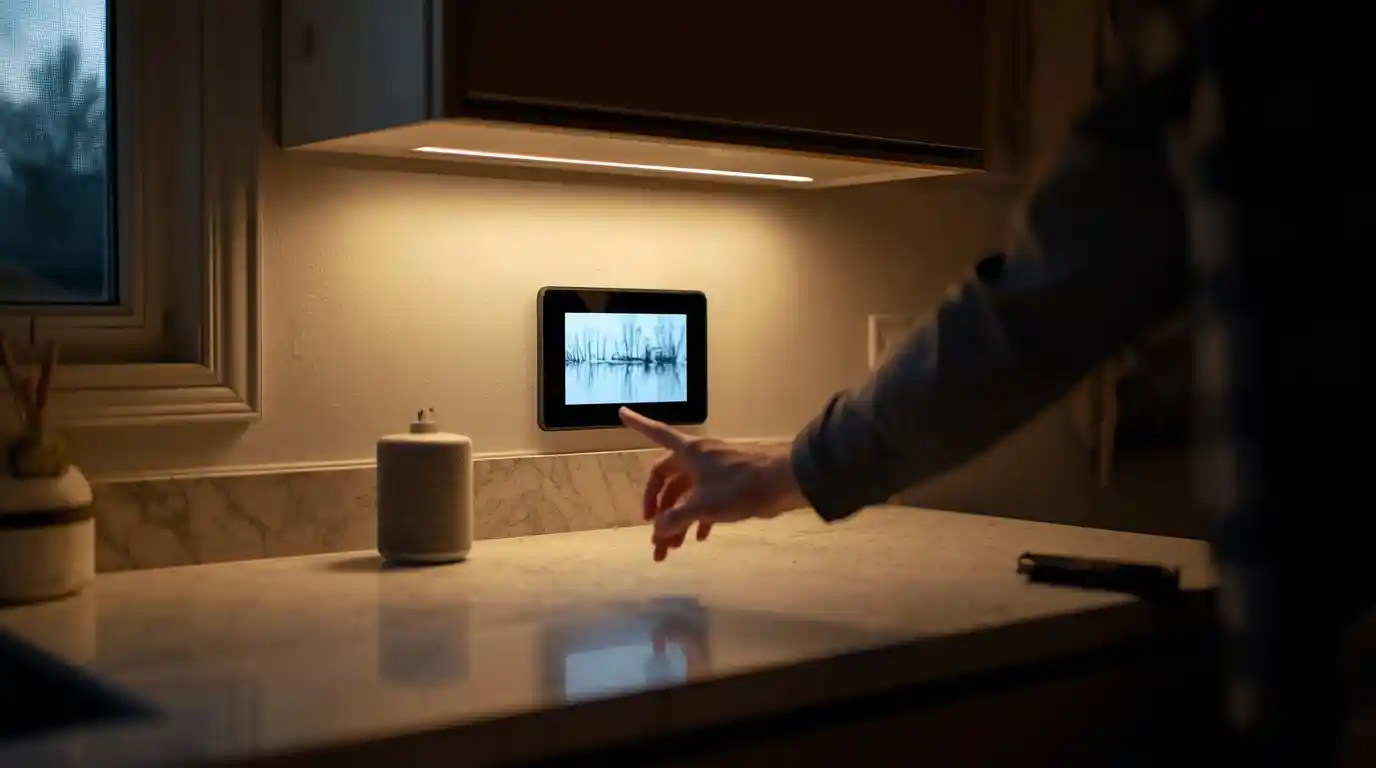
The Apple smart home lineup is about to get its biggest hardware refresh in years, and the reason it took so long has almost nothing to do with hardware. Bloomberg's Mark Gurman has reported, and 9to5Mac summarized this week, that a new Apple TV 4K and a new HomePod mini are due this fall — with a wall-mounted display arriving right behind them.
That display was supposed to land in March 2025. It didn't, because the rebuilt version of Siri it depends on wasn't finished. Nearly two years later, the device — known internally as J490 — is now expected between October 2026 and early 2027, at a reported price of roughly $350. None of this is official. Apple has announced nothing.
If you own either of the products getting refreshed first, the takeaway is short: wait. The current Apple TV 4K went on sale in October 2022. The HomePod mini has been sold unchanged since November 2020. Gurman has described both replacements as nearly ready to launch, which puts them weeks away rather than quarters.
Siri Was the Bottleneck, Not the Hardware
It's worth sitting with how unusual this is. Apple designed a screen, a speaker and a set-top box around an assistant that couldn't yet do the job, then held the whole category until the software caught up. Per Bloomberg, the new Siri runs on a language model Google built to Apple's specification, executed on Apple's own Private Cloud Compute servers, with Apple insisting user data never reaches Google.
That single dependency froze the Apple smart home roadmap for the better part of two years, and it explains the shape of everything on it. Each device is a Siri device first and a screen or speaker second. It also sets the risk: if the assistant underdelivers, buyers are holding a $350 panel whose main job is listening.
What's Landing First This Fall
Neither fall product is being redesigned. Apple's apparent position is that the enclosures are fine and the interesting work is inside them. Both are reportedly getting the company's new N1 wireless chip, which is where the actual home relevance sits.
A Faster Apple TV 4K, Four Years On
The A15 Bionic gives way to the A17 Pro — the oldest iPhone-class chip capable of running Apple Intelligence on device. The N1 adds Wi-Fi 7, Bluetooth 6 and Thread, which turns the box into a border router for Matter accessories instead of a passive streamer. A refreshed Siri Remote has also been reported. Pricing is the open question: the current model already jumped from $129 to $199.
A HomePod mini That Can Finally Keep Up
The mini moves from the S5 to the S9, the chip Apple shipped in the Series 9 Watch back in 2023. Not cutting edge, but a generational leap over 2020 silicon, and enough to handle more of the assistant's work locally. Better audio, the N1 and new colors including red have all been reported, with the $129 price expected to hold.

The $350 Screen Meant for Your Kitchen Wall
The display itself is small and square — around seven inches, roughly two iPhones set side by side, with noticeably thick bezels. Two versions are planned: one that snaps magnetically to a wall, and a tabletop model on a speaker base that looks like a HomePod mini with a face. It runs an A18 and a custom operating system referred to internally as homeOS.
There's no App Store. Apple's own apps appear as widgets, which is a smaller ambition than an iPad on a wall and probably the right one. Amazon shipped the first Echo Show in 2017 and Google followed with the Nest Hub in 2018, so Apple arrives late, expensive, and betting almost entirely on the assistant being better.
What the Apple Smart Home Push Costs You
Do the arithmetic before you get excited. An Apple TV 4K at $199, a HomePod mini at $129 and a hub at $350 comes to $678 — for one room, before a single light, lock or camera. And the streaming box has already been repriced: $129 became $199, $149 became $249. That's a 54% increase on the entry model before the new one even ships.
So the practical advice is boring and useful. Don't buy an Apple TV 4K or a HomePod mini in the next few weeks. And if you're mid-renovation, tempted to rough in power for a wall panel, remember there's no confirmed product, no confirmed date and no confirmed price — only reporting.
Cameras, Doorbells and a Robot With an Arm
After the hub, the Apple smart home story stops being about brains and starts being about parts. Three things have been reported for late 2026 and beyond:
- An indoor security camera — Apple's first — targeted for late 2026
- A smart doorbell to follow, putting Apple directly against Ring and Nest
- A tabletop robot in 2027: a nine-inch display on a motorized arm that swivels toward whoever's speaking
The camera and doorbell are the meaningful shift. Until now Apple sold the hub and let partners sell the accessories. Competing with Ring and Nest changes who it fights, and on price, those rivals are brutal. The robot is a further bet — that people want a screen that turns to face them rather than one they walk up to.
Watch the fall event first. If the new Apple TV and HomePod mini show up with a Siri that visibly does more than the old one, the rest of this becomes easy to believe. If the assistant lands flat, expect the hub to drift into 2027 the way it drifted out of 2025 — and keep using what you already own.



Comments 0