

Your Used Eclipse Glasses Work Again in Egypt Next August
Millions of pairs bought for Wednesday's near-total eclipse are about to be thrown away, and most of them are still perfectly safe to use.

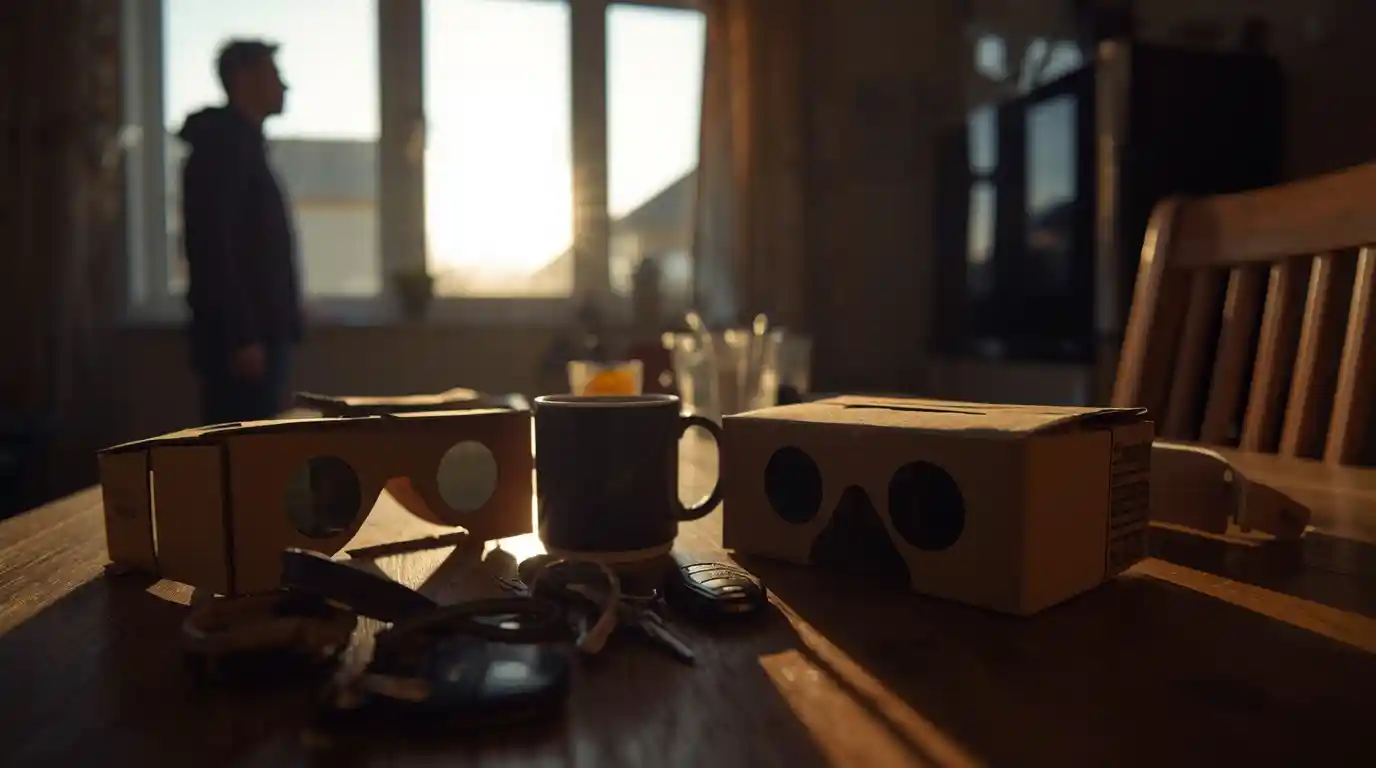
If you're now looking at a pair of used eclipse glasses on the kitchen worktop, don't put them in the bin. Wednesday evening's partial solar eclipse was the closest thing to totality Britain has had in a generation, and the flimsy cardboard viewer you queued or paid for is a precision optical filter that hasn't stopped working just because the Moon has moved on.
The numbers explain the scramble. Around 90% of the Sun was covered from London, rising to roughly 94% over Pembrokeshire and close to 96% at Land's End, according to the Royal Observatory Greenwich, which also confirmed its own shops had sold out of viewers before the event. Totality itself passed well to the north and west, across Greenland, Iceland and northern Spain.
Here's the part that should stop you reaching for the recycling box. The next time the British Isles get this close again is 2081, when up to 99% of the Sun will be blocked. A genuine total solar eclipse over the UK doesn't arrive until 2090 — 64 years away, and the first since the Cornwall eclipse of 11 August 1999. Almost nobody reading this will see one from home.
Do used eclipse glasses actually expire?
The old advice about a three-year shelf life is out of date. Viewers made to the ISO 12312-2 standard, introduced in 2015, don't degrade on a timetable, and Euronews reports they can be safely reused for up to a decade provided they're undamaged. What matters is physical condition, not the calendar. A pair bought this month should still be fine for the eclipses of 2027 and 2028.
Three checks before you trust them again
Damage is the only thing that turns a safe filter into a dangerous one, and it isn't always visible at a glance. Run through these before you put them away — and repeat the first one immediately before any future eclipse, because a year in a drawer can do more harm than an evening outdoors.
Hold them up to a bright bulb
Take them into a dark room and look at a bare, bright household light. You should see the filament or the bulb outline and absolutely nothing else — no grey haze, no pinpricks of light, no glow around the edge of the frame. Any stray light getting through means the filter has been perforated, and the pair belongs in the recycling, not the drawer.
Find the ISO 12312-2 stamp
Check the arm or the frame for the wording ISO 12312-2 or ISO 12312-2:2015. That marking is the whole basis for reusing them, and it's what separates a certified solar filter from a novelty item or dark sunglasses. If there's no marking anywhere on the card, treat the pair as unknown and don't put it near your eyes again.
Work out when you bought them
If these came from a drawer rather than a shop this month, date them. Anything from before 2015 predates the current standard and used materials that degrade faster, so it should be retired regardless of how good it looks. The same goes for any pair that has been folded, sat on, or carried loose in a bag or a car glovebox all summer.

Where to send them instead of your bin
Undamaged pairs are worth passing on rather than storing. Local astronomical societies, science centres, museums, libraries and school science departments all use them for outreach and often collect them after big events; several UK societies said as much this week. Astronomers Without Borders has run a large international collection scheme in the past, though its programme is currently paused, so check locally first.
- Your nearest astronomical society — most have a public Facebook page and meet monthly
- A local primary or secondary school science lead
- Friends or family travelling to Egypt or Australia in the next two years
How to recycle a pair that failed the test
Scratched or punctured viewers can be partly recycled, but not as they are. The lenses are a black polymer or metal-coated polyester that kerbside facilities can't process, so pop them out first and put them in general waste. Clean cardboard or paper frames then go straight into your household card recycling. Most plastic frames, unfortunately, can't be recycled at all.
When you'll actually need them again
Astronomers have taken to calling the next few years a golden age of eclipses, and the diary backs it up. On 2 August 2027 totality crosses Egypt, lasting more than six minutes over Luxor — one of the longest land eclipses this century. On 22 July 2028, Australia and New Zealand get theirs, including Sydney's first total eclipse since 1857. Flights and hotels for both are already filling.
There's also something much sooner and much cheaper. A partial lunar eclipse on 28 August 2026 will see about 90% of the Moon slide into Earth's shadow, starting at 3:33am BST. For that one you need no filter at all, just a clear sky and an alarm. So do the bulb test tonight, store the good pairs flat in their sleeve somewhere dry, and put the 2027 date in your phone.
Comments 0