

138 Miles, No Sleep: Inside a 33-Hour Backyard Ultra
A San Diego software engineer outlasted 239 rivals in a race with no finish line — while the sport's world record still sits in regional Queensland.

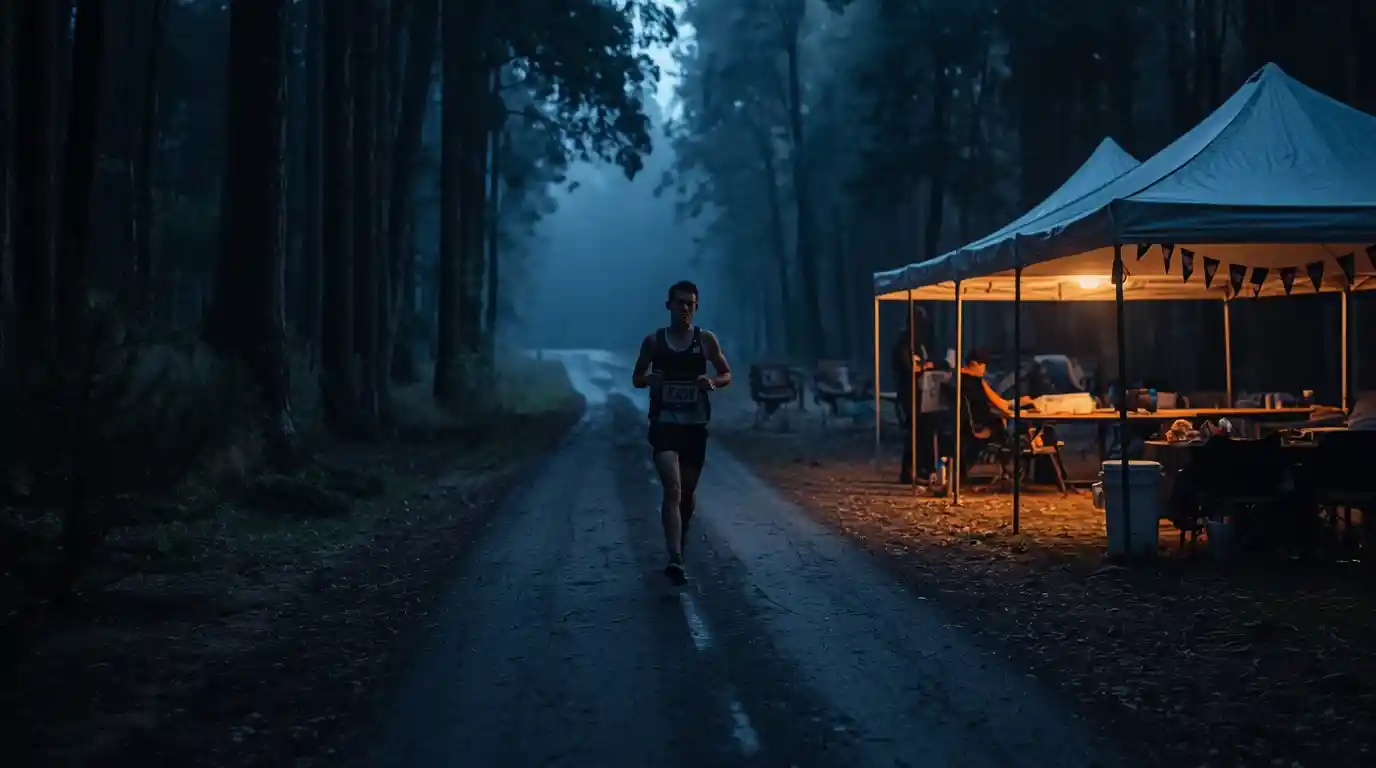
A 35-year-old software engineer from San Diego has won a backyard ultra in upstate New York by running for 33 hours straight on no sleep at all. Kyle Hunter, who lives in Pacific Beach, was the last of 240 starters still moving at the Last Man Standing event in Lake Placid in late July. His official total was 137.51 miles, or about 221 kilometres.
Fox 5 San Diego put the real distance past 138 miles, because Hunter took a wrong turn in the dark and added a bit extra to one lap. He never lay down and never napped. Between laps he refuelled on whatever was in reach — breakfast sandwiches, quesadillas, pizza. He also raised more than US$6,500, roughly A$10,000, for charity along the way.
If the format sounds obscure, it isn't, and Australians have more claim to it than almost anyone. The world record for this style of racing was set in regional Queensland, by an Australian, and it still stands. Hunter's 33 hours is a serious effort. It's also nowhere near the sport's ceiling.
What a Backyard Ultra Actually Asks of You
The rules are the cruellest thing about it. There's no finish line, no target distance, and no clever pacing trick that banks time for later. You either complete the loop inside the hour or you're out, and the clock resets whether you feel fresh or you're falling apart on the side of the track.
One Loop, Every Hour, On the Hour
The loop is 6.7056 kilometres — 4.167 miles — chosen so that 24 laps come to exactly 100 miles. A bell sends the field off at the top of every hour. Finish in 50 minutes and you get 10 minutes off your feet. Finish in 58 and you get two. Miss the next start by one second and your race is over.
The Winner Has to Run One Lap Alone
This is the rule that makes the whole thing strange. Everyone who stops is recorded as a DNF, no matter how far they got. To be declared the winner, you have to head out for one more loop after the last of your rivals has quit, and finish it by yourself. In official terms, second place does not exist.
What You Eat at Three in the Morning
Nutrition plans collapse fast. Runners start on gels and electrolyte drink, then switch to anything the stomach will still accept — hot chips, soup, instant noodles, cold pizza. Hunter's menu of breakfast sandwiches and quesadillas is typical rather than eccentric. Sleep is the other problem, and 33 hours is short enough that most winners simply don't bother.
The World Record Belongs to Queensland
In 2025, Australia's Phil Gore ran 119 laps at the Dead Cow Gully Backyard Ultra in regional Queensland — about 797 kilometres, close to five days of continuous running. He outlasted New Zealand's Sam Harvey, who reached 118 laps before an Achilles injury ended his race, then went out and completed lap 119 on his own. The field had started with 263 runners.
Gore's mark broke a record of 116 laps set only weeks earlier by Poland's Łukasz Wróbel. Next to that, Hunter's 33 laps is a little over a quarter of the distance — which says less about Hunter than about how far the top of this sport has drifted from anything a normal body can do.

Breaking a Jockey's Record at Lake Placid
The Lake Placid race had its own benchmark. Last year it was won by Ramón Domínguez, the retired champion jockey, who lasted 27 laps before stopping. Hunter went six laps further — roughly four extra hours and another 40 kilometres on wrecked legs. Beating a professional athlete's mark is one thing; doing it as someone who writes code for a living is what made the result travel.
Why Patience Beats Speed in These Races
Backyard ultra racing rewards a personality more than a physiology. The winning pace is barely quicker than a brisk walk — 33 laps in 33 hours works out to about nine minutes per kilometre once the rest breaks are counted. What separates the last two runners is tolerance for boredom, discipline about eating early, and a willingness to keep getting out of the chair.
It also explains why these fields fill with people who have ordinary jobs and stubborn routines. Hunter fits the pattern: a full-time engineering role, a running habit built around it, and one weekend where the habit gets tested to failure.
How to Try One in Australia
Events in this format now run across the mainland states, from Dead Cow Gully in Queensland to small club races on farm tracks and rail trails. Most take entries months ahead and cap the field. A few things are worth knowing before you pay the fee:
- You need a crew spot at the start line — a chair, food, dry socks and a second pair of shoes.
- Your first lap should feel embarrassingly easy. Runners who go out hard rarely see lap 20.
- Eat on lap one, not lap ten. Appetite disappears long before the legs do.
- Set a stopping point in advance and tell your crew, so the call isn't made at 4am by a brain that hasn't slept.
Watch for the next crack at 119 laps, and expect it to come from an Australian start line — the flat rural loops and the depth of the local field suit the format. If you want to test yourself first, don't enter anything yet. Pick a loop near home and run it every hour, on the hour, for six hours. That's a marathon, one hour at a time.



Comments 0