

Congress Says a Chair Explains the Vande Mataram Row
A few seconds of Independence Day footage from the Congress headquarters has revived a dispute over India's national song that began in 1937.

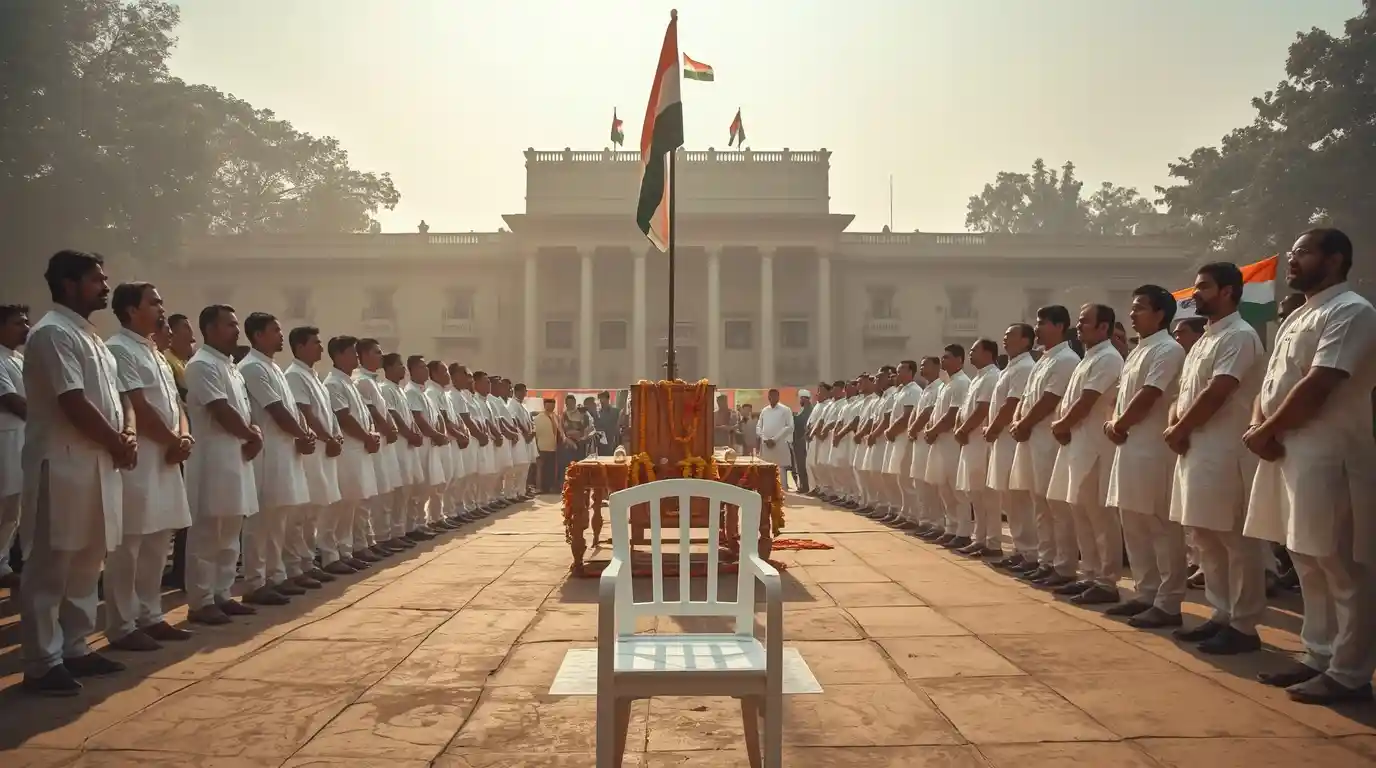
The Vande Mataram row now running through Indian politics turns on something unexpectedly small: a chair. On 15 August, footage from the Congress headquarters in New Delhi showed Sonia Gandhi leaning across and gesturing while the national song was being sung at the party's Independence Day function. The BJP read that gesture as an instruction to party president Mallikarjun Kharge to cut the rendition short. The Congress says she was asking workers to bring Kharge a chair, because he had been standing for a long stretch.
Within a day, a few seconds of party-lawn video had reached a rally stage 600 kilometres away. Union Home Minister Amit Shah, speaking at Chittorgarh in Rajasthan on 16 August, aimed directly at the Congress Parliamentary Party chairperson. He told the crowd that 140 crore people were watching her, and that the sin she had committed would never be forgiven. He also reminded them that thousands of Indians once faced bullets, lathis and prison for singing those two words.
What makes this land so hard has almost nothing to do with a chair. It has to do with an argument that is nearly 90 years old, and with an anniversary campaign the BJP has been building since late 2025. Knowing both is the difference between watching a viral clip and understanding what the two sides are actually fighting over.
What happened at the Congress office
The AICC headquarters holds a flag-hoisting every Independence Day, and the national song is part of it. The clip that spread online is short and, like most short clips, cuts off the seconds that would settle the question. Congress leaders have flatly denied any attempt to stop the singing and have stuck to the chair explanation. The BJP has refused to accept it, and has widened the demand: not just Sonia Gandhi, but Kharge and Rahul Gandhi too should apologise to the country.
Why the Vande Mataram row keeps returning to 1937
Both sides know the real fight is historical. Bankim Chandra Chattopadhyay wrote the poem in 1875 and later placed it inside his novel Anandamath. It became a chant of the freedom movement long before anyone thought about which lines to sing. The trouble started when the Congress had to decide what an official public rendition should sound like.
The two stanzas that became the standard
In 1937, the Congress Working Committee settled on singing only the opening two stanzas at national gatherings. That decision carried the weight of Mahatma Gandhi, Jawaharlal Nehru, Subhas Chandra Bose and Maulana Abul Kalam Azad behind it. Nearly nine decades on, that shortened version is still what most Indians hear at school assemblies, government functions and party events — including, this year, at the Congress headquarters.
The verses that were left out
The later stanzas describe the motherland in explicitly devotional terms, invoking Durga and Lakshmi. In the 1930s that imagery was the reason Muslim League leaders objected to compulsory singing, and the reason the CWC trimmed it. The BJP's argument today is that trimming the song weakened it and set a template for appeasement. The Congress replies that the committee was following the advice of its own tallest leaders, in a country it was trying to keep together.
Shah was not the only one demanding an apology
The pile-on was fast and unusually broad. West Bengal Chief Minister Suvendu Adhikari, who took office in May after the BJP's assembly win, called it an insult to nationalism and to Bankim Chandra Chattopadhyay himself, and accused the Congress of appeasement politics. Sumitro Chatterjee, a BJP MLA and a descendant of the writer, asked for an unconditional apology. In Mangaluru, BJP leader Vikas Puttur filed a police complaint at Urva station citing the Prevention of Insults to National Honour Act.
Thousands of people faced bullets and lathis and were jailed for singing Vande Mataram.
The Parliament debate that set this up
None of this arrived out of nowhere. The song turned 150 in 2025, and the Union Cabinet decided to mark it as a national celebration. The BJP ran programmes at 150 locations that November, and the Prime Minister released a commemorative stamp and coin. On 8 December, Narendra Modi opened a special discussion on Vande Mataram in the Lok Sabha, with the Rajya Sabha following two days later. He argued there that Nehru and the Congress had broken the song in the 1930s to accommodate the Muslim League. Congress leader Jairam Ramesh said the whole exercise was designed to discredit Nehru.
What to watch over the next few weeks
Three things are worth tracking. Whether the Mangaluru complaint becomes an FIR, given that Karnataka has a Congress government and the case is a BJP filing. Whether more complaints follow in BJP-run states, which is how these things usually scale. And whether the Congress quietly starts singing the fuller version at official events, which would be an admission it cannot afford but may find easier than repeating the 1937 defence every time.
For readers, the practical bit is simpler. If the clip lands in your family WhatsApp group, check whether the version you're watching includes the moments before and after the gesture — most circulating copies don't. And when someone tells you the Congress cut the national song, the accurate version is that a committee in 1937 chose two stanzas over five, with Gandhi and Nehru signing off. That is a real decision worth debating. It is not the same claim as the one being made about a chair.


Comments 0