

Minimal Style Kitchen Appliances Are Losing Their Handles
Fisher & Paykel's 2026 range strips ovens, cooktops and dishwashers down to flush glass and stone — and quietly shifts the hard work onto the cabinetry around them.

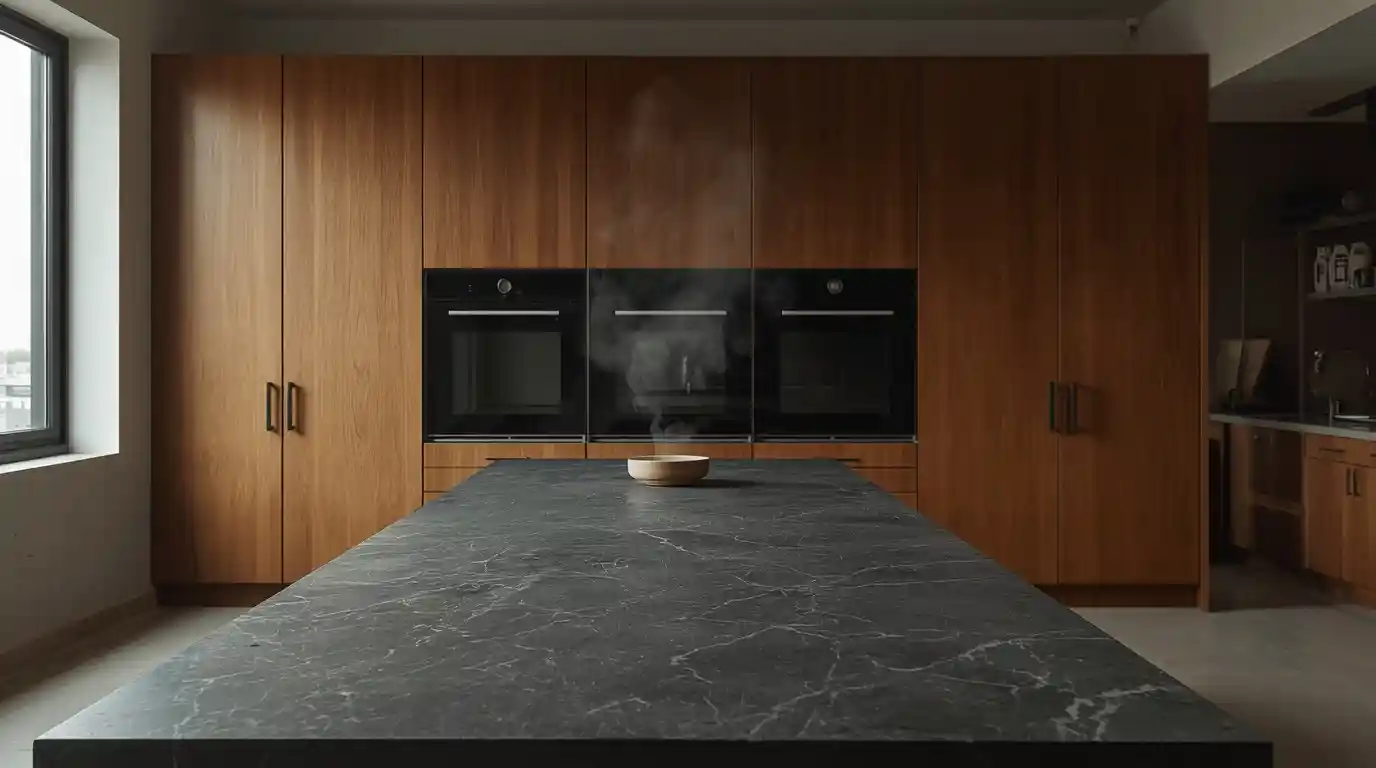
Fisher & Paykel has spent years arguing that Minimal Style kitchen appliances should be the quietest object in the room, and its 2026 range pushes that argument about as far as it will go. Ovens with no handle to grab. Glass fronts in one flat black or grey. Dishwasher drawers faced in 20mm slabs of stone so they read as cabinetry, not machinery. Dezeen covered the line-up this week.
The number to hold onto is 450. That's the square metreage of the installation the New Zealand brand built in Milan in April, at EuroCucina inside Salone del Mobile, to launch the range globally. It was called Nature—Ritual, it sat in Hall 4P, and the whole thing was made from essentially two materials: tōtara, a native New Zealand timber, and volcanic basalt.
That matters to a reader in India for a simple reason. Every modular kitchen showroom from Andheri to Whitefield is now selling "handleless" and "flush-fitted" as the premium upgrade. This range is the pure version of that idea — and it makes very clear that the appliance is only half the job. The rest lands on whoever builds your cabinets.
What Fisher & Paykel Actually Showed in Milan
The centrepiece is what the company calls its State of the Art Collection. Named products include the Series 11 60cm ovens, which have already picked up a Red Dot 'Best of the Best' award, and a 30-inch oven with steam assist that made its debut in Milan. There's also a 61cm integrated column wine cabinet, a fabric care cabinet, a modular induction cooktop that sits flush with the worktop, and the brand's DishDrawer dishwashers.
Chief executive Daniel Witten-Hannah framed it as design tied to place rather than trend. The exhibition itself was designed by Dean Poole of Alt Group, who described the intent plainly.
It distils the qualities of untouched forest and a deep understanding of life in the home into a warm, tactile minimalism, expressed through just two materials.
How Minimal Style Kitchen Appliances Disappear
Fisher & Paykel sells three visual families — Minimal, Contemporary and Professional. Contemporary uses stainless doors and signature handles. Professional borrows from commercial kitchens: heavy steel, continuous grates, deliberate bulk. Minimal is the opposite instinct. It removes contrast instead of adding it. Here is what that actually involves.
Flush fronts and hairline gaps
The appliance sits level with the cabinet face rather than proud of it, with only a very slight perimeter gap around each door. Get it right and the eye reads a continuous wall. Get it wrong by two or three millimetres and the error is the first thing anyone notices, because there's no handle or steel bezel to distract from it.
Glass doors with nothing to grab
The handleless combi-steam oven is the clearest example — a sheet of dark glass that opens on touch or a push mechanism. Azure magazine noted that handle and handle-free versions both exist in the collection, so this isn't all-or-nothing. But the handleless variant is the one carrying the design argument.
One palette, no visual noise
Everything runs in a single colour family, black or grey, with texture doing the work that contrast usually does. That's why the dishwasher drawers get 20mm stone fronts. The machine stops looking like an appliance and starts looking like part of the island.

Does This Suit the Way Indians Cook?
Partly, and honestly. Flush glass surfaces and high-heat Indian cooking are not natural friends — tadka spatter, pressure-cooker steam and daily deep-frying all show up faster on a matte dark front than on brushed steel. Budget properly for extraction; a strong chimney matters more here than it does in the Milan showroom.
The DishDrawer, though, is a genuinely good fit. Two independent drawers mean you can run a half load of steel thalis after lunch without waiting to fill a full-size machine — closer to how most Indian households actually wash up. Fisher & Paykel, founded in New Zealand in 1934 and now part of the Haier group, sells through dealers in India and lists its kitchen range on an Indian site, but it does not publish India pricing. Expect landed cost, duty and installation to be quoted per project.
What to Check Before You Commit
- Cabinet tolerance in writing. Ask your fabricator what gap variance they guarantee — flush installation is unforgiving.
- Service reach. Confirm there's an authorised technician in your city, not just a dealer.
- Stone fronts add serious weight. Your carcass hinges and runners must be rated for it.
- Touch-open doors need clearance. Check the swing against your island overhang before sign-off.
If you're specifying a kitchen this year, the useful takeaway isn't the brand — it's the sequence. Pick the appliances before the carpentry, not after, because flush fronts are a cabinetry decision disguised as an appliance decision. Watch for India availability and pricing to firm up over the next few quarters as the 2026 range rolls out beyond Europe.



Comments 0