

What Passive Cooling Design Does to Your Power Bill
Six new Australian homes bend, screen and breathe their way out of the heat — and India already has the rulebook to do the same, only nobody has to follow it.

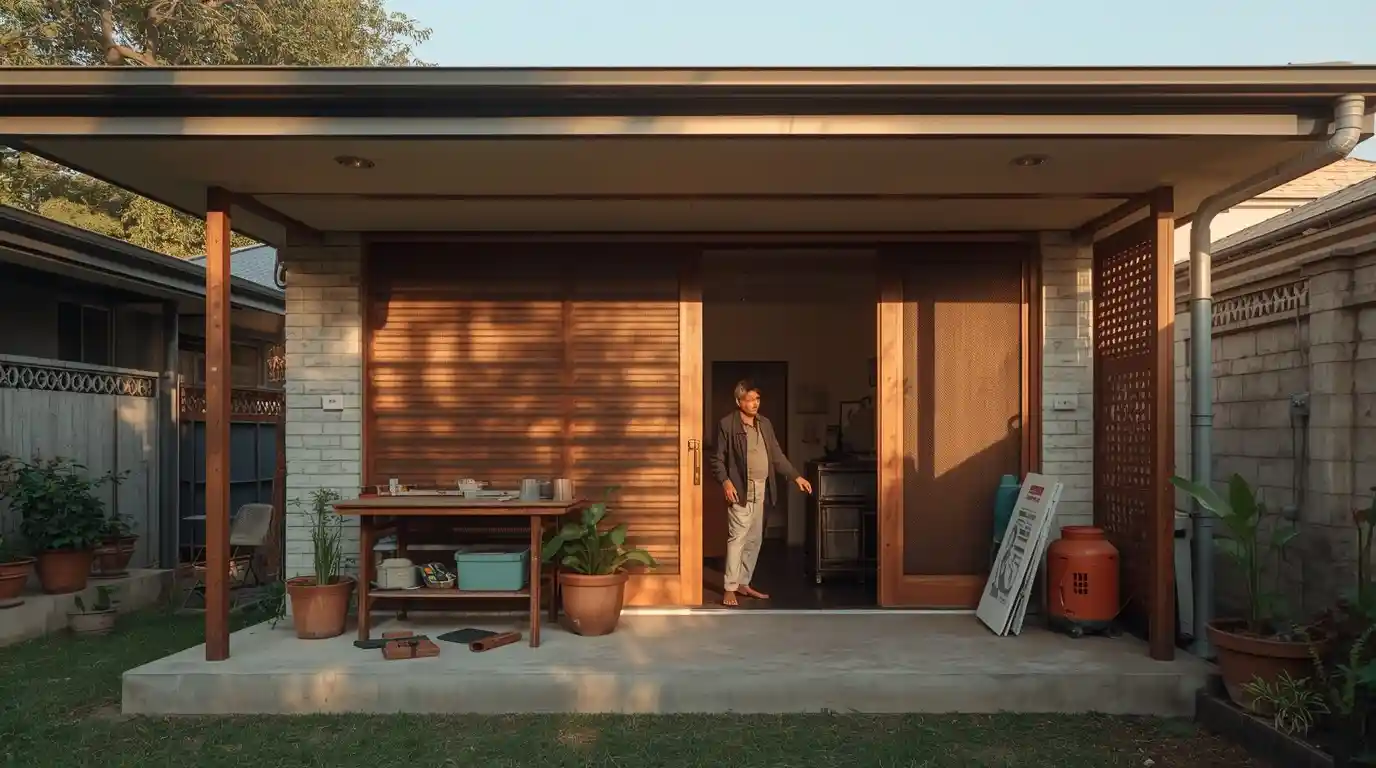
For most Indian homebuyers, passive cooling design sounds like something an architect adds once the marble has been picked — but it is the one decision that sets how hard your air conditioner works for the next thirty summers. A group of new Australian houses, collected in a recent roundup by the design site designboom, makes that case in brick, timber and curved glass rather than in a consultant's slide deck.
The six projects share a single refusal: not one of them is a plain box. Terabithia House in Northbridge, Sydney, by CplusC Architectural Workshop, is built on circles — curved windows, corbelled arches, a spiral stair — from recycled brick and reclaimed timber, with a butterfly-shaped rooftop solar array and twin rainwater cisterns feeding automated irrigation. In Brisbane, Peter Besley's Birdwood House sits behind a tall screen of salvaged foundry bricks that filters sunlight while letting breeze pass.
So why should someone house-hunting in Pune or Kochi care? Because Australia has already done the unglamorous, decisive thing. Since October 2023 its National Construction Code has required most new homes to reach 7 stars on the national house energy rating scheme, up from 6, plus a whole-of-home energy score of 60 out of 100. India has a comparable code on the books. It simply isn't compulsory.
Six Houses That Fight Heat With Shape
ioa studio's Front House Back House in Seddon, Melbourne, stacks two dwellings for intergenerational living under a wave-like roof, with exposed brickwork doing the thermal-mass work. Carter Williamson Architects turned disused garages in Sydney's inner west into Denj Lane, its volume sculpted to catch low winter sun from the north. FIGR Architecture Studio's Ha Ha Haus in Alphington wraps charred timber around a courtyard that draws breeze through the plan and funnels rain into storage. Curious Practice's Aru House in Newcastle — named from the Awabakal word for insect — spreads open in summer and retreats to an insulated core in winter behind operable spotted gum screens.
Why Australia Rewrote Its Building Rulebook
The star jump was not a gesture. States phased it in over roughly eighteen months — New South Wales from October 2023, the ACT from January 2024, Victoria and Queensland from May 2024, South Australia that October, Western Australia in May 2025. Apartment buildings must average 7 stars with no single flat below 6. In practice that forces thicker insulation, better glazing and floor plans arranged around sun and wind instead of around the biggest possible living room. designboom argued the results offer a "vital blueprint for international architecture" as Europe and North America grind through record heat.

Where Passive Cooling Design Stands in India
India is not starting from zero here. The technical groundwork was laid years ago, and much of it borrows from building traditions the country abandoned in the rush to glass towers — courtyards, jaalis, deep chajjas, heavy walls. The gap is enforcement, not knowledge.
The Code Nobody Mentions at the Sales Office
The Ministry of Power launched Eco Niwas Samhita in 2018, developed through the Bureau of Energy Efficiency, as the residential arm of the energy conservation building code. Its first part governs the building envelope and turns heat gain into a measurable number called RETV — the net heat entering through walls and windows over the cooling season, divided by envelope area. It also sets floors for daylight and natural ventilation. The 2024 edition folds in equipment and renewables.
Why a Voluntary Rule Stays on the Shelf
Adoption runs through state governments, and the code remains largely voluntary. A developer optimising for saleable carpet area and a launch price has little reason to volunteer for a thermal calculation nobody in the queue is asking about. In Australia, by contrast, an assessor signs off the rating before approval, so the cost of getting it wrong lands on the builder rather than on whoever pays the electricity bill later.
What to Check Before You Book a Flat
You will not get a star rating in an Indian brochure, so the checking falls to you. Five things separate a flat that stays liveable from one that runs its compressor from March to October:
- Which way the bedrooms face — a large west-facing window is the most expensive glass in an Indian summer.
- Cross-ventilation: can you open windows on two different walls of the same room and feel air move?
- Shade before glass — chajja depth, recessed balconies and external louvres beat any coating on the pane.
- The roof, if you are buying on the top floor. Ask what insulation or reflective finish is going on it.
- Floor-to-ceiling glazing in Nagpur, Ahmedabad or Hyderabad is a heater with a view.
What Happens Next
Two things are worth watching. One is whether more states notify Eco Niwas Samhita as mandatory rather than aspirational. The other is the trend line on cooling: industry trackers put Indian room-AC sales in the low teens of millions of units a year, with fewer than one in ten households owning one — which means most of the demand hasn't arrived yet. Every badly shaped building finished this year locks that load in for decades.
If you are buying or building, ask your developer or architect one question: what is the RETV of this envelope? A good passive cooling design will have an answer ready. Blank stares tell you what you need to know — and a 1.5-tonne split AC, plus the running cost of feeding it every summer, is what that silence eventually costs you.


Comments 0