

Ontario Data Centre Requests Now Equal Seven Ottawas
Queen's Park says new data centres must pay full price for power and recycle their own water, just as Ontario towns start voting to shut them out entirely.

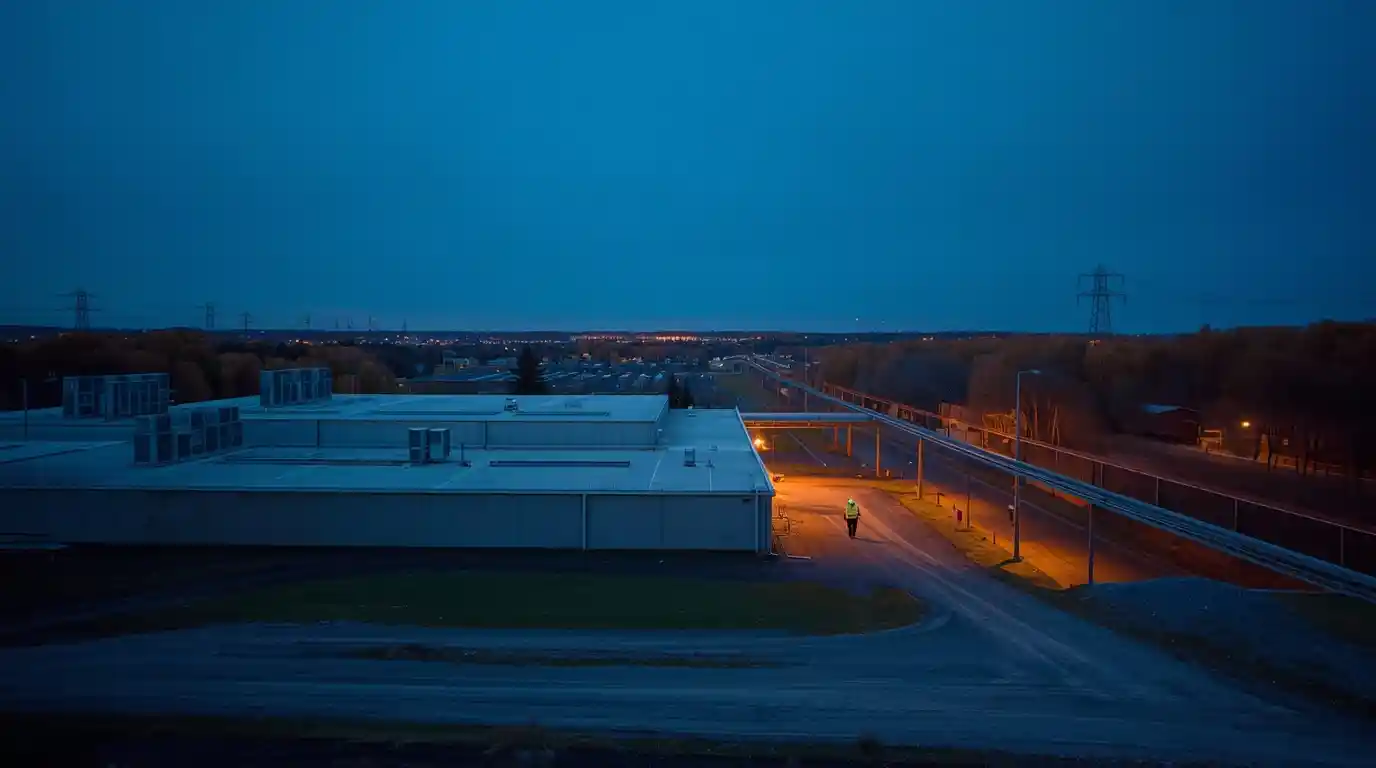
The queue of Ontario data centre projects waiting to plug into the provincial grid has roughly doubled since March, and it now sits at about 7,000 megawatts. To put that in plain terms: it's more than a quarter of the roughly 25,000 megawatts the province draws on its heaviest days, and it's about seven times the electricity demand of the entire city of Ottawa. That figure comes from the Independent Electricity System Operator, the agency that keeps the lights on.
That number is why Premier Doug Ford stood up in Guelph on Thursday with a framework for who gets to build in this province and on what terms. The short version: you're welcome here, but you're paying for it yourself. New facilities will cover the full cost of the power they consume, sit in a new rate class priced above what other large industrial customers pay, and receive no cash from the treasury to sweeten the deal.
The timing wasn't a coincidence. Two days earlier, Oakville became the first municipality in Ontario to hit the brakes, passing a one-year pause on data centre construction. Mississauga councillors vote on their own pause in September, and Toronto and Hamilton had already pushed Queen's Park for clearer rules. Ford's answer was blunt — he called the local bans hypocritical, and compared them to classic NIMBYism.
What the Ontario Data Centre Rules Actually Say
The province built its framework on three stated pillars: economic development, data protection and digital sovereignty, and community investment. Ford framed the sovereignty piece as keeping Canadians' data on Canadian soil rather than in American or foreign facilities — a pitch that lands differently in 2026 than it would have five years ago.
On the practical side, the rules push builders toward generating their own electricity rather than leaning on the shared grid. Cooling has to run on closed-loop systems that recycle water instead of consuming it. And approvals are meant to come with something for the neighbourhood — the province pointed to community centres, parks and road work. What Ontario will offer is help cutting through permits, not a cheque.
If any data centre thinks they're coming into Ontario and getting a freebie: not happening.
Why 7,000 Megawatts Is Such a Big Number
Connection requests aren't the same as buildings. Developers file speculative applications, shop several provinces at once, and many projects quietly die. But the doubling since March is the part worth watching, because it happened in roughly five months. Figures cited by The Canadian Press put data centres at about 13 per cent of all new electricity demand in Ontario by 2035.
Ontario spent most of the past two decades with surplus power and, at times, paid neighbouring jurisdictions to take it. That era is over. Electrified vehicles, new factories and heat pumps were already adding load. A single hyperscale campus can draw as much power as a mid-sized city, and unlike a factory, it runs flat out at 3 a.m. on a Sunday.

Why Ontario Towns Are Hitting Pause
Oakville Moved in a Single Day
Oakville's council passed its interim control bylaw unanimously at a special meeting on Tuesday afternoon — the motion had only been tabled the day before. That speed tells you how little appetite there was for a drawn-out debate, and interim control bylaws are the standard municipal tool for freezing a land use while planners write proper rules.
Mississauga Votes in September
Mississauga councillors have asked for their own one-year pause, with the decision landing next month. If it passes, two of the largest municipalities in the Greater Toronto Area will be closed to new builds at the same time the province is telling investors Ontario is open.
What Residents Keep Raising
The objections aren't abstract. Residents have asked for hard numbers on noise from cooling equipment, water use, waste heat and air quality from backup generators. Underneath all of it is a simpler worry: that a handful of enormous customers will strain the grid and push everyone else's utility bills up.
What This Could Mean for Your Hydro Bill
The separate rate class is the piece that matters most to households. In principle, it means the cost of new transmission lines and generation built for these facilities lands on the facilities, not on the person paying a monthly bill in Guelph or Windsor. That's a meaningful commitment, and it's the opposite of the subsidy race some U.S. states have run.
The caution: a framework is not a tariff. Nobody has published what the new rate class costs per kilowatt-hour, how "full cost" gets calculated, or what happens if a project builds its own generation and then wants grid backup on the worst day of winter. Those details decide whether ratepayers are genuinely shielded. Ontario also passed legislation last year letting the energy minister prioritize and approve large connection requests, so a lot of discretion sits in one office.
What to Watch Over the Next Few Months
Three things will tell you whether this framework has teeth. Watch the September vote in Mississauga, and whether other councils in Halton, Peel and Waterloo Region follow. Watch for the actual rate-class filing and how it's set. And watch the IESO's next connection queue update — if 7,000 megawatts becomes 10,000 by winter, the pressure won't ease. If you live near a proposed site, your council's planning agenda is the document that decides it, not the premier's podium.



Comments 0