

The Bullet Hit the Floor First: Varanasi Airport Firing
A passenger did everything the rulebook asks — declared his licensed pistol and 21 cartridges — and a single round still ricocheted off the terminal floor into two screeners.

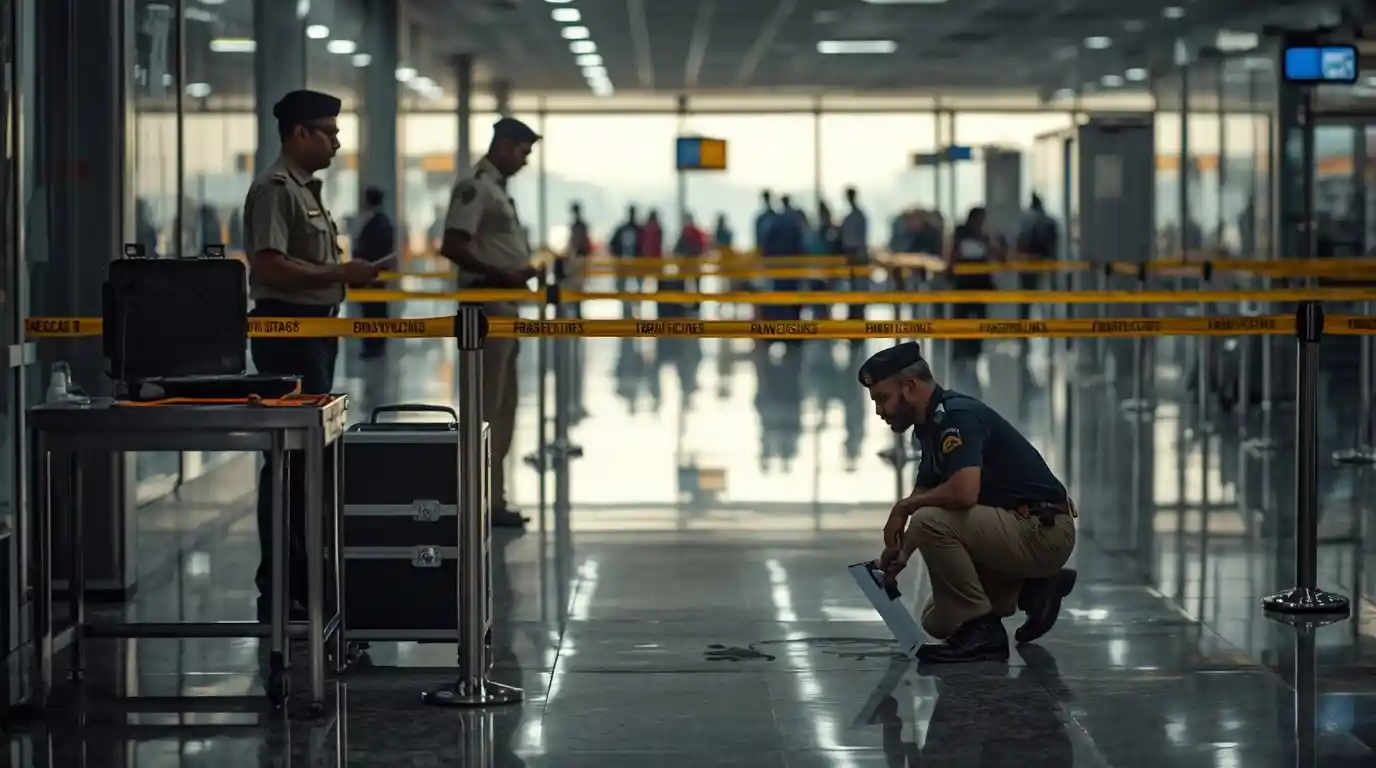
The Varanasi airport firing on Sunday morning was over in about a second, and nobody was aiming at anyone. Around 9.30 am on 16 August, a round went off from a passenger's licensed pistol during the mandatory weapons check at Lal Bahadur Shastri International Airport. The bullet struck the floor, bounced, and hit two screening staff standing nearby. Both were taken to hospital and are stable.
The passenger was Kamlesh Kedarnath Rai, a resident of Azamgarh, travelling to Mumbai with his wife on Air India Express flight IX 1810. Here is the part that has aviation officials uncomfortable: Rai did what the rules ask. He declared a licensed 7.62 mm pistol and 21 live cartridges at the check-in counter. That declaration is precisely what sets off the hands-on inspection where the weapon discharged.
So this was not a smuggling case or a security breach in the usual sense. It was a paperwork-compliant passenger, a legal firearm, and a handling procedure that went wrong at the counter. The Bureau of Civil Aviation Security has begun examining whether the prescribed drill for handling declared weapons was actually followed. Rai has been detained by police.
How One Round Injured Two People
The two injured are screeners employed by AAICLAS, the Airports Authority of India subsidiary that provides ground and screening services at several Indian airports. Rohit Raj was hit in the thumb; Suman Kumari was hit in the foot. Both were taken to the New Laxmi Trauma Centre in Varanasi. Early reports differed slightly on the exact wounds, but every account agrees neither injury is life-threatening.
Airport Director Puneet Gupta described what happened in blunt terms.
During the weapons check, the passenger fired a round, injuring two AAICLAS screeners.
Remarkably, the terminal kept running. Flight IX 1810 left for Mumbai roughly 14 minutes behind schedule, according to FlightRadar24 data cited by Aviation A2Z, and airport operations were not suspended. That is a sharp contrast with a comparable incident at Atlanta's Hartsfield-Jackson airport in 2021, where an accidental discharge during screening triggered a stampede and briefly halted departures, as NBC News reported at the time.
What the Rules Say About Flying With a Gun
Most Indians never think about this, but carrying a licensed firearm on a domestic flight is legal and fairly common among licence holders travelling between states. The rules are strict, and the failure point is almost always the same: the few minutes when the weapon is out of its case and in human hands.
You declare it at check-in, not at the gate
The declaration happens at the airline counter, with the licence and supporting documents produced there. Airlines generally want advance notice too. Once declared, the weapon goes for verification — the step that failed at Varanasi. There is no version of the rules where a firearm travels quietly and unannounced.
Unloaded, locked, and in the hold
The firearm must be completely unloaded and packed in a locked, hard-sided container that travels as checked baggage. Ammunition is stored separately. Carrying arms or ammunition into the terminal's secure area or the aircraft cabin is banned outright under Indian aviation law.
The 50-cartridge ceiling
A passenger may carry one licensed revolver, pistol or shotgun with up to 50 cartridges in registered baggage, after paying the applicable handling charge. Rai's 21 cartridges were well inside that limit. Being within the rules on quantity, though, tells you nothing about whether the weapon was safe at the moment it was handed over.

What the Varanasi Airport Firing Probe Must Answer
The central question is simple and awkward: how was there a live round in a position to fire during a check that only happens after a weapon is supposed to be unloaded? Investigators will want to know who was holding the pistol when it went off, whether a clearing procedure was followed, and whether the inspection point had any backstop or safe direction for exactly this scenario.
The Ministry of Civil Aviation has said that appropriate action will be taken based on the findings. Expect the outcome to land on procedure rather than on any single person — a revised standard operating drill for declared-weapon checks, possibly a designated clearing station away from public areas.
If You're Flying With a Licensed Weapon
- Unload the weapon and physically check the chamber before you leave home, not at the counter.
- Keep ammunition in a separate container, never loose in a bag or a pocket.
- Use a locked, hard-sided case; soft pouches get rejected.
- Carry the original licence plus copies, and budget for the handling fee.
- Reach the airport well ahead of the usual cut-off — verification takes time.
- Never handle the firearm yourself once you are inside the terminal unless a staff member specifically asks you to.
Watch for the BCAS findings over the next few weeks. If they lead to a rewritten drill for weapons checks, licence holders will feel it first — probably as a longer, more supervised process at the counter. That's a small price for a morning that could easily have ended much worse.




Comments 0