

The Solar Eclipse Glasses That Arrived a Day Too Late
Britain's last-minute hunt for eclipse eyewear ended in sold-out shops, five-per-person rationing and delivery dates that landed after the Sun had already been covered.

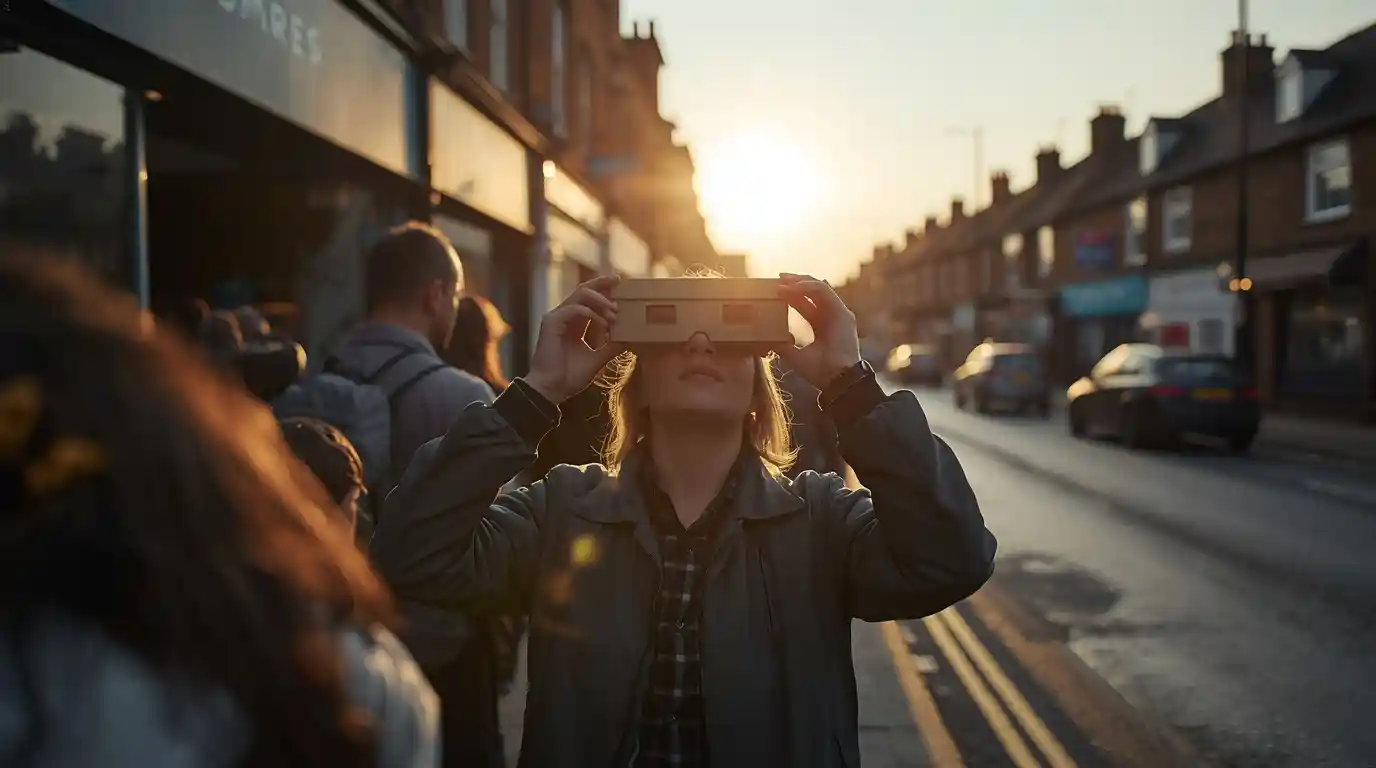
Britain's frantic hunt for solar eclipse glasses ended the way a lot of panic orders do — with a delivery estimate that landed after the thing you bought them for. Shoppers checking Amazon UK on the eve of Wednesday's partial eclipse found Lunt-branded filters at £14.99 showing an arrival date of 13 August. That is the morning after the Moon had already slid across the Sun and moved on.
The Royal Observatory Greenwich, the obvious first stop for anyone in the South East, said it had cleared out both online and in its shops because of what it called an unprecedented volume of orders. What stock remained in Greenwich and at the National Maritime Museum was rationed to five pairs per customer on the Tuesday and Wednesday. Robert Dyas had Bresser specs listed at £2.99 — out of stock.
This mattered because the eclipse was not a minor one. More than 90% of the Sun was covered from the UK between roughly 6.17pm and 8.06pm BST, the deepest bite taken out of a British sky since the total eclipse of August 1999. Cardiff topped the table at 93.2%, with Belfast on 93.1%, London and Glasgow on 91.4% and Edinburgh on 90.7%. The next one this good over Britain is in 2081.
What Actually Sold Out, and Where
The Guardian described a hunt that had gone slightly feral by Tuesday: WhatsApp threads passing round tip-offs about which branch had a box out back, queues forming at museum shops, and quiet restocks treated like trainer drops. One reader, Emma from Tonbridge in Kent, said an optician's assistant simply put the phone down on her when she asked whether they had any. Bookshops, camera shops and hardware chains told the same story.
Why Solar Eclipse Glasses Sold Out So Fast
The shortage was not really a supply problem. It was a timing problem, and a very British one — millions of people deciding on the same Monday that they should probably sort this out.
One Stargazer Brought In 300,000 Pairs
Neill Sanders, who runs Go Stargazing and coordinates Astronomers Without Borders in the UK, imported 300,000 pairs from the United States ahead of the event and pushed around 100,000 of them out to astronomy clubs at discounted prices. Even so, spread across a country of 68 million, that is barely one pair for every 220 people. The phone did not stop.
I'm getting loads of calls, text messages, emails with people asking 'Do you have some glasses?'
Everyone Ordered in the Same Week
A distributor told the Guardian the filters existed — what collapsed was the ability to pick, pack and post them once orders arrived in one enormous last-minute wave. Warehouses can absorb steady demand for months. They cannot absorb a nation remembering on a Sunday night. Buyers who ordered in July paid £2.99 and got theirs; buyers who ordered on Tuesday paid five times that and missed it.
The Eye Damage That Shows Up Days Later
If you did sneak a look without proper filters, the risk is not theoretical. After the 1999 eclipse, the Royal College of Ophthalmologists logged around 70 people reporting vision problems, and roughly 40% of them had looked for less than a minute. The retina has no pain receptors, so nothing hurts at the time. Symptoms — a blurred or missing patch in the centre of your vision, washed-out or shifted colours, straight lines that bend — can take hours or days to surface. If that describes you, book an optician or see your GP rather than waiting to see if it settles.
Don't Throw Your Pair in the Bin
Anything carrying the ISO 12312-2 mark does not expire. Filters made to that standard stay usable more or less indefinitely, and specialists generally say a decade is a sensible working life, provided the lenses are intact. So the pair you queued for is an asset, not litter.
- Hold them up to a bright bulb first — scratches, pinholes or a lens peeling away from the frame means bin them.
- The lenses can't go in kerbside recycling, according to Euronews. Pop them out, recycle the cardboard frame, discard the film.
- Better still, donate: libraries, museums and schools run collection schemes that send lightly used pairs to countries with eclipses coming up.
The Next Ones Worth Booking Time Off For
Wednesday's totality never touched Britain — the shadow ran over the Arctic, Greenland, Iceland, the Atlantic, northern Spain and a sliver of north-east Portugal. The next serious one is 2 August 2027, when a total eclipse crosses Egypt with more than six minutes of darkness, followed by Australia and New Zealand on 22 July 2028.
Keep your glasses flat inside a hardback book and put 2027 in the calendar now. If you missed out entirely, watch for the post-eclipse clearance — unsold stock tends to go cheap within a fortnight, and £3 spent this month beats £15 and a delivery slot you can't use next time.
Comments 0