

The Village Has 130 People and a 182-Foot Virgin Mary Statue
Poland's new record-holder cost around 100 million zloty, went up in 18 months, and towers over a hamlet with barely enough people to fill a school bus.

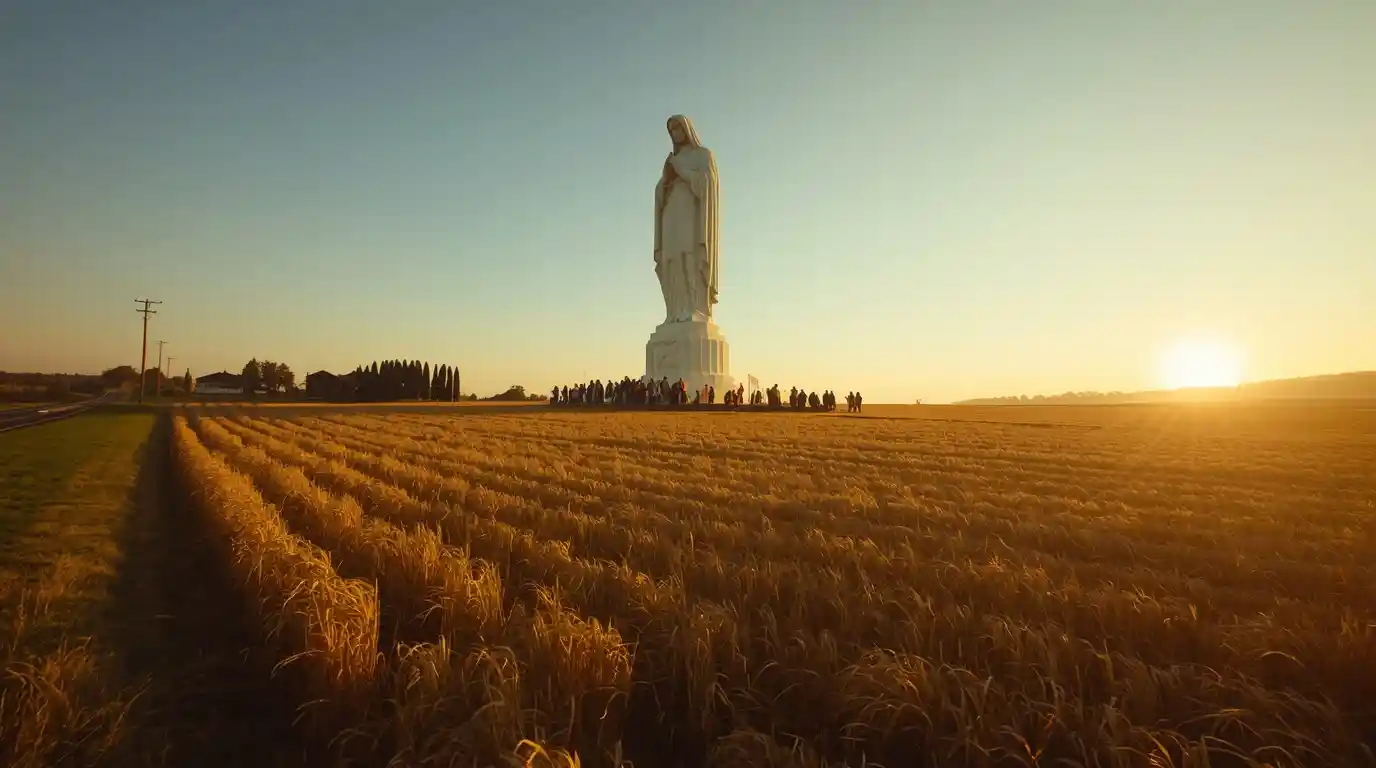
The new Virgin Mary statue in Konotopie, a farming hamlet in central Poland, rises 55.6 meters — about 182 feet — from its base to the top of its crown, and since August 15 it has been the tallest religious statue standing anywhere in Europe. Clergy blessed it on the Feast of the Assumption while helicopters scattered rose petals over a crowd of thousands.
Konotopie has roughly 130 residents. No cathedral, no tourist strip, no famous shrine — just flat farmland in the Włocławek diocese, out toward the city of Toruń. The monument clears Rio de Janeiro's Christ the Redeemer, pedestal included, by nearly 18 meters, according to Notes From Poland, and it comes with a free public observation deck 15 meters off the ground.
Here's an American yardstick. The Statue of Liberty, from her sandals to the tip of the torch, is about 151 feet of copper. The figure in Konotopie is taller than that by roughly 30 feet, though Liberty's granite pedestal still puts her higher overall. And unlike Liberty, which was a gift between nations, this one was paid for by a single married couple who live nearby.
What the Virgin Mary Statue Cost, and Who Paid
Roman and Grażyna Karkosik commissioned it. Roman Karkosik is one of Poland's better-known industrialists, the majority shareholder behind Boryszew SA, Impexmetal and Alchemia — companies that work in metals, chemicals and car parts. Forbes valued him at $1.8 billion back in 2007. Notes From Poland reports the build ran to around 100 million zloty, roughly €23.2 million, which lands near $27 million at current rates.
Split that across the village and you get roughly $208,000 of statue per resident. The couple have framed the project as an act of thanks to God rather than a business plan, but the region is plainly hoping for pilgrims, and local investment interest has already picked up. Bishop Krzysztof Wętkowski of Włocławek led the inauguration; former president Lech Wałęsa, now 82, was in the crowd.
18 Months of Work and Molds Shipped From Italy
Adam Jakub Matejkowski designed the figure. Construction started in March 2025 and took about 18 months, which is quick for something this size, and the pace shaped the engineering. One detail captures the scale better than the height does: the molds used to form the statue had to be manufactured in Italy, because no Polish supplier could make them.
How It Stacks Up Against Rio and the Rest
Height claims around religious monuments get slippery fast, because some are measured with the plinth and some without, and nearly every project markets itself as a record of one kind or another. Konotopie's claim holds up, but only if you're precise about which record is being claimed.
Taller Than Rio, With an Asterisk
Christ the Redeemer's figure is about 30 meters, closer to 38 counting its pedestal. At 55.6 meters the Konotopie Madonna beats it on either measure. What it actually took was the European title, previously held by a Marian statue at Miribel in France — a record that had stood quietly for decades before this summer.
The World Record Is Still in the Philippines
The tallest Marian figure on the planet remains the Mother of All Asia — Tower of Peace, at 98 meters. Konotopie isn't in that conversation, and nobody involved has pretended otherwise. The claim is continental, not global, a distinction that went missing in a fair amount of the coverage this weekend.
Poland Already Had One of These
This isn't the country's first colossus. In Świebodzin, in western Poland, a Christ the King statue was finished in November 2010: a 33-meter figure reaching 52.5 meters with its crown and the mound beneath it. It turned an unremarkable town into a stop on the map, which is very likely the template the people behind this one are working from.
Why Build It Now, With Poland's Pews Emptying?
The timing is the strange part. Weekly Mass attendance in Poland — the dominicantes rate the Church's own statisticians publish — has hovered near 30% in recent years, down from roughly 45% two decades ago, and enrollment in school religion classes keeps sliding. So the country raised its largest sacred object at the exact moment fewer Poles are turning up on Sunday.
One reading is that private wealth now does what parishes and the state once did, and that a Virgin Mary statue is far easier to fund than a congregation. The other is that Marian devotion here runs deeper than attendance data captures. Jasna Góra in Częstochowa still draws walking pilgrims every August, decades into the same decline.
What to Know Before You Go
Entry is free, which is unusual for a monument that cost this much. The observation deck sits 15 meters up, so expect a view across the fields rather than a view from the crown. The nearest sensible base is Toruń, whose medieval old town is a UNESCO World Heritage site and works well as an anchor for a half-day trip out into the countryside.
Watch the next twelve months. Świebodzin's history suggests the opening summer is always the loud one, and the real test is whether coaches are still pulling into Konotopie in 2028. If a trip through central Poland is on your list, go early and go on a weekday — a village of 130 has no infrastructure for a crowd, and next August 15 will not be quiet.

Comments 0