

What Climate-Responsive Homes Do to Your Power Bill
Six new Australian houses swap the standard box for circles, curves and recycled brick — and the reason sits in the National Construction Code, not the design magazines.

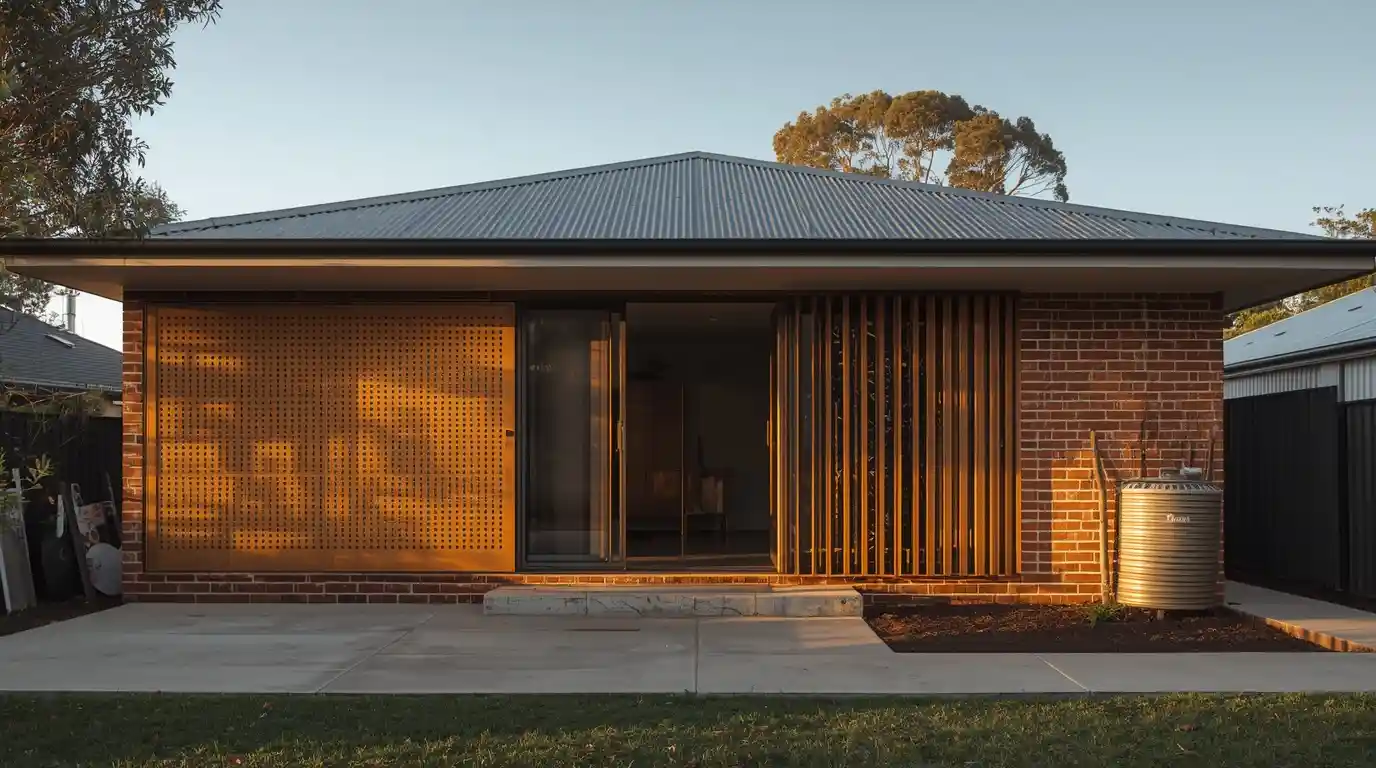
A new crop of climate-responsive homes across Sydney, Melbourne, Brisbane and Newcastle has quietly abandoned something Australian housing took for granted for decades: the rectangle. Design publication designboom pulled six recent projects together this month, and barely one of them is a box. There are circular floor plans, wave-shaped roofs, curved glass walls, and a facade screen made from bricks salvaged out of a demolished foundry.
It looks like architects showing off. It isn't. Every curve in these houses is doing a job — catching low winter sun without throwing the neighbours into shade, funnelling a summer breeze through the middle of the plan, or steering rain into a tank. The payoff turns up on the power bill. Running a reverse-cycle air conditioner costs the average Australian household close to $900 a year, according to comparison site iSelect.
That number is the entire argument. CSIRO has estimated that pairing thermal upgrades with electrified hot water and cooking can strip up to $2,200 a year off a household's energy costs. A house that stays liveable in February without the aircon grinding away is no longer a lifestyle flourish. It's the gap between a manageable summer quarter and one that hurts.
The six houses breaking the mould
What's striking is how different the six answers are, given they're solving the same problem. Sydney gets shade and glare control. Brisbane gets breeze. Melbourne gets thermal mass to ride out a 38-degree day followed by a cold night. The shared move is treating climate as the brief rather than an afterthought bolted on at the insulation stage.
- Terabithia House, Northbridge in Sydney, by CplusC Architectural Workshop — a circular plan, a butterfly-shaped rooftop solar array, and twin rainwater cisterns feeding automated irrigation.
- Front House Back House, Seddon in Melbourne, by ioa studio — a wave-like roof that harvests rain, sitting over a heavy concrete slab that holds the cool.
- Denj Lane, Sydney's inner west, by Carter Williamson Architects — curved glazing that grabs low northern winter sun without stealing the neighbours' light.
- Birdwood House, Brisbane, by Peter Besley — a screen of reclaimed foundry bricks that filters harsh sun while letting the breeze straight through.
- Ha Ha Haus, Alphington in Victoria, by FIGR Architecture Studio — a central courtyard that draws air into the core of the house.
- Aru House, Maryville in Newcastle, by Curious Practice — operable spotted gum screens that let the building change shape with the seasons.
Why the rules changed underneath all this
None of this is happening in a vacuum. The National Construction Code shifted the floor for new housing, and that shift is now law almost everywhere in the country. Architects didn't wake up one morning and decide corners were passé — the compliance bar moved, and the cheapest way to clear it turned out to be design rather than equipment.
What a 7-star rating actually asks for
New houses and townhouses now have to hit a 7-star NatHERS-equivalent thermal standard, up from the 6-star minimum that stood for more than a decade. There's a second test alongside it: a Whole of Home annual energy budget covering heating, cooling, hot water, lighting and pool pumps, which rooftop solar can help offset.
When your state switched over
The rollout was staggered. New South Wales moved first through aligned BASIX standards in late 2023, the ACT followed in January 2024, Victoria and Queensland in May 2024, South Australia that October, and Western Australia completed its adoption in May 2025. Tasmania and the Northern Territory have not fully adopted the residential energy provisions.
Why nothing changes again until 2029
Building ministers have paused further residential energy-efficiency changes to the code until at least mid-2029. That's unusually long, and it matters if you're planning a build. The standard you design to this year is the standard you'll still be designing to at the end of the decade — no moving target, no reason to wait.

What climate-responsive homes do to your bills
Savings depend heavily on where you live, because electricity rates aren't remotely uniform. Typical usage charges run roughly 25 to 28c per kilowatt-hour in the Northern Territory and parts of Tasmania and WA, 28 to 32c in Victoria and Queensland, 35 to 40c across much of New South Wales, and 42 to 46c in South Australia. The same kilowatt-hour you avoid is worth almost twice as much in Adelaide as in Darwin.
So a passive move that trims 1,500kWh of cooling a year is worth around $450 in Sydney and closer to $650 in Adelaide. That's the honest way to judge a design decision: not "is it sustainable" but "what does it return, in this postcode, every year, forever".
The catch with thermal mass
Heavy materials only help when the rest of the design cooperates. A concrete slab or brick wall left exposed to summer sun absorbs heat all day and radiates it into your bedrooms at 11pm — the opposite of what you paid for. Mass works when it's shaded through summer, hit by winter sun, and flushed with cool night air. Get the shading wrong and you've built a storage heater.
What to check before you build or renovate
Ask your builder or designer for the NatHERS certificate and read which side of the house the living areas face — north-facing living space with correctly sized eaves does more for comfort than any appliance you can buy later. Check whether openable windows sit on opposite walls, because cross-ventilation needs an exit as well as an entry. Ask what the eave overhang is in millimetres, and whether it was calculated for your latitude or just drawn.
Retrofitting any of this is expensive and disruptive, so the leverage is entirely at the drawing stage. If you're signing plans in the next twelve months, spend an extra hour on orientation, shading and window placement before you spend anything on finishes — it's the cheapest quarter you'll ever save.

Comments 0