

What the New LPG Production Targets Mean for Your Cylinder
A quiet August 13 government order tells 21 refineries and upstream firms to be ready to make nearly 70% of India's daily cooking gas at home — here's what it changes for households.

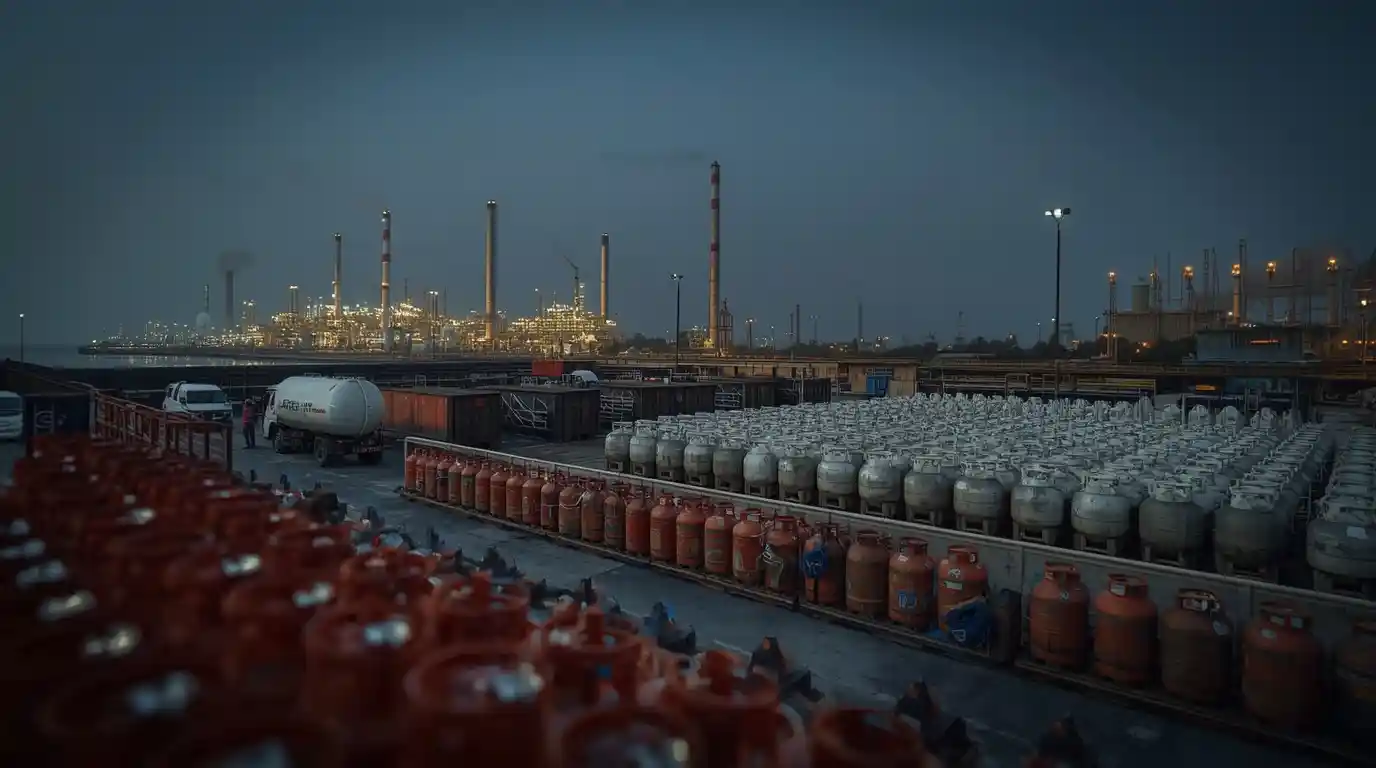
India's new LPG production targets landed on August 13 with almost no fanfare, and they ask the country's refiners to be ready to make close to double the cooking gas they averaged last year. The Petroleum and Natural Gas Ministry has named 21 refineries and upstream producers and told each one exactly how much LPG it must be capable of pushing out every single day.
Add those numbers up and you get 63,810 tonnes a day. India burns roughly 91,000 tonnes of LPG daily — about 33.2 million tonnes a year — so the order covers close to 70% of national demand from domestic plants alone. For comparison, refiners and gas processors actually produced around 35,900 tonnes a day in the financial year that ended in March 2026.
This matters in your kitchen because India does not make most of its own cooking gas. Roughly 64% of it arrives by ship, and according to ThePrint and Bloomberg, about 90% of those cargoes traditionally sailed through the Strait of Hormuz — the waterway that has been shut since late February. The order is essentially a standing instruction: if the sea route closes again, this is what the country can cook with.
Where the 63,810 Tonnes Would Come From
The ministry did not hand out one national number and hope for the best. It went plant by plant, splitting the load between private refiners, state-owned ones and the companies that pull gas out of the ground. The split tells you a lot about which assets India is actually leaning on when supply gets tight.
Jamnagar Carries the Single Biggest Load
Reliance Industries' domestic-tariff-area refinery at Jamnagar has been assigned 18,000 tonnes a day — more than a quarter of the entire national figure from one complex. Nayara Energy's Vadinar refinery, also in Gujarat, is down for 4,480 tonnes. Two private plants on the same stretch of Saurashtra coast therefore account for well over a third of the target.
Eighteen State Refineries Share 31,470 Tonnes
The public-sector refineries — the Indian Oil, BPCL and HPCL network spread across the country — carry a combined 31,470 tonnes a day between 18 sites. BPCL's Kochi refinery alone is set at 4,800 tonnes. Spreading the burden this widely is deliberate: it keeps supply close to consumers instead of forcing long rail hauls from one corner of India.
Oilfields and Gas Plants Add 6,460 Tonnes
ONGC, Oil India and GAIL are expected to contribute 6,460 tonnes a day from gas processing rather than crude refining. It's the smallest slice, but it's the one least exposed to imported crude — useful if a shipping disruption ever squeezes feedstock as well as finished cargoes.
How a Refinery Suddenly Makes More Cooking Gas
Refineries don't have an LPG dial. The order tells companies to take "all technically and economically feasible measures" — in practice, that means diverting naphtha, a feedstock normally sold to petrochemical plants, and reconfiguring catalytic crackers to throw off more propane and butane. Firms have also been told to expand storage, evacuation and transport capacity so the extra gas can actually reach bottling plants.
There's a real cost buried in that. Naphtha turned into cooking gas is naphtha not turned into plastics, packaging and fertiliser inputs. During the peak of the crisis, output climbed from about 36,000 tonnes a day to as much as 54,000 — proof the flexibility exists, and a reminder that it comes out of someone else's supply chain.

Why the New LPG Production Targets Matter Now
Since the Hormuz closure, Indian buyers have gone shopping in the United States and Algeria — voyages that take far longer and cost more than a short hop from the Gulf. Union Petroleum Minister Hardeep Singh Puri, writing in Outlook, said India expanded its supplier base from 27 countries to 41 over the past decade and lifted the share of energy imports bypassing Hormuz from 55% to 70%.
Not one of India's more than one lakh petrol pumps has run dry, no household has gone without cooking gas.
That holds so far. But keeping it true has meant rationing at the edges: refill booking windows stretched to 25 days in cities and 45 days in rural areas, commercial supplies capped at 70% of normal allocation, and a delivery-code system to stop subsidised domestic cylinders leaking into restaurants and shops.
What It Costs, and What You Actually Pay
Here's the number most households never see. At import-linked rates a 14.2 kg cylinder would cost upward of ₹1,600, yet an Ujjwala beneficiary still pays ₹642. The government absorbs roughly ₹900 on each of those cylinders and close to ₹600 on every other household refill. State-owned retailers pushed through four consecutive price increases in May 2026 after concluding they could no longer swallow the whole gap.
Every extra tonne made in Jamnagar or Kochi is a tonne that doesn't have to be bought at a war-inflated international price. That's the quiet arithmetic behind the order — it's a subsidy-bill defence as much as a supply plan.
What to Watch Before the January Review
The targets aren't fixed forever. They get reviewed twice a year, in January and July, which makes this a permanent switch the government can flip rather than a one-off emergency measure. Watch the January revision: if the numbers go up again, it means Delhi still doesn't trust the shipping lanes.
For your household, the practical move is unglamorous. Book your refill early rather than waiting for the cylinder to run out, since the booking window is longer than it used to be. If piped natural gas is available in your locality, the switch now looks less like a convenience and more like insurance. And treat any promise of a cheap "commercial" cylinder as a red flag — the delivery-code checks are precisely what those diversions are meant to catch.




Comments 0