

What the Sugar Price Rise Adds to Your Diwali Sweets Bill
Retail sugar has crossed ₹52 a kilo just as festive buying begins, and the Centre has halved how long big industrial buyers can hoard it.

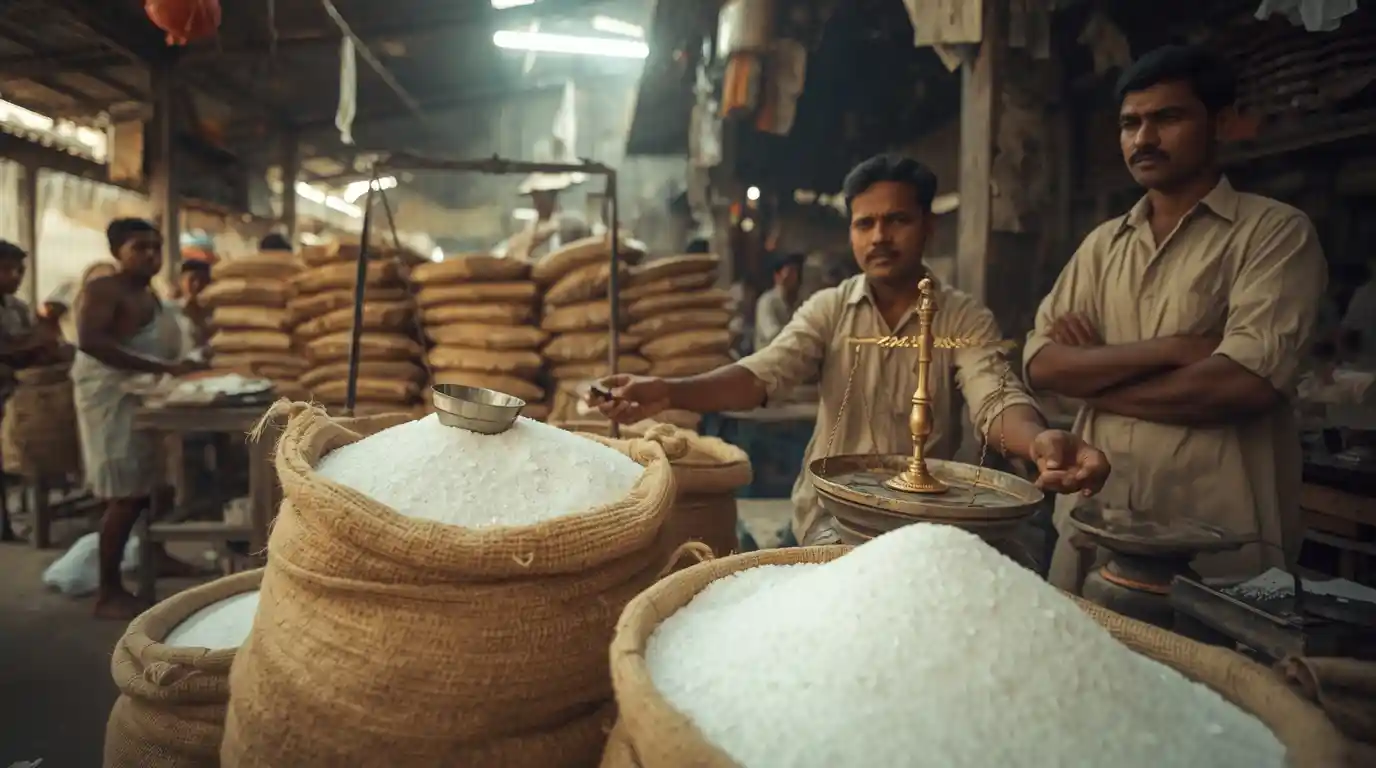
India's sugar price rise has pushed retail rates to about ₹52 a kilo, the highest the trade says it has seen, right as households begin stocking up for the festive stretch. Official price monitoring put the average retail rate at ₹52.30 a kilo on 18 August, against ₹46.34 twelve months earlier. That is roughly 13 per cent in a year. In Kolhapur and several other Maharashtra markets, shoppers are already handing over ₹55.
Two days later, Delhi moved. The Ministry of Consumer Affairs, Food and Public Distribution notified an order on 20 August halving how long big industrial buyers may sit on stock. Any bulk consumer using more than 10 tonnes of sugar a month can now hold no more than 15 days' worth, down from 30. The rule runs from 1 September to 30 November — almost exactly the window that covers Ganesh Chaturthi through Diwali.
Here is the part that doesn't add up at first glance. This isn't a failed-crop year. Mills across Maharashtra, Uttar Pradesh and Karnataka produced more sugar this season than last. Prices went up anyway. Understanding why tells you whether ₹55 is a festive blip or the new floor.
Why the Sugar Price Rise Looks Different Everywhere
You will see the same story reported as 10 per cent, 13 per cent and 20 per cent in the space of one week. Nobody is lying. They are just counting from different starting points. The New Indian Express put the increase at around 20 per cent, measuring the run-up over a longer stretch. The 13 per cent figure is a clean year-on-year comparison of retail rates. The 10 per cent number tracks wholesale movement inside August alone.
Wholesale always moves faster and further than retail, because shop prices are sticky — a kirana owner absorbs part of the jump before passing it on. So the wholesale figure tells you where retail is heading, and retail tells you what already happened. Both matter, and quoting only one of them is how a sharp move gets flattened into a soft one.
The 15-Day Rule and Who It Actually Binds
Stock limits are the Centre's oldest lever on food prices, and they work by squeezing hoarding rather than adding supply. The logic is simple: if a large buyer cannot legally warehouse two months of sugar, that sugar stays in the open market and prices soften.
Who counts as a bulk consumer
The order covers anyone averaging at least 10 tonnes a month over the past year — confectioners, soft drink bottlers, food processors, biscuit makers and, notably, sweetmeat sellers. That last category is why the timing matters. Halwais buy heavily in September and October to build stock for Diwali. They now have to buy in smaller, more frequent lots.
Who has been left out
Central and state government institutions, Union Territory administrations and local bodies are exempt. Ordinary households and small retailers were never covered by a limit this specific. The order's own wording, as reported by IANS, is blunt:
No bulk consumer using or consuming more than 10 metric tonnes of sugar a month as raw material for production, consumption or use can hold stocks exceeding 15 days of such consumption.
Why 15 days and not 30
Thirty days was already the standing cap. Halving it is the government signalling it thinks stock is being held back deliberately. It is also cheap: no subsidy bill, no import decision, and it can be reversed on 1 December without anyone noticing.

Where the ₹10 Between Mill and Shelf Goes
Mills in Kolhapur are selling ex-factory at ₹4,200 to ₹4,500 a quintal — that is ₹42 to ₹45 a kilo. You pay ₹52 to ₹55. The gap breaks down roughly like this: 5 per cent GST, about ₹4 a kilo in freight and handling, and then the margins of every wholesaler and stockist between the mill gate and your shop.
For perspective, the government's minimum sale price for sugar — the floor below which mills cannot sell — sits at ₹3,100 a quintal and has not been revised since 2019. Mills are currently getting well above it. That is good news for cane payment arrears, which is precisely why the Centre is reaching for stock limits instead of anything that would knock mill realisations down.
Is There Actually Enough Sugar This Year?
On paper, yes. ISMA's third advance estimate pegs gross output for 2025-26 at 32.4 million tonnes, up more than 9 per cent year-on-year, though that is a cut from its earlier 34.4 million tonne call. Maharashtra is seen at 10.6 million tonnes, Uttar Pradesh at 9.3 million and Karnataka at 4.8 million.
The catch is the word gross. Around 3.1 million tonnes of that is expected to be diverted to ethanol, never reaching a sugar bowl. India has also cleared 15 lakh tonnes of exports for the season. Strip both out and the comfortable-looking surplus thins considerably — closing stock is projected near 5.3 million tonnes. A bigger harvest plus a bigger diversion can still leave a tight domestic market.
What This Costs You, and What to Watch
Do the arithmetic on your own kitchen. Five kilos of sugar now costs about ₹30 more than last year — annoying, not painful. The real hit arrives through mithai, bakery items and packaged drinks, where sugar is an input and shops round up rather than absorb. Expect box prices at your local sweet shop to move before the sugar packet on the shelf does.
Watch two things through September. First, whether wholesale rates ease after the 15-day rule kicks in on 1 September — if they don't, the Centre's next options are extra monthly release quotas or trimming ethanol diversion. Second, the start of the new crushing season in late October, which usually pulls prices down. If you buy sugar in bulk for a festival or a small business, split your purchases across weeks instead of loading up now; you would be buying at the top of the curve.




Comments 0