

What Your Child's School Needs for Sudden Cardiac Arrest
A 17-year-old lineman in Texas collapsed at an August practice and died three days later — and the part Canadian parents should read is what happens in the first three minutes.

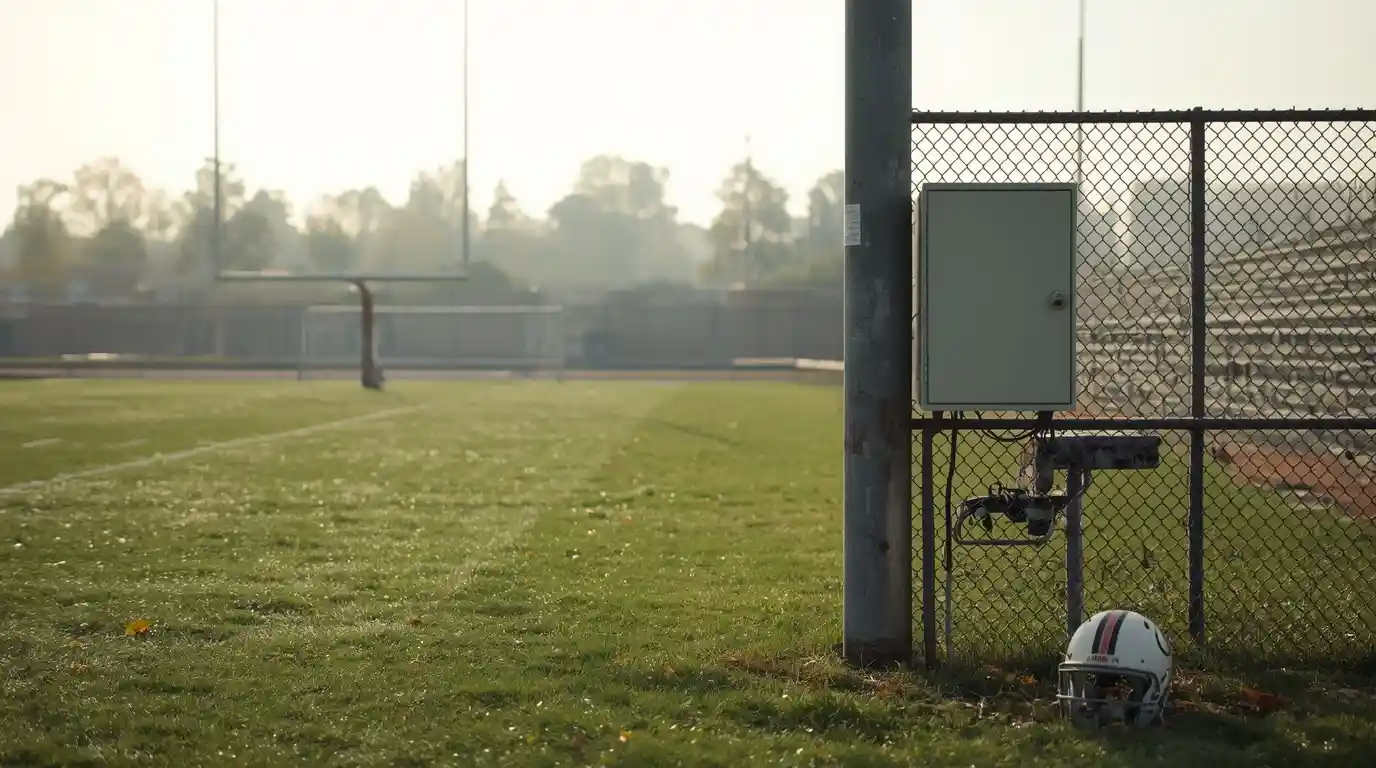
When a 17-year-old collapses at football practice and dies three days later, the first question anyone asks is whether it was sudden cardiac arrest — and the second is whether anything could have been done in time. Odin Hensley, a senior offensive lineman at Lake Travis High School outside Austin, Texas, went down around 8 a.m. on Monday, August 10. Travis County STAR Flight airlifted him to Dell Children's Medical Center. His district confirmed his death on Thursday, August 13.
Lake Travis ISD has described the cause only as complications from a medical emergency. FOX 7 Austin reported that he went into cardiac arrest during the session. That wording matters more than it sounds. A heart attack is a plumbing problem — a blocked artery starving the muscle, often with warning signs. Cardiac arrest is electrical: the rhythm scrambles, pumping stops within seconds, and the person is unconscious before anyone has finished dialling for help.
That difference is why this story travels well past Texas. Survival odds drop by roughly seven to ten per cent for every minute between a collapse and a shock from a defibrillator. Whether a Canadian student gets that shock in time comes down to where a machine is mounted, who has been trained to grab it, and which province wrote the rules — and those rules are nowhere near consistent across the country.
What Happened on the Field in Texas
Hensley collapsed during one of the team's first practices of the season. Coaches cancelled the rest of the morning and the school opened its counselling centre. He had been in Lake Travis schools since elementary, wrestled in winter and played the line in fall — the kind of student half the building could name on sight.
A vigil set for Wednesday evening had to be moved off campus to Lake Hills Church because the turnout was larger than the school could hold. His family has since set up a fundraiser. Superintendent Curtis Null described him in the district's statement as:
a kind, determined young man who was a valued teammate, classmate, and friend
Why the First Three Minutes Decide Everything
Nothing about the medical response in Texas has been criticised, and none of what follows is a comment on it. But every one of these cases turns on the same short window, and that window is where school policy either works or doesn't.
The defibrillator has to be reachable, not just owned
A machine locked in a main-office cabinet is useless to a kid on a field four minutes away at a jog. Research on public-access defibrillators in settings like schools and airports has found survival climbing from single digits into far higher numbers when a bystander uses one immediately. Distance, not ownership, is the variable that kills.
Somebody standing there has to be willing to use it
Modern units talk the user through it and will not deliver a shock to a heart that doesn't need one. The failure mode is hesitation, not equipment. Schools that run an actual emergency action plan — who calls 911, who runs for the AED, who starts compressions — cut minutes off the response without spending a dollar more.

How Canadian Schools Handle Sudden Cardiac Arrest
Manitoba legislated first. Its Defibrillator Public Access Act came into force on January 1, 2013, requiring AEDs in high-traffic public places — schools, arenas, gyms, community centres, airports — by January 31, 2014, and requiring each unit to be registered so 911 dispatchers can direct a caller to the closest one. Ontario followed with Bill 141, the Defibrillator Registration and Public Access Act, 2020.
Elsewhere it is patchier. The Squamish Chief has reported that defibrillators still are not mandatory in British Columbia schools, leaving the decision to individual districts, PACs and fundraising drives. Two students in two provinces can collapse the same way and get very different odds.
Why Canada Doesn't Put Every Athlete Through an ECG
The obvious fix — screen every young athlete's heart rhythm before the season — is not Canadian policy, and that is deliberate. The Canadian Cardiovascular Society and Canadian Heart Rhythm Society joint position statement recommends against routine ECGs as the first step in screening competitive athletes.
Italy went the other way. After mandatory screening began in 1982, the Veneto region recorded an 89 per cent drop in sudden cardiac death among athletes. Canadian specialists weigh that against false positives: a healthy teen flagged by a borderline tracing faces more tests, more cost and sometimes an unnecessary benching. It is a real trade-off, not neglect — but it means a normal sports physical here is not a clean bill of cardiac health, and parents should read it that way.
What to Ask Before the Season Starts
You will not get an answer to Odin Hensley's case for weeks, if ever. What you can do is ask your own school four blunt questions this month, ideally in writing to the athletic director:
- Where is the nearest AED to the field, gym and pool — and how many seconds does it take to get there?
- Is it registered with the local 911 dispatch service?
- Who on the coaching staff is current on CPR and AED use, and is one of them at every practice?
- Is there a written emergency action plan, and has anyone rehearsed it this year?
If your family has a history of unexplained deaths before 50, fainting during exercise, or seizures with no clear cause, say so to your doctor before your kid signs up — those are the flags that move a teen from routine screening to a proper cardiac referral. And if you get vague answers from the school this week, keep asking. The gap between a defibrillator in a hallway and a defibrillator on the sideline is the whole story.




Comments 0