

Why a Beach Resort Built a Community Canteen, Not a Café
Verse Design's 1,000-square-metre canteen at Aranya Qinhuangdao turns a leftover corner of a seaside resort into the thing every new suburb quietly needs — somewhere to eat together.

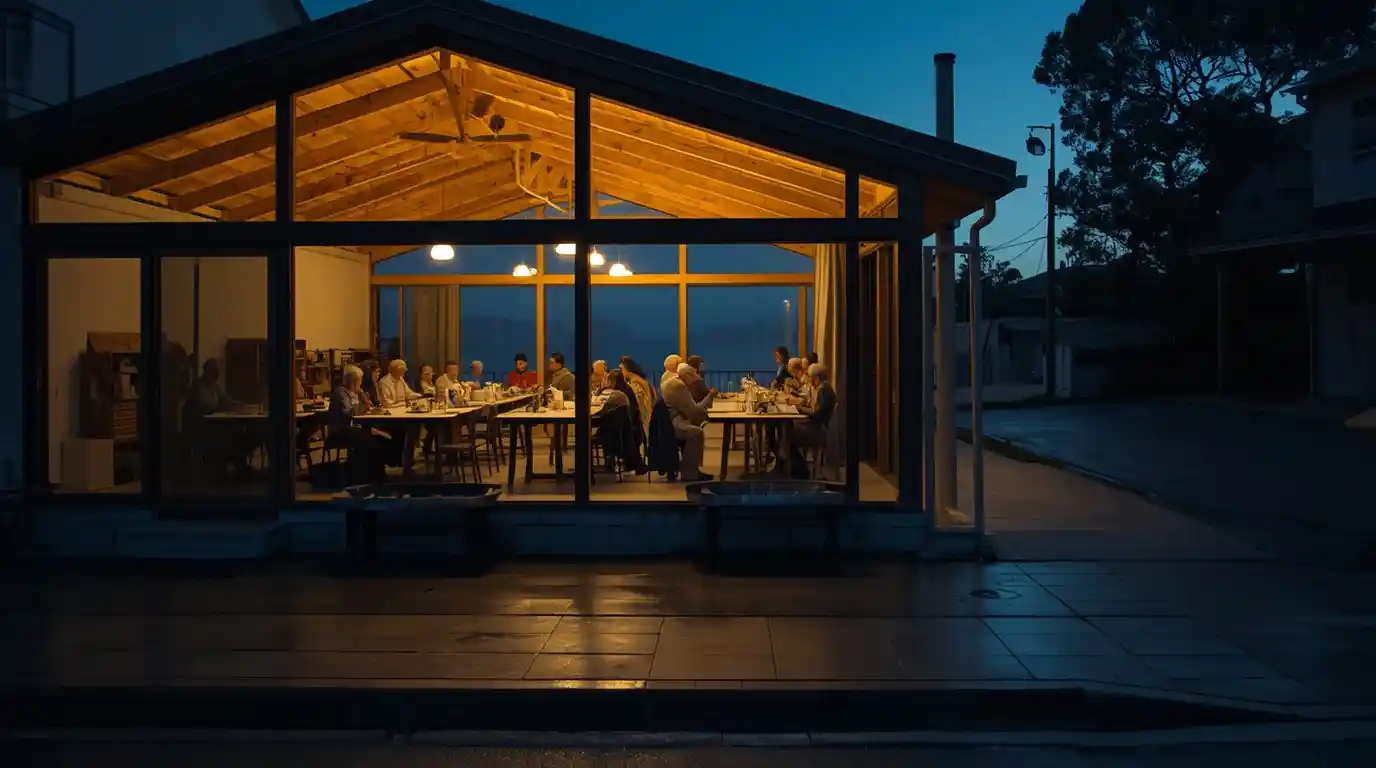
A community canteen has just opened on the eastern edge of a Chinese seaside resort, and it is nothing like the fluorescent-lit food hall those words usually conjure. Community Canteen No. 11 at Aranya Qinhuangdao, published by ArchDaily on 16 August, covers 1,000 square metres and was designed by Verse Design, with Leon Dai and He Xiaojian leading. It sits in a leftover corner hemmed in by apartments, shopfronts and a children's water park.
The number in the name is the giveaway. This is not a one-off pavilion — it is part of a numbered set, an item of infrastructure rather than a signature building. And it lands in the middle of a national push: China now runs more than 11,000 community canteens, backed by roughly 300 million yuan (about A$64 million) in central funding for meal assistance, according to reporting by the Global Times.
So why does a resort community full of holiday apartments need one? Because the canteen is the part of a neighbourhood that a developer can't fake with retail tenancies. It's the reason people leave the flat on a Tuesday. That question — how you manufacture ordinary daily life in a place built from scratch — is one Australian planners are wrestling with in every greenfield estate and mid-rise infill site right now.
What Verse Design Actually Built
The site was a fragment: a transitional strip where apartment blocks, ground-floor shops and a community street didn't quite meet. Rather than dropping a box into it, the architects treated the gap itself as the project, stitching the edges together with a bright, glazed hall. Photographs by Haha Lu and Arch-Exist show timber, generous beams and glass doing most of the work.
The team list says a lot about the ambition. Interiors came from Zhang Sanqiao, Dong Haopeng and Zhou Yitong; lighting from TUNGSTEN Studio; the facade engineering from BRM Facade Technology, with construction documentation by the Dalian Architectural Design and Research Institute. That's a specialist facade consultant and a dedicated lighting studio — on a canteen. The stated aim, in the architects' own words, was a place for gathering, interaction and everyday community life.
Why China Is Building So Many Canteens
None of this is happening in a vacuum. China's population aged 60 and over passed 300 million for the first time at the end of 2024, and Xinhua reports the country is expanding community-based aged care to match. Subsidised meals are the front door to that system: cheap, dignified, and a daily reason to check that someone is still coming through it.
A hot meal for about A$2.80
At one Beijing canteen documented by the Global Times, a government subsidy of three yuan per meal combines with a five-yuan seniors' allowance so eligible diners pay 13 yuan — roughly A$2.80 at current rates. Try buying a cooked lunch anywhere in Sydney or Melbourne for that. The price isn't a discount; it's policy, deliberately set below what the market would charge.
The canteens that shut within two months
The model is fragile, though. That same reporting found canteens needing around 150 meals a day just to break even, a Suzhou network serving 24,000 meals against a theoretical capacity of 120,000, and some venues closing within two months of opening. Staffing costs, unpredictable demand and thin margins kill them. A beautiful room does not fix an empty one.

What Makes a Community Canteen Work
Which is exactly why the Aranya project is interesting rather than decorative. The failures cluster in canteens parked somewhere convenient for the operator instead of somewhere convenient for the diner. Verse Design's site — next to the water park, on the walking route between homes and shops — is a footfall decision dressed up as an architectural one.
The second lesson is mixing. A canteen aimed only at pensioners becomes a pensioners' canteen, and then a stigma, and then empty. Putting one where parents drift over after swimming lessons gives it three or four different lunchtime crowds. The design question is less about the kitchen than about who walks past the door.
Aranya's Long Run of Famous Buildings
Aranya has form here. The seaside development drew international attention with Vector Architects' Seashore Library — a 450-square-metre concrete volume facing Bohai Bay, run in partnership with Sanlian Bookstore — followed by the Seashore Chapel, Restaurant y Sea and the Chapel of Music. Neri&Hu built the Aranya Art Center, and OPEN Architecture's Dune Art Museum opened nearby in October 2018. The canteen is more than twice the library's floor area, which tells you something: the resort has moved on from photogenic solitude to feeding people.
What This Could Look Like in Australia
Australia is not about to subsidise 11,000 canteens. But the underlying problem is shared — ageing residents in car-dependent suburbs, apartment towers with no shared room, and Meals on Wheels delivering to people who would rather come out. Neighbourhood houses and council community hubs already do a version of this work, usually in a demountable behind a car park.
If you want to act on any of this, look at what your council has planned. Check whether the next development application in your area includes a genuine shared eating space or just another row of retail tenancies, and say something at the exhibition stage — that's the only window when it's cheap to change. Watch, too, for whether Aranya's Canteen No. 12 ever appears. A numbered series that keeps counting is the real proof the model works.

Comments 0