

Why Police Want an IIT Delhi Student's Counselling File
A 31-year-old MSc Physics student died on the IIT Delhi campus on Saturday, and the paperwork police are now asking for says a lot about how Indian campuses track distress.

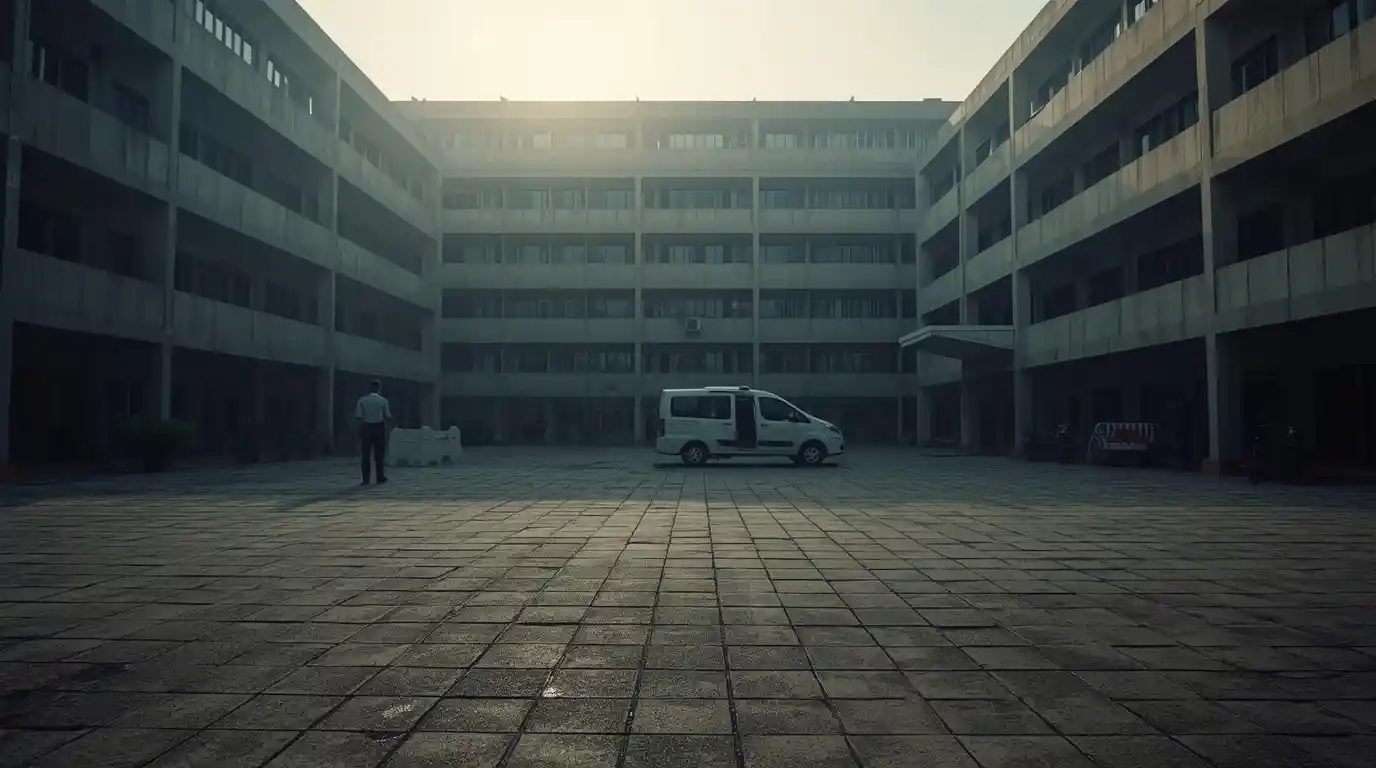
Delhi Police have asked the institute for the counselling records of an IIT Delhi student who died on campus on Saturday morning — a request that tells you as much about the investigation as it does about the death. There was no note. There is a mobile phone, recovered from his pocket, that forensic examiners will now open. Everything else has to be reconstructed from what the campus already knew about him.
The student was 31, enrolled in the MSc Physics programme, and originally from Saran district in Bihar. According to The Tribune, he entered through the main gate at around 8 am, walked to the Lecture Hall Complex, took the lift, and fell from the sixth floor. The PCR call came in at 8.33 am. A team from Kishangarh police station reached the spot, and he was taken to the campus hospital, where doctors declared him brought dead.
Two details make this different from the story most people scrolled past. One is his age: at 31, he was roughly a decade older than the typical entrant to a two-year MSc at an IIT, most of whom arrive in their early twenties through IIT JAM. The other is that this is the second such death reported at IIT Delhi in 2026, after a first-year undergraduate was found dead in March — and, per The Tribune, one of three suicides reported across Delhi in a single 24-hour stretch.
What happened between 8 am and 8.33 am
Police brought in the crime team and a Forensic Science Laboratory unit to collect evidence at the site. A preliminary examination found no injury marks on the body beyond those attributable to the fall, which effectively rules out the lines of inquiry investigators are obliged to eliminate first. With no note recovered, the phone becomes the primary document — messages, search history, call logs, the ordinary digital residue of the days before.
The institute deeply mourns the tragic and untimely demise of the MSc student on August 22, 2026.
IIT Delhi said it is extending all support to the bereaved family. Beyond that, the institute has not made public any account of whether the student had been in contact with campus counsellors.
What an IIT Delhi student's counselling file can show
Asking for counselling records is standard in these investigations, and it is also where they most often stall. The file is meant to establish a timeline of distress: did he seek help, was he referred onward, did anyone follow up. In practice, what police receive is usually thinner than what the public imagines.
What counsellors actually write down
Campus counselling notes typically log dates of appointments, presenting concerns in broad terms, and any referral to a psychiatrist. They are confidential by design, and counsellors are trained to record sparingly precisely so students will walk in at all. A file can show that someone came four times in March and never returned. It rarely explains why.
Where the paper trail usually stops
If a student never booked a session, there is no file — and the absence proves nothing except that the system never saw him. Support structures at IITs are built around hostels, wardens and faculty advisors. A postgraduate who walks in through the main gate in the morning may sit outside all of them.
Thirty-nine deaths, and what they miss
Education Ministry data placed before Parliament recorded 39 student suicides at the IITs between 2018 and 2023, alongside 25 each at central universities and NITs, four at the IIMs, three at IISERs and two at IIITs. Those figures cover the country's most selective institutions — roughly the same student population that clears exams with success rates under two per cent.
Set against the national picture, they are a rounding error. The NCRB counted 13,044 student suicides in 2022 alone — about 36 a day. The IIT numbers get headlines because the institutions are famous, not because the problem lives there.
The rules that already exist on paper
In July 2025, the Supreme Court issued 15 binding guidelines on student mental health, arising from the death of a 17-year-old NEET aspirant. Any institution with 100 or more students must engage at least one qualified counsellor or psychologist; smaller ones must hold formal referral tie-ups. Helpline numbers, including Tele-MANAS, must be displayed prominently in hostels, classrooms and on websites. Written referral protocols are mandatory, and district magistrates head monitoring committees to check compliance.
The IITs moved earlier. At the IIT Council's meeting in April 2023, it was agreed that one faculty advisor would be assigned for every ten students, and the Education Ministry circulated a well-being framework for higher education institutions that July. The gap now is not policy. It is whether anyone audits it.
The older student nobody plans for
Mature students carry pressures that campus systems are not designed to read: a gap in the CV, savings burning down, family at home who assumed the degree would be finished years ago, peers already earning. A 22-year-old missing lectures gets flagged by a hostel warden. A 31-year-old who comes in for class and leaves is invisible by default, and the standard buddy-mentor schemes rarely reach him.
What to watch, and what you can do
Three things will decide whether this becomes more than a news cycle: the FSL report and phone forensics, whether IIT Delhi publishes any account of its own review, and whether Delhi's district monitoring committee actually inspects institutions as the Supreme Court directed. If you are a student or a parent, one practical step is worth taking this week — ask your institution for its written mental health policy and the name of its counsellor. Under the 2025 ruling, you are entitled to both. The government's Tele-MANAS helpline is free and available round the clock in multiple Indian languages.



Comments 0