

Your Prostate Cancer Test Now Depends on Your GP
A one-page letter from the health department has ended the 24-year rule that let any man over 50 ask the NHS for a PSA blood test and expect one.

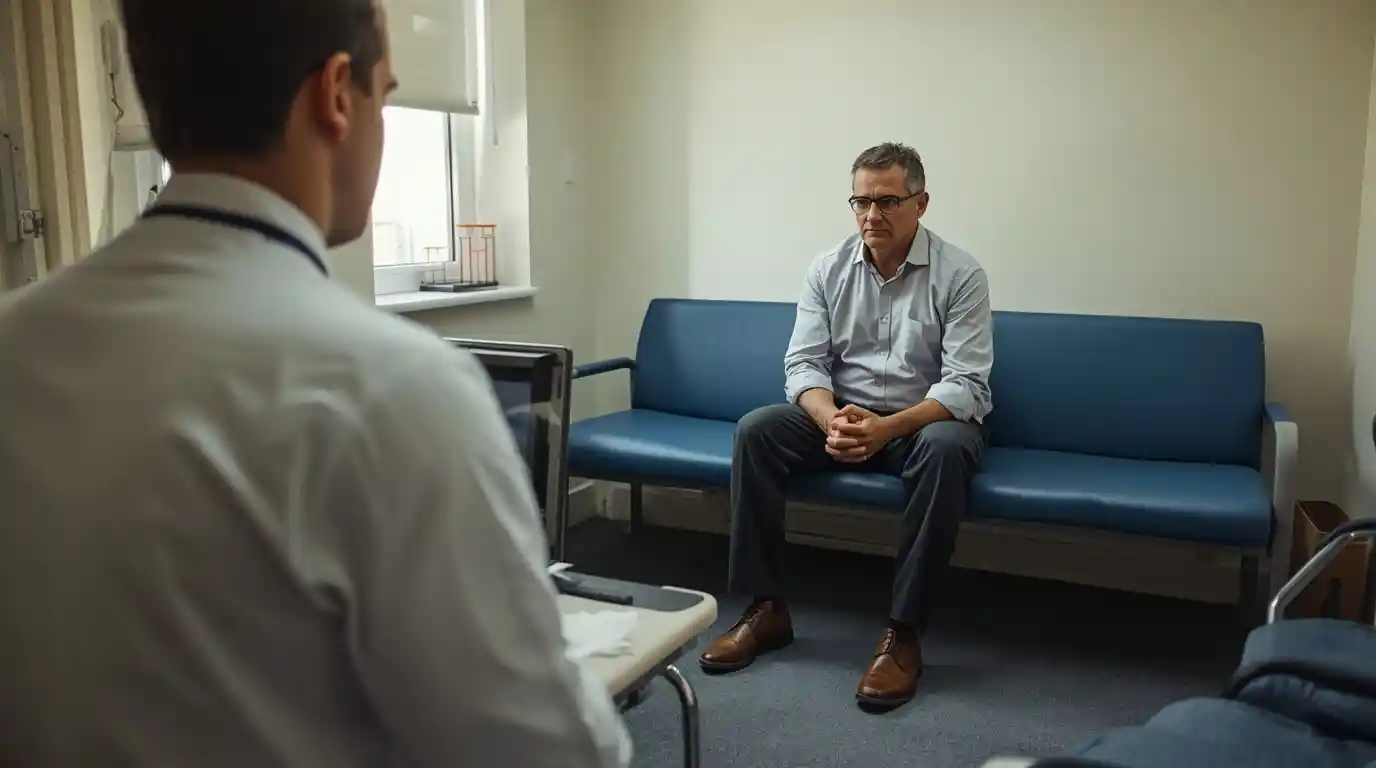
Any man over 50 in England could once ask his GP for a prostate cancer test and expect to get one, and that promise has just been deleted. The Department of Health and Social Care wrote to health organisations on Thursday 14 August confirming that the prostate cancer risk management programme, in place since 2002, has been withdrawn.
Nothing formal replaces it. GPs are now expected to weigh up each man's individual risk and decide for themselves whether the PSA blood test is worth doing. There is no longer an age at which a man without symptoms is automatically entitled to one. For a disease that kills roughly 12,000 men a year in the UK, the timing has struck a lot of people as strange.
About 63,000 men are diagnosed with prostate cancer here every year, making it the most common cancer in men. There is still no national screening programme for it, unlike breast, bowel and cervical cancer. Asking was the only door an asymptomatic man had into the system. That door now opens at a doctor's discretion.
What the letter actually changed
The old wording was unusually blunt for NHS guidance: the test was available free to any man aged 50 or above who requested it, after a proper conversation about the benefits and the risks. Twenty-four years of that sentence has gone. The new position asks family doctors to assess risk first — age, ethnicity, family history, symptoms — and then judge. Nothing has been banned. Something has been un-guaranteed.
Why the department says this is not a cut
Officials insist the change is tidying-up, not rationing. The old guidance was ambiguous, the department argues, because in practice the final call always rested with the GP anyway — no doctor was ever obliged to order a test he believed would do more harm than good. An official in the department's secondary prevention directorate put it plainly: a patient who is worried about prostate cancer can ask his GP about having a PSA test.
That is true as far as it goes. The difficulty is what "ask" is worth once the printed backstop disappears. Two men with identical circumstances — no symptoms, same age — can now walk into two surgeries three miles apart and get different answers, with no national line either of them can point at.

The backlash from campaigners and former PMs
Lord Cameron, who was treated for prostate cancer himself, called it yet another step backwards and said it showed why simple, targeted screening is needed for all at-risk men. Rishi Sunak has separately campaigned for wider testing. Sir Chris Hoy, the six-time Olympic cycling champion, was diagnosed with incurable cancer at 47 with no symptoms at all, and has been fundraising to widen access ever since.
David James of Prostate Cancer Research called the move a shocking betrayal and a backward step that will condemn thousands more men each year to a late and incurable diagnosis.
His sharper point was about coherence. Ministers have ruled out screening every man, and now they have removed the informal safety valve that partly stood in for it. Campaigners call that the worst of both worlds.
How to still get a prostate cancer test
The practical position for readers is less bleak than the headlines. You can still request the test. What has changed is that you may have to make the case, so it helps to walk in prepared.
If you are over 50 with no symptoms
Book a routine appointment and say clearly that you want to discuss PSA testing and your personal risk. Ask for the reasoning to be recorded in your notes. If the answer is no, ask what would change it, and whether a repeat conversation in twelve months is reasonable.
If you are black or have a family history
Higher-risk men are usually advised to start the conversation nearer 45 than 50. A father or brother diagnosed with prostate cancer, or a family pattern of breast, ovarian or pancreatic cancer, is worth stating out loud at the start of the appointment rather than waiting to be asked.
What the test can and can't do
PSA is imperfect in both directions. It misses some aggressive cancers and flags plenty of harmless ones, which is exactly why the screening committee has never backed testing everybody. A raised result means more investigation, usually an MRI scan, not a diagnosis.
What arrives in 2027, and who it misses
In May the UK National Screening Committee recommended a narrow targeted programme: men aged 45 to 61 who carry a BRCA2 gene change and have a family history of breast, ovarian, pancreatic or prostate cancer would be offered PSA testing every two years. Ministers accepted it on 2 June, with rollout in England expected from 2027. The committee rejected screening all men, and rejected screening black men as a group, who are instead being pointed towards a research trial.
So the eligible population shrinks to a few thousand while the informal route narrows for everyone else. If you are over 50, or over 45 with risk factors, the sensible move is not to wait and see how the new discretion beds in — book the conversation now, and watch for whether NHS England publishes any replacement wording for GPs this autumn.




Comments 0