

84 Seconds and 600 Hours Behind One Red Bull Eclipse Photo
A wingsuit flyer crossing a blacked-out sun over northern Spain took nine months to arrange and one 84-second window to capture.

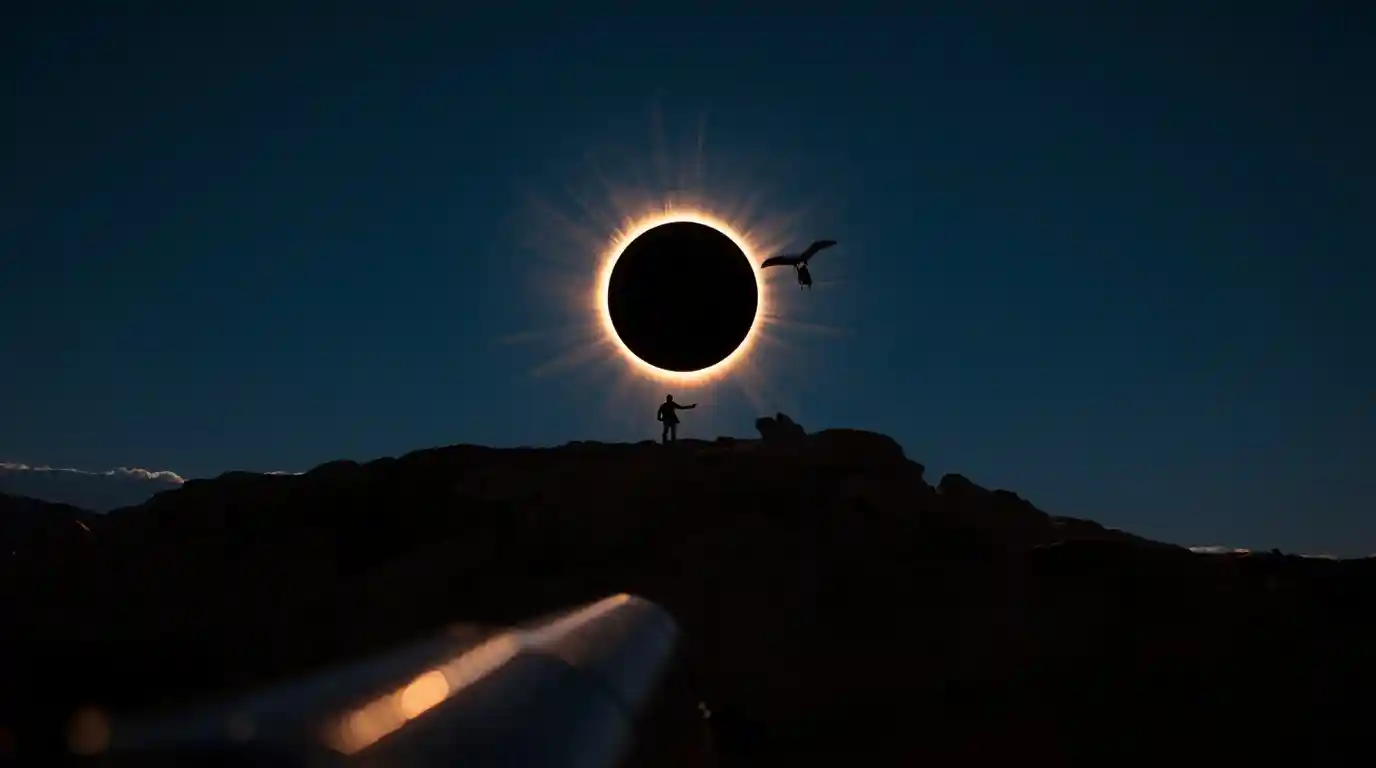
The Red Bull eclipse photo spreading across feeds this week looks like a fluke — a tiny human shape in a wingsuit, arms spread, sliding across the black disc of a blotted-out sun. It wasn't luck. It took nine months, roughly 600 hours of work and four separate test productions, and the moment it was all built for lasted 84 seconds.
The picture was made on the evening of 12 August 2026 near Alarilla, a village north of Madrid, as the path of totality swept across northern Spain. Photographer Noah Wetzel shot it from 1,400 metres away — the better part of a mile — while Red Bull Air Force flyer Mike Brewer crossed the frame at more than 150mph, around 15 feet above the Balcón de la Muela ridgeline. Fellow flyer Dani Román flew support.
If you were in Britain that evening, you watched the same eclipse from the wrong side of the line. The Moon covered about 91% of the Sun over London and Edinburgh, 93% over Cardiff and Belfast, and close to 96% in Cornwall and the Isles of Scilly. Dramatic, but never properly dark. Spain got the real thing for the first time since 1905, and the UK won't see totality of its own until 2081.
What actually happened on that ridge
Totality near Alarilla arrived with the Sun barely clear of the horizon — across northern Spain it sat somewhere between 2 and 10 degrees up, which is roughly a fist held at arm's length. That low angle is exactly what made the shot possible and nearly impossible at the same time. Wetzel needed a flying human and an eclipsed sun on the same sightline, with one attempt and no second run.
Brewer was covering around 200 feet every second. At that speed, a whisker of drift in his flight line puts him outside a 600mm frame entirely. The hero camera was a Canon EOS R5 Mark II; Digital Camera World described the rig as two 600mm f/4 lenses linked together. The exposure landed at 1/200th of a second, ISO 2500, wide open at f/4.
How do you light a man moving at 150mph?
This is the part the finished frame hides completely. Almost a mile of near-darkness sat between camera and subject, and none of the kit that solved it appears in the picture.
Four flashes, all fired at one-eighth power
Three Godox AD1200 Pro heads and a smaller AD360 II lit the flyer, every one of them dialled down to 1/8 power. That sounds backwards — less light for a subject that far away — but low power is what makes a flash pulse short. At 1/8, the burst lasts roughly 1/2500th of a second, freezing Brewer to about an inch of movement. The ambient exposure on its own would have smeared him across a foot.
A radio chain and 200 feet of cable
The trigger ran from a PocketWizard Plus Ve transmitter to Plus IIIe receivers, with 100 to 200 feet of cable strung out across the plateau so the heads could sit where the light needed to come from. Radio, at that range, in the dark, aimed at one fast-moving body: every link had to hold for a single frame.
The second camera nobody sees
Dane Cronin shot backup on a Canon EOS R5 with two Godox 600B heads at ISO 1250, 1/25th and f/3.2 — a far slower shutter, and a deliberate hedge. On a job with no retakes, a second angle on the same instant is cheap insurance.
Why the Red Bull eclipse photo can't be redone
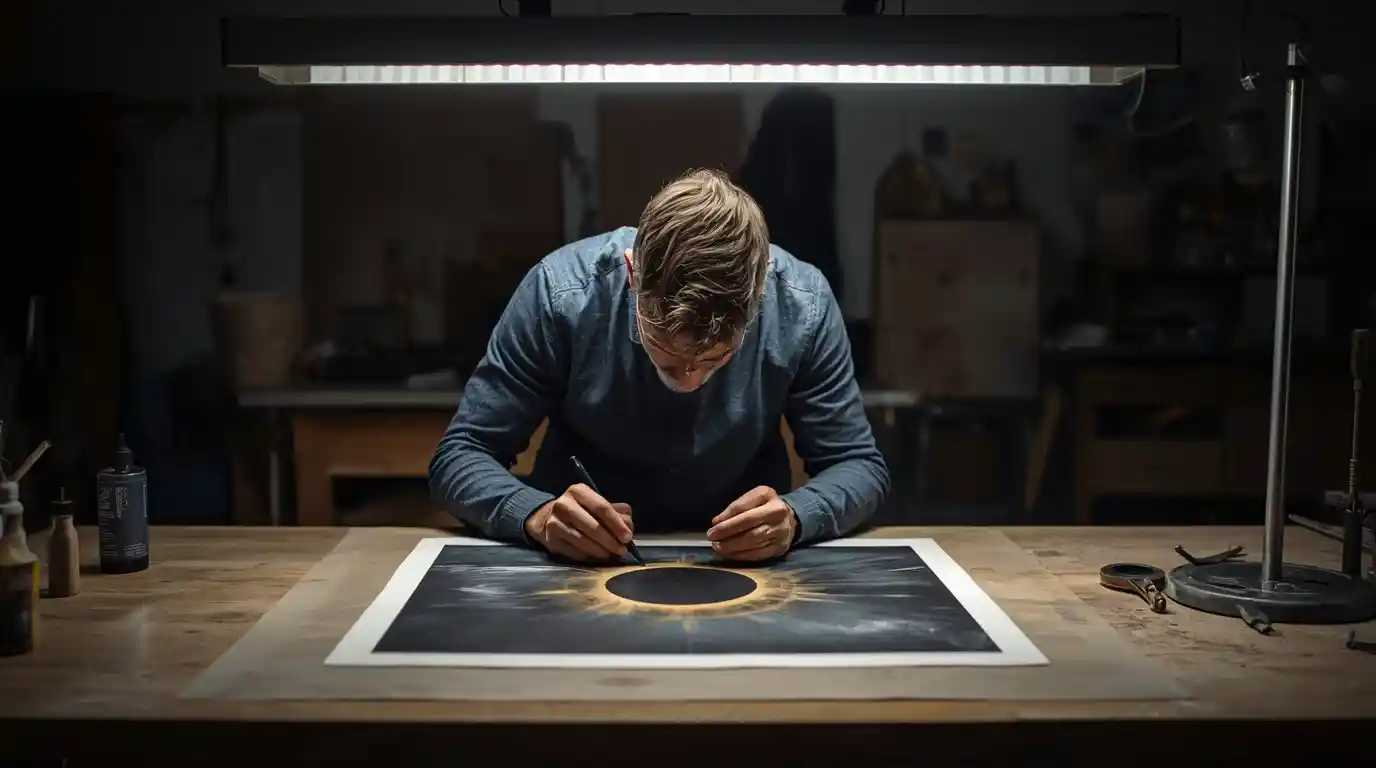
Eclipse geometry never repeats. The same sun angle, the same ridge, the same 84-second window won't line up again in any of our lifetimes, which is why the team ran four full rehearsals first, including a pre-dawn run in Moab, Utah, standing in for the real thing. Wetzel didn't undersell the difficulty.
Literally the pursuit of this photograph was treading the fine line of photographically impossible in about five different areas.
It follows a pattern for the same crew. In March, near Palmer in Alaska, Michael Clark photographed Red Bull wingsuiters flying under the aurora at -40°F after a jump from 8,000 feet. Brewer was part of that one too. The house style is now clear: pick a sky event you can't schedule, then spend months making a single frame of it inevitable.
What Britain actually saw that evening
Across the UK the partial phase opened between roughly 6pm and 6.20pm BST, peaked between about 7pm and 7.17pm, and was over by around 8pm. The catch was altitude: in London the Sun was only about 10 degrees above the horizon at maximum, so anyone without a clean western view got trees, rooftops or a bank of cloud instead. Plenty of people missed it standing outside.
The next one is closer than you'd think
Europe's next total solar eclipse falls on 2 August 2027, and it crosses southern Spain before running on through North Africa and the Middle East. That's a two-and-a-half hour flight from most British airports, in peak holiday season, on a date every eclipse chaser already has ringed. Accommodation along the centre line will go early. If the Red Bull eclipse photo has made you want to see one properly rather than squint at a 91% version from a car park, book the trip now and worry about the camera later.
Comments 0