

Botticelli in Bengaluru Hangs Beside an Older Mother Goddess
The first Botticelli ever shown in India is at NGMA Bengaluru until 20 September — and the sculptures around it are far older than the painting.

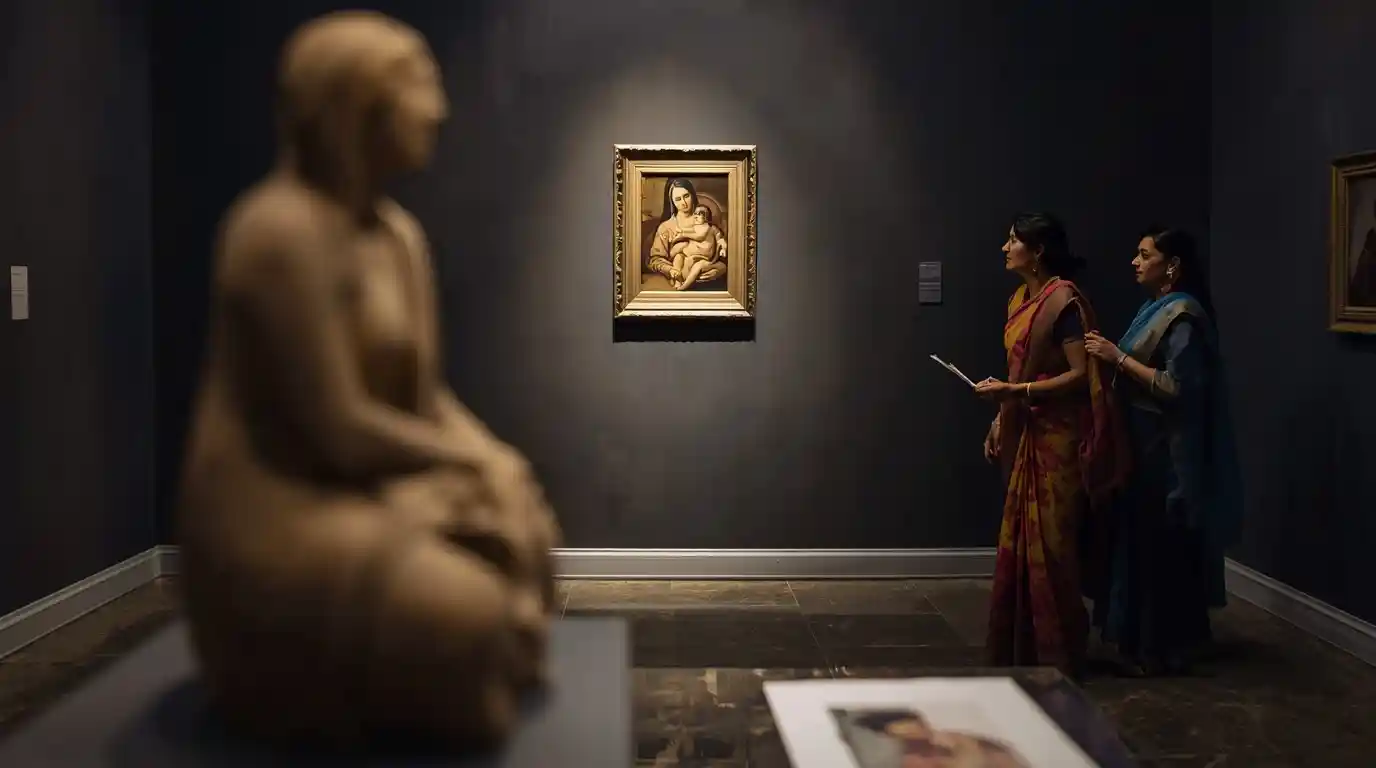
For the next few weeks you can stand in front of a Botticelli in Bengaluru — the first painting by the Florentine Renaissance master ever brought to India. Sandro Botticelli's Madonna and Child, made around 1490, went on public view at the National Gallery of Modern Art on 20 August. It comes down on 20 September. That is a window of roughly thirty days, and then the painting goes home.
It isn't travelling alone. The picture anchors an exhibition called One Mother, Many Mother Tongues, which gathers 26 objects from Indian and Italian collections into a single gallery and asks an awkwardly simple question: why do cultures that never met keep carving and painting the same image of a woman holding a child? Indian news reports have put the combined value of the Italian loans at close to €100 million, or roughly ₹1,000 crore.
For a city with no shortage of galleries but very little history of landing Renaissance loans, that is a genuine first. Objects of this insurance weight normally reach Delhi or Mumbai and stop there. Bengaluru got a turn because the Consulate General of Italy pushed for a second leg, working with NGMA and the Union Ministry of Culture, with backing from the Prestige Group.
What Botticelli was actually painting in 1490
This is not the Botticelli of The Birth of Venus, all wind and mythology. By 1490 the painter had turned inward and was producing small devotional works for private patrons — pictures meant to be looked at in a bedroom or a family chapel, not a public square. That scale matters when you see it. Visitors expecting a wall-sized showstopper tend to walk past the case once before doubling back.
Why a Madonna and a Yogini Belong in One Room
The curators, art historian Naman P Ahuja of JNU and Andrea Anastasio of the Italian Cultural Centre in New Delhi, have not hung the Botticelli as a trophy. They have surrounded it with mother figures in marble, schist, sandstone and terracotta, some of them centuries older than Christianity itself, and let the visual echoes do the arguing.
The Indian side: Hariti, Skandamata and the Matrikas
Roughly ten Indian museums have lent to the show, including the Mathura Museum, the Government Museum and Art Gallery in Chandigarh, and collections in Kolkata, Prayagraj, Surat, Baroda and Udaipur. Among the loans are a Kushan-period Hariti, a monumental Hariti from Skarah Dheri in the Peshawar district, a Skandamata from a temple near Udaipur, and pieces drawn from the Matrika, 64 Yogini and Dasa Mahavidya traditions.
The Italian side: Mater Matuta and the Renaissance
Three Italian institutions contributed — the Museo Etrusco in Rome, the Museo Provinciale Campano di Capua and the Museo Stibbert in Florence. The Etruscan Mater Matuta figures are the quiet shock of the show. These seated mothers with infants were being carved in Italy some six centuries before Christianity existed, which makes the Madonna less an invention than an inheritance.
How to see Botticelli in Bengaluru before it leaves
NGMA Bengaluru is running the show until 20 September, and 31 schools and institutions have already registered for guided visits and workshops. That is worth planning around: weekday mornings will be thick with school groups. Late afternoons on a weekday, or the first hour after opening, are your best bet for standing in front of the painting without a queue behind you. Check NGMA's current timings before you go.
We are particularly honoured to bring a masterpiece by Sandro Botticelli to India for the first time, following its presentation in Delhi.
That was Giandomenico Milano, Italy's Consul General in Bengaluru, at the launch. Karnataka's Energy and Tourism Minister K J George, NGMA Bengaluru director Priyanka Mary Francis and Prestige Group joint managing director Rezwan Razack were also present — a guest list that tells you the state is reading this as tourism, not only culture.
The Delhi run that came first
Before Bengaluru, the exhibition sat at the Humayun's Tomb museum at Sunder Nursery in New Delhi, opening on 22 June and closing in early August. That version held 24 objects; the southern edition has 26. Delhi's setting was a modern underground museum inside a World Heritage site, open till late evening — a very different experience from a colonial mansion gallery. If you saw it there, the rehang alone is a reason to look again.
What this sets up for 2027
The show is a warm-up. India and Italy have an Italy-India Year of Culture and Tourism scheduled for 2027, and loans like this one are how museums build the trust needed for bigger ones. A Renaissance panel crossing continents without incident is the strongest argument a lending institution can make internally for the next request.
If you want to see it, don't leave it to the last weekend — closing days at NGMA get crowded, and there is no announced extension. Go once for the Botticelli, then walk the room backwards, from the 1490 panel to the Etruscan terracottas, and watch a 4,000-year-old idea assemble itself in reverse.

Comments 0