

Why Camera-First Design Now Shapes What You Buy
Products are increasingly engineered for a nine-second vertical clip before they are engineered for a shop shelf — and Indian shoppers are already paying for it.

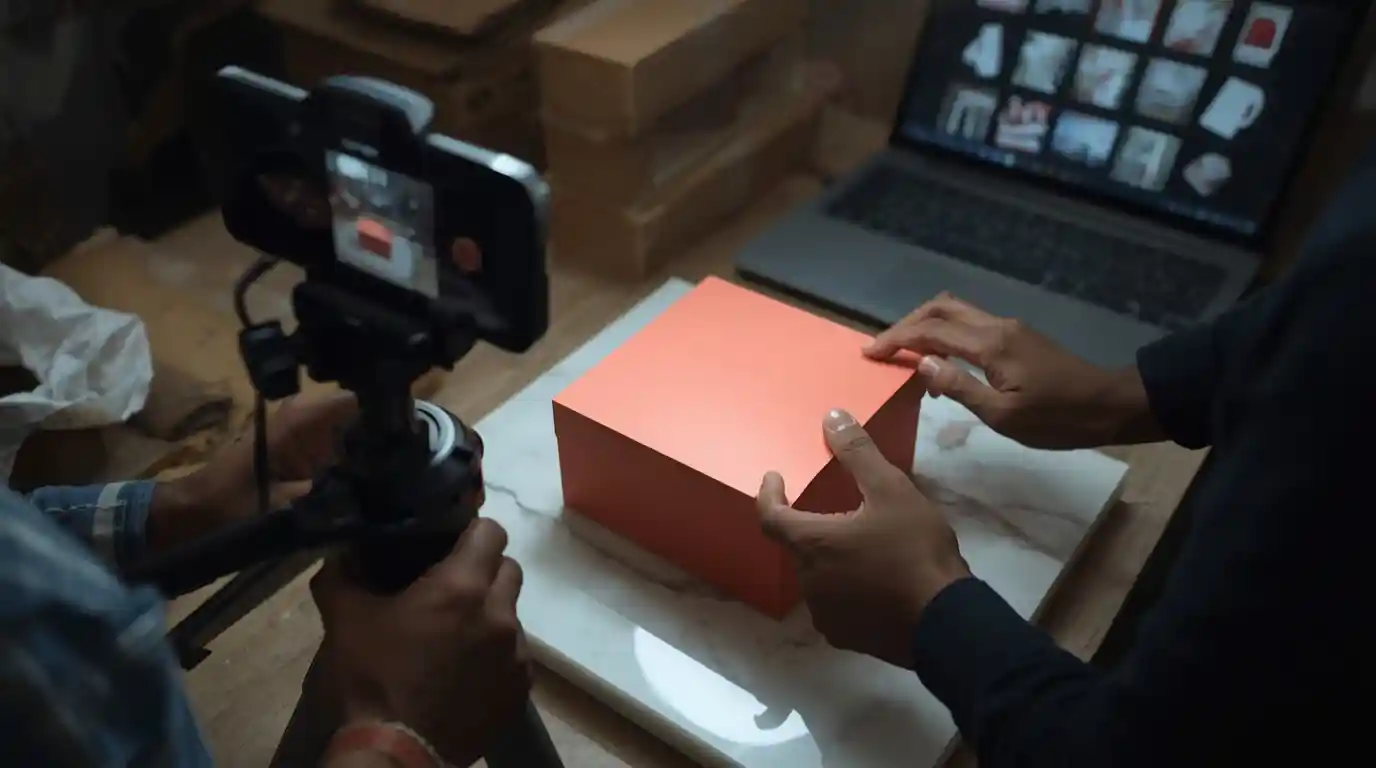
Camera-first design — building a product so it performs on a phone screen before it performs on a shelf — has quietly moved from a finishing touch to the opening line of the brief. The tell isn't what brands say in press releases. It's what they now spend money on: the shape of a lid, the sound a box makes when it opens, the two seconds of reveal a customer can film in a badly lit bedroom without any help.
The money behind this shift is not small. Mordor Intelligence values India's social commerce market at about USD 29.27 billion in 2025 — roughly ₹2.5 lakh crore — and projects USD 143.86 billion by 2030, a compound growth rate of 37.5%. Video commerce alone made up close to 42% of that market in 2024, and smartphones accounted for nearly 90% of revenue. Products are being sold inside phone videos, so products are being built for that frame.
That changes what ends up in your cart. When a jar, a styler or a sneaker is engineered partly to look good in a vertical clip, you're paying for the camera as much as the contents. Sometimes that's a real upgrade — better closures, sturdier cartons, labels you can actually read. Sometimes it's theatre you'll bin in thirty seconds.
What Camera-First Design Actually Changes
The old question was whether a product stood out among rivals on a lit shelf, seen at arm's length, for maybe four seconds. The new question is whether it survives a thumbnail — a two-centimetre square, held vertically, scrolled past in under a second. That pushes designers toward higher contrast, fewer words on the front face, and silhouettes recognisable in pure outline. It also pushes them toward a moment: a click, a snap, a colour change. A still image can't carry a Reel.
The Three Tests a Product Now Has to Pass
Talk to anyone briefing packaging or industrial design for a direct-to-consumer brand and the checklist has shifted. It used to end at cost, shelf life and shipping durability. Those still matter. But three newer tests now sit above them, and failing any one of them means the product simply never appears in anyone's feed.
Does It Read at Thumbnail Size?
Shrink the design to the size of a stamp and see what's left. If the brand name vanishes and the shape looks like everything else in the category, the product is invisible where most discovery now happens. This is why so much Indian D2C packaging has gone loud — flat blocks of colour, one enormous word, minimal supporting text.
Is There a Second Worth Filming?
Shareable products build in a small physical event. A magnetic flap. A pull-tab that tears clean. A cap that seats with an audible click. None of these improve the formulation inside, but each gives a creator something to point a lens at, and gives the brand free distribution it never bought.
Can Someone Shoot It Badly and Still Look Good?
This is the underrated one. Most footage is filmed on a mid-range phone under a tubelight, not in a studio. Matte finishes that don't blow out, colours that hold up under warm indoor light, and surfaces that hide fingerprints now beat mirror-gloss finishes that photograph beautifully only in controlled conditions.
What a Hair Styler and a Plush Toy Proved
Two very different products made the case. Dyson's Airwrap accumulated billions of views on short-video platforms largely because its curling action is inherently watchable — the hair wraps itself. Dyson relaunched it in July 2026 as the Airwrap Co-anda2x with four new attachments, per PR Newswire. Then there's Labubu, the collectible plush figure: TODAY reported it sold out in seconds and reappeared on resale sites at roughly five times its original price, driven almost entirely by unboxing clips.

Why India Is the Sharpest Test of This
India is Instagram's largest single market, with industry trackers putting the base at around 362 million users. Coherent Market Insights sizes India's creator economy at USD 15.03 billion in 2026, growing to USD 61.87 billion by 2033. Mordor Intelligence puts India's D2C e-commerce market at USD 108.76 billion in 2026. Cheap data, a young population and a creator layer that sits between brand and buyer make shareability a cheaper acquisition channel here than performance ads.
Where This Quietly Backfires
Designing for the clip has costs. Elaborate unboxing means more material, which collides with India's tightening plastic-waste rules and with shoppers who notice three layers of filler around a 50g product. Worse, a product that films better than it works generates returns and angry comment sections. The gap between the reveal and the reality is now the fastest way to lose a customer.
What to Watch in Your Next Order
Next time a parcel arrives, separate the two things you were sold. Ask whether the packaging protected the product or just performed for a lens — and whether the extra ₹100 or ₹200 in the price bought better contents or a better ten-second clip. Brands that get camera-first design right make both true at once. The ones that don't are betting you'll film it before you use it.

Comments 0