

Why China's Aranya Community Canteen Has a Sanskrit Name
A 1,000 sq m canteen on the Chinese coast is the eleventh of its kind in one gated estate — and its name traces back to a very different Aranya in Indore.

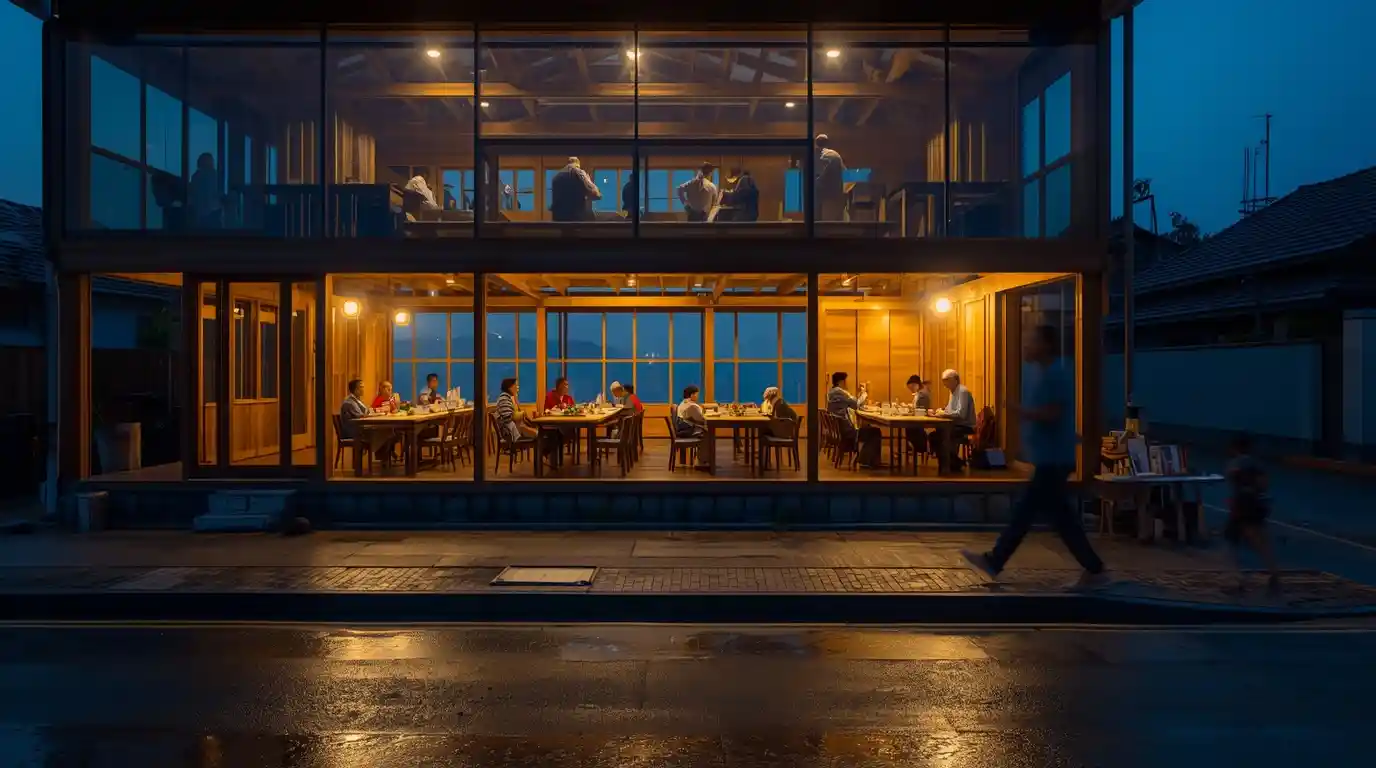
The newest Aranya community canteen on China's northern coast is officially No. 11 — a 1,000 sq m dining hall by the studio Verse Design, completed this year. It sits on the eastern edge of Aranya's North Shore Art Bay in Qinhuangdao, boxed in by apartment blocks, ground-floor shops, a children's water park and a tangle of residential lanes.
The number is the actual story. One gated seaside development has numbered its canteens into double digits. Per the project description published by ArchDaily, the brief was not to park a standalone restaurant in a leftover corner, but to turn an awkward transitional edge into somewhere people stop, sit and bump into each other on an ordinary Tuesday.
For an Indian reader there's a second hook waiting. Aranya is a Sanskrit word, and India already has a famous Aranya — Balkrishna Doshi's low-cost housing township in Indore. Same name, opposite economics, and a shared obsession with the space between buildings. That comparison is where this small Chinese canteen gets genuinely useful.
What the Aranya Community Canteen Actually Is
It's a 1,000 sq m single-purpose building in wood and glass, led by architects Leon Dai and He Xiaojian with a four-person team. A curtain wall system by BRM Facade Technology carries the glazing, with materials supplied by CSG Holding, lighting by TUNGSTEN Studio and construction drawings by the Dalian Architectural Design and Research Institute. The design leans hard on daylight and transparency, so the building reads as open before you reach the door.
Why a Beach Town Keeps Building Canteens
Aranya was a failed, half-built property project until developer Ma Yin took it over in 2013. It now covers roughly 220 hectares in Beidaihe district, about two and a half hours from Beijing by high-speed rail, and media reports put annual footfall above 1.5 million. TIME named it one of the World's Greatest Places in 2024. The icons get the attention — the Seashore Chapel, the 450 sq m Lonely Library, Vector Architects' Chapel of Music, OPEN Architecture's Dune Art Museum, the Neri&Hu art centre. The canteens are the plumbing that makes those icons liveable.
A Sanskrit Name, and an Indore Namesake
Sixth Tone has reported the estate's name as a Sanskrit borrowing, glossed by the developer as a retreat from the noise of the city.
a quiet, secluded place where you can recover your true self
Doshi's Aranya, finished in 1989 in Indore, took the same word somewhere else entirely: 86 hectares, over 6,500 plots, planned for more than 80,000 people, mostly in the lowest income brackets. It won the Aga Khan Award for Architecture in 1995, and Doshi went on to become India's first Pritzker laureate in 2018. His unit was ten houses around a courtyard opening onto a lane — the street doing the social work, not a hall.
What Indian Townships Could Borrow
Indian developers now sell "community living" in every brochure from Gurugram to Whitefield. What gets built is usually a gym, a banquet hall nobody books and a landscaped lawn. Two habits from the Aranya community canteen translate directly, and neither needs an imported architect.
Open the Clubhouse to the Street
The Verse Design building faces its neighbours through glass instead of hiding behind a boundary wall and a boom barrier. That single move changes behaviour: you can see whether anyone's inside before you commit to walking in. Most Indian clubhouses are opaque boxes set back behind parking, which is why they empty out after the first six months.
Make Food the Anchor, Not the Gym
A canteen pulls people daily; a squash court pulls them weekly at best. Building No. 11 works because eating is the one activity every age group in a township already does. A subsidised mess, a tiffin counter or even a licensed café at the tower entrance will do more for neighbourly contact than another amenity you pay maintenance on and never use.
The Part the Photos Leave Out
Aranya is not a public town. Sixth Tone has described strict entry rules for anyone without property or an event ticket, and separate dining arrangements for owners versus outside visitors — a two-tier system inside a place marketed as a community. Peak-season hotel rooms have been reported at about 2,000 yuan, roughly ₹27,000, a night. Residents wrote an Owner's Pact in 2015, but the developer still holds the controls.
If you're buying into a township this year, that's the test worth applying. Ask three things before you sign: who runs the food and beverage space, whether outsiders can enter it, and who pays for it once the developer exits. Check the sanctioned plan for those areas, not the brochure render. A canteen that only opens for owners is an amenity; one that opens onto the street is a neighbourhood.

Comments 0