

Why the Fine Arts Garden Restoration Starts With Sidewalks
The Cleveland Museum of Art's most famous lawn is getting its first full rebuild since the 1920s — and the unglamorous concrete comes before the fountains.


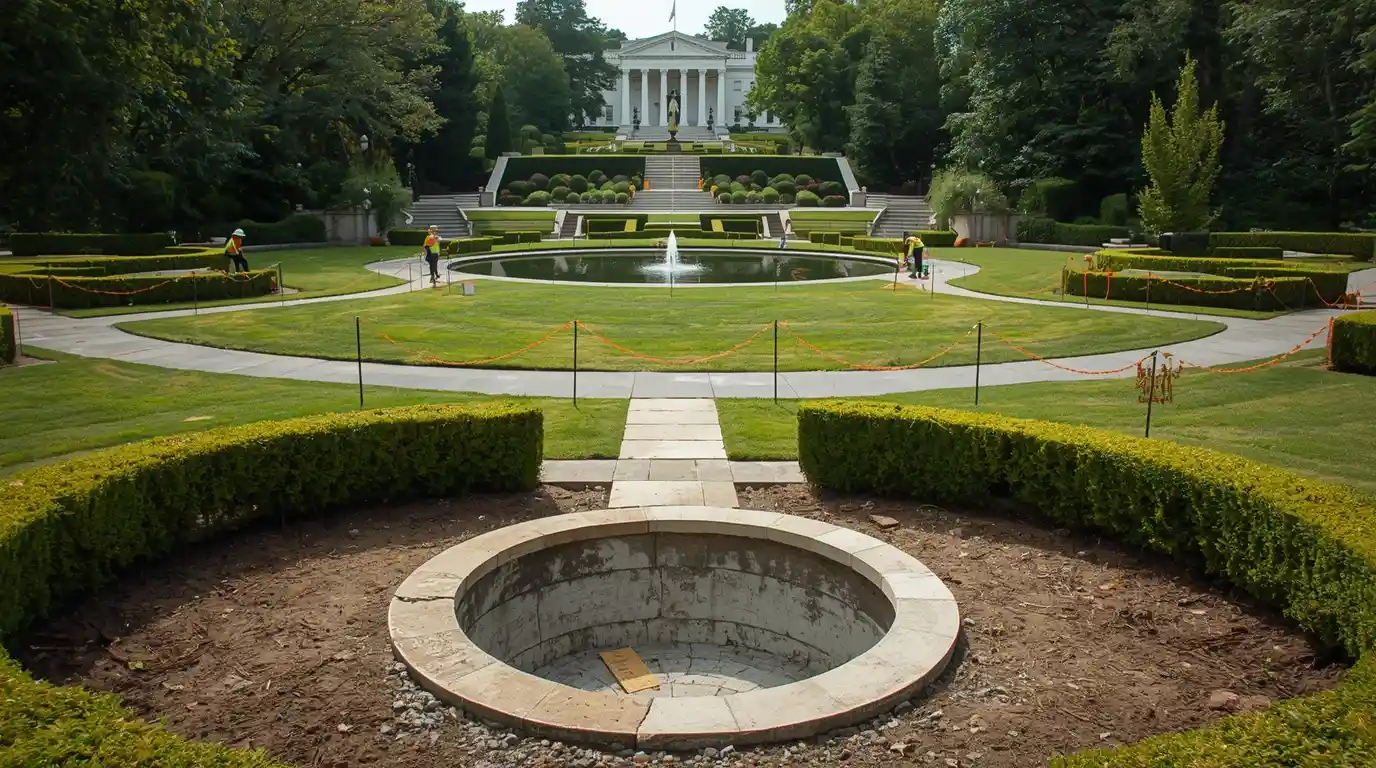
The Fine Arts Garden restoration at the Cleveland Museum of Art begins with the least photogenic thing on the property: the pavement. Before anyone touches a fountain, a hedge or a sculpture, crews are rebuilding the walkways that run down the slope from the museum's south terrace to Wade Lagoon. Those paths have been cracking and heaving for decades, and they set the ceiling on what the rest of the garden can do.
The scale behind that modest starting point is larger than it sounds. The museum's landscape plan covers close to 41 acres of lawn, parkland and paths, according to News 5 Cleveland. The grounds draw more than 200,000 people a year, by the museum's own count. And in February 2026, the Horace Kelley Art Foundation committed $5 million as the founding gift for the work.
Here's why it lands differently than a typical museum project: this is public ground, not a ticketed garden. General admission at the Cleveland Museum of Art is free, and the lawn out front functions as a park for all of University Circle. A broken path isn't a cosmetic problem there. If you use a wheelchair, a walker or a stroller, a broken path is a closed path. Cleveland.com reported this is the first major overhaul in nearly a century.
What the Fine Arts Garden Restoration Covers
The plan breaks into a few distinct pieces. Some are repairs nobody will notice once they're finished. One will change how the space gets used in January. News 5 Cleveland, reviewing the museum's landscape master plan, described work stretching from buried infrastructure to a new building at the water's edge.
New Walks, Drains and Lights
The core job is a full reconstruction of the garden's sidewalks to meet accessibility standards, plus storm drainage, site lighting and security systems that a 1920s design never anticipated. None of it will show up in a photograph. All of it decides whether the garden works after dark, after a downpour, or on wheels — which is most of the year in Northeast Ohio.
The Fountain of the Waters and Zodiac Garden
Two signature features are on the list. Chester Beach's Fountain of the Waters, with its flanking figures, sits at the center. Just above it is the Zodiac Garden — an oval lawn ringed by yew hedges and twelve carved zodiac plinths, also Beach's work. Both are original to the build-out, and both sit on the axis that runs from the terrace straight down to the lagoon.
A Lagoon That Can Freeze on Purpose
Wade Lagoon is the surprise. The plan calls for a skating arrangement described as invisible and reversible: during skating season the water level shifts up or down by roughly 12 inches, then returns. No permanent rink, no year-round equipment parked in a historic basin. Cleveland's weather would handle the rest, as it did generations ago.
A 1928 Design That Never Got a Full Reset
The garden isn't an accessory to the building — it's the front porch, and it has a pedigree. The Garden Club of Cleveland brought in Frederick Law Olmsted Jr. in 1925, and the firm's Edward Whiting and Leon Zach completed the design in 1928. The land goes back further still: Jeptha Wade gave the city 63 acres in 1882, and his grandson later donated the parcel the museum opened on in 1916.
There have been touch-ups since. Behnke Associates rehabilitated the garden in 2002, and Sasaki finished work in 2018 that included the Nord Family Greenway, linking the grounds toward Doan Brook and neighboring institutions. What separates the Fine Arts Garden restoration from those efforts is that it targets the formal garden's own bones. The site has been on the National Register since 1982 as part of the Wade Park Historic District.
The Boathouse a Flood Took Away
One item is a revival rather than a repair. A boathouse stood at the lagoon from 1922 — two floors, a concession stand, restrooms and a room set aside for skaters. Flash-flood erosion did enough damage that it was demolished in 1959. The master plan proposes a new multipurpose structure modeled on it, with ramped terraces stepping down toward the water. That skater's room is the tell: people were already skating here a hundred years ago.
Who Is Paying for It
The Kelley foundation's $5 million is aimed squarely at the Fountain of the Waters, the Zodiac Garden and Wade Lagoon. Measured against the 200,000-plus people who use the grounds annually, that single gift works out to about $25 per visitor per year — before any other dollar arrives.
"As a vital part of the museum's grounds, its rehabilitation ensures that these iconic spaces can be enjoyed by all." — Curtin G. Kelley, MD, president of the Horace Kelley Art Foundation
The wider context is the museum's $600 million campaign, which Ideastream Public Media reported had hit 80% of its goal in June 2026. Roughly $40 million of that is earmarked for capital work, including the fountain and Zodiac Garden refurbishment and the lagoon overhaul. Separately, the museum has worked with the Northeast Ohio Regional Sewer District on stabilizing the Doan Brook streambank nearby.
What to Watch for on Your Next Visit
Expect fencing and staged closures rather than one long blackout. The garden is a daily walking route between the museum, Case Western Reserve University and the rest of University Circle, so it can't simply go dark for a season. The museum hasn't published a phase-by-phase calendar yet, which makes a quick check of its website worth doing before you plan anything on the lawn. Three things are worth tracking:
- Whether the boathouse moves from proposal to funded construction
- Whether a first skating season on Wade Lagoon actually gets scheduled
- How much of the garden stays walkable while the sidewalks come out
The practical move is simple. If you've wanted a clean photo of the Fountain of the Waters the way it looks right now — figures, hedges, reflection and all — take it this fall, before the fencing goes up around it. Then come back in a couple of winters and see whether the lagoon is holding skaters again.
Comments 0